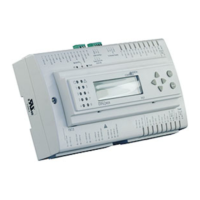
FX16 Master Controller Technical Bulletin
102
• user interfaces - master and slaves as defined
• events and trends - master
• messaging services and address book - master
• Web page and services - master
Control Application
The control application defines the functions of a controller. Each
controller, whether master or slave, executes its own control
application.
Use FX Builder to build control algorithms and logic on a graphical
canvas by creating and connecting instances of the objects in the
database of the controller. An object is a functional block with inputs,
attributes, an internal processing method, and outputs.
By means of connections between inputs and outputs, values are passed
between the objects or between the objects and the network profile. A
connection has always the same direction, from the source to the
destination. Sources can be the network variables inputs and
configuration parameters in the network profile, and the object outputs.
Destinations are the network variable outputs in the network profile and
the object inputs.
The object inputs are used by the object to obtain values from other
objects or from the control system network via the network profile.
The object outputs are used by the object to present its results. They can
then be used by other objects or sent to other devices through the
network profile and the control system network.
The objects also have some static values, set at design-time, known as
attributes. These values are typically used to determine the behavior of
an object or used as default values in case input values are missing or
have invalid values.
When you develop an application, a maximum of 255 instances of the
available objects can be included. The available objects in the
FX16 controller are shown in the following table.
The control application and logic can also interact with the alarm and
event management, user interfaces, and communication services to
generate information and alarm messages for the user.



 To Next Page