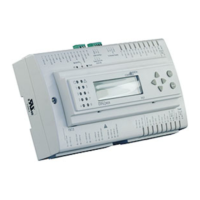
FX16 Master Controller Technical Bulletin
68
Supervisory Option
You can integrate the FX16 Master Controller into a supervisory
building automation system for continuous monitoring of the control
system. The FX16 Master Controller supports two methods of
integration:
• N2 Open integration
• LONWORKS network integration
Alternatively, you can use the RS-232 communication plug-in card to
allow for a modem connection (either GSM or landline standard models
can be connected) or a null modem connection. This allows a computer
to directly connect to the FX16 for point-to-point communication via
Transmission Control Protocol/Internet Protocol (TCP/IP) protocol.
Alarm and Event Management
The FX16 Master Controller manages and records events generated by
the operating system and events associated with data points or variables
in the control application.
You can also configure the event to send a message via one or more of
the communication services available (e-mail or SMS).
You can view the table of active events and the event history log on the
integral or remote display (MUI) or on a Web browser.
Data Trend Logging
The FX16 Master Controller can log analog and digital data in onboard
flash memory. The original FX16 controllers have a limited amount of
memory for trend logging (16 variables). The latest FX16X Rev. A
controllers have 4 MB of flash memory dedicated to trend logging of up
to 40 variables from within the control application. You can configure
the FX16 Master Controller to record data samples at defined intervals
from one minute to one day, each variable with its own sampling rate.
You can view the trend log buffer from a Web browser, and you can
configure the FX16 to transmit trends at regular intervals via the modem
connection to an e-mail server. A system event message appears if the
trend buffer is not configured in the circular recording mode and the
buffer becomes full.
Time Scheduling
Time Scheduling allows the execution of functions based on a weekly
time schedule and an exception day schedule in a calendar. The
real-time clock operation is supported by an onboard battery with an
average backup time of more than 3 years.



 To Next Page