S90-010 CS (APR 08) FRICK
QUANTUM™ COMPRESSOR CONTROL PANEL
Page 70 COMMUNICATIONS SETUP
SPECIAL:
Frick
®
Address
AB
Address
Modbus
Address
Read /
Write
Description Of Data
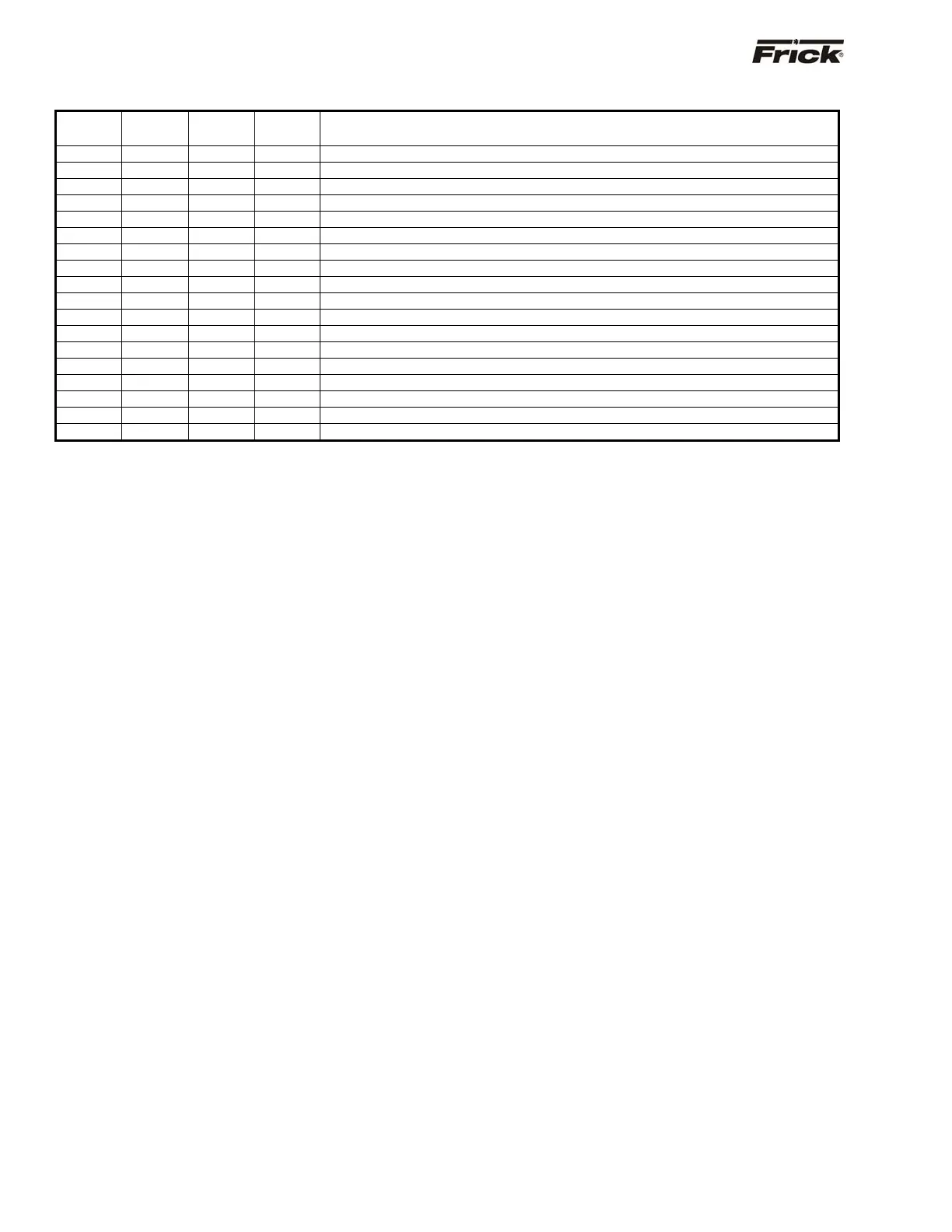
2679 N25:179 42680 Read Alarm # 16 Min.
2680 N25:180 42681 Read Alarm # 16 Date Hi
h Order
2681 N25:181 42682 Read Alarm # 16 Date Low Order
2682 N25:182 42683 Read Alarm # 17 Messa
e
2683 N25:183 42684 Read Alarm # 17 Hrs.
2684 N25:184 42685 Read Alarm # 17 Min.
2685 N25:185 42686 Read Alarm # 17 Date Hi
h Order
2686 N25:186 42687 Read Alarm # 17 Date Low Order
2687 N25:187 42688 Read Alarm # 18 Messa
e
2688 N25:188 42689 Read Alarm # 18 Hrs.
2689 N25:189 42690 Read Alarm # 18 Min.
2690 N25:190 42691 Read Alarm # 18 Date Hi
h Order
2691 N25:191 42692 Read Alarm # 18 Date Low Order
2692 N25:192 42693 Read Alarm # 19 Messa
e
2693 N25:193 42694 Read Alarm # 19 Hrs.
2694 N25:194 42695 Read Alarm # 19 Min.
2695 N25:195 42696 Read Alarm # 19 Date Hi
h Order
2696 N25:196 42697 Read Alarm # 19 Date Low Order
NOTE 1: A read request to Frick
®
Address 2500 returns
three values for each alarm. The alarm code, the hour the
alarm occurred, and the minutes after the hour the alarm
occurred. If the alarm code is 0, the hour and minutes are
not relative. The maximum number of alarms that can be
requested is 19. The message size value determines how
many alarms are returned. Multiply 3 times the number of
alarms to be requested and enter this number as the size
of the message. For example, if the data of 19 alarms is
desired, set the message size to 57. Reference the
numerical listing of the alarm codes in this manual. An
alternate way to access the alarm data is to utilize Frick
®
Addresses 2602 - 2696. Each alarm is accessible
independently. For instance, reading Frick
®
Address 2602
will return the value of the most recent alarm code. This
code value will correspond to the ALARMS/SHUTDOWNS
MESSAGE CODE near the back of this manual. Reading
the next address (2603) will return the hours integer (0 to
24) and the following address (2604) will give the minutes
integer (0 to 59). It should be pointed out that an alarm
value of zero indicates that although no alarm is present,
there is a still a time stamp returned. Simply ignore this
time stamp.
The High and Low Order Date values sent with the Alarm
information define a 32-bit number that describes the
number of seconds that have passed since January 1,
1970. The High Order Date holds the upper 16-bits of this
number, while the Low Order Date holds the lower 16-bits.
To combine these values into one number, the High Order
value must be multiplied by 2
16
or 65,536. The resulting
value should then be added to the Low Order Value.
We can use the following values as an example: Alarm # 1
Date High Order = 14423, and Alarm # 2 Date Low order =
60660. First, we multiply 14423 x 65,536 = 945,225,728.
Then we add this value to 60660 and get 945,286,388.
This value represents the number of seconds that have
passed from January 1, 1970 to the time that Alarm # 1
occurred. A quick calculation will confirm that this number
does describe a date in late 1999:
945,286,388 sec. * 60 sec. * 60 min. * 24 hr.
= 10,940.81 days
10,940.81 days * 365 days = 29.97 yr. + 1970 = 1999.97
1999.97 indicates that the alarm occurred in 1999 and
97/100’s. If you take 97/100 * 365 yr. the answer would be
354.05 (or just 354). This would equate to the 354
th
day of
1999, or December 20
th
, 1999. Of course, to use this value
to define an exact date and time, more precise
calculations must be used, including accounting for Leap
years. We realize that this is a rather involved calculation
which is why the Alarm’s Hour and Minute values are
provided. Only if Date and Time information is required
beyond Hours or Minutes, should the Date High Order and
Low order values be used.
These addresses have been provided in order to assist
the end user with their applications.
Note 2: A read request to Frick
®
Address 2501 return two
values for the number of hours the machine has run. The
first value is the number of hours greater than 1000 and
the second value is the number of hours less than 1000.
The size of the read message must be set to two to
properly receive this data. An alternate way to access the
Run Time Hours is to utilize Frick
®
Address 2600 and
2601. Address 2600 now contains the hours greater than
1000, and address 2601 contains the hours less than
1000.
As an example, if the Quantum™ Run Time hours
displays 3,456 hours, this would break down as follows:
Frick
®
Address 2600 = 003
Frick
®
Address 2601 = 456
If the Quantum™ Run Time hours displays 32 hours, this
would break down as follows:
Frick
®
Address 2600 = 000
Frick
®
Address 2601 = 032
These addresses have been provided in order to assist
the end user with their applications.


 To Next Page