7
3.8
CENTRAL HEATING
WATER SYSTEMS
3.8.2
SEALED SYSTEMS
The boiler must not be used for direct hot water supply. The hot
water cylinder must be of the fully indirect (double feed) type, Self
priming (single feed) cylinders MUST NOT BE USED.
The boiler is supplied with 22mm copper tail ends for use with
copper tubing to BS2871 on fully pumped systems.
The boiler is NOT suitable for semi gravity systems.
Drain down devices must be fitted at the lowest points of the
system.
The boiler has a built-in frost protection function when in stand-by
mode. However, a system frost protection thermostat is
recommended if the boiler is installed in locations which are
vulnerable to freezing or away from the living area of the
building, e.g. garage.
The pump, with its isolation valves, should be fitted in the heating
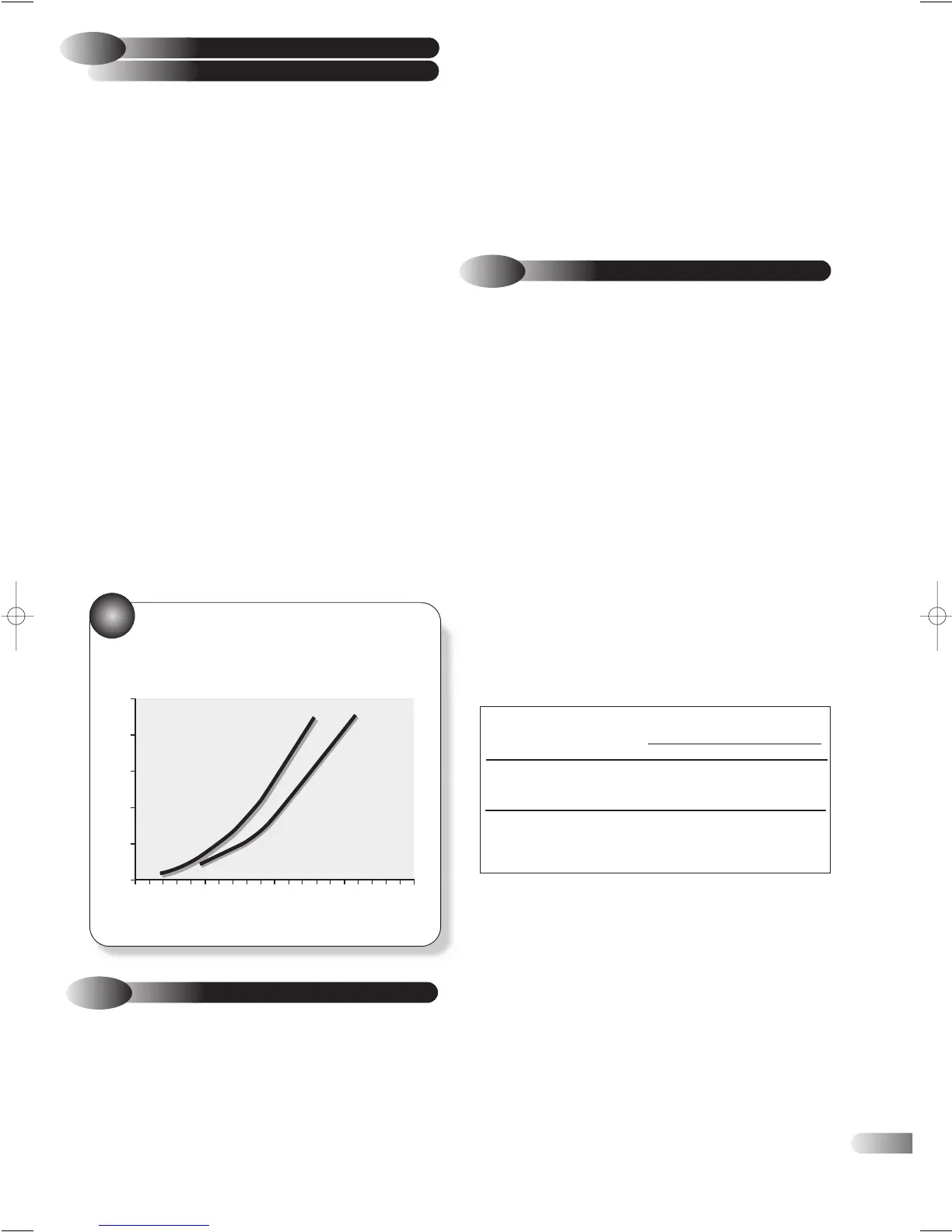
flow pipework from the boiler. The flow rate should be set to
produce a temperature differential of 11°C between the flow and
return pipes at maximum heat output (Fig 7 – Heat exchanger
resistance curve).
All components of the central heating water system shall be
suitable for a working pressure of 3 bar and temperature of
110°C. Halstead boilers recommend that any plastic pipe used
should not terminate within 2 metres of the appliance. Care should
be taken to ensure that air locks are not present in the appliance
or pipe run.
The installation of a sealed system must comply with the
appropriate requirements of the current issue of BS4814, BS5449,
BS6759, BS6798 and BS7074 and recommendation R24.2 of the
Water Regulations Guide. For IE the current edition of I.S. 813.
A typical sealed water system is shown in Fig 9.
The following components and guidance have to be considered:
Safety Valve: It must comply with the requirements of BS759
and must be fitted to the flow pipe as near as possible to the
boiler with no restriction in the flow before the valve.
The valve should be so positioned so that any discharge of steam
or water cannot cause any harm to occupants or electrical
installations.
Pressure gauge: A pressure gauge with a range of 0 - 4 bar
must be fitted so that it is visible to the person filling or servicing
the system.
Expansion tank: The expansion tank must be connected close
to the inlet side of the pump and must suit the water volume of the
system.
The volume of water in the appliance is given in Section 2.
The system pressure should be not less than the static height, this
being the highest point in the system above the expansion tank.
Hot Water Cylinder: The cylinder should be of the indirect
type, suitable to operate at a total pressure 3 bar. It is also
recommended to use indirect cylinders with a heating coil
capacity of at least 30% above the maximum heat output of the
boiler. If the heating coil output is less than the boiler output it
makes the system less efficient and the recovery time gets poorer.
Filling Point: The system must be provided with a low level
filling point fitted with a shut off valve. The method filling the
system should comply with the Water Supply (Water Fittings)
Regulations – 1999 and the local Water Authority Regulations.
7
HYDRAULIC FLOW GRAPH
3.8.1
OPEN VENTED SYSTEMS
A typical open vented system is shown in Fig 8. An open vent
pipe of 22 mm diameter must be fitted in the boiler flow and
terminated above the cold feed, discharging into the expansion
cistern.
The expansion cistern should not have a smaller capacity than
22 litres (5 gallons).
The cold feed pipe should be of 15 mm minimum diameter.
The expansion cistern should have a lid to prevent evaporation
loss and debris falling into.
The maximum height of the cistern to the boiler is 30 m (100 ft)
which is the equivalent of 3 bar static water pressure. The
minimum height is 1.2 m (47 in.) or 0.12 bars.
The combined heating and hot water pipes must be connected to
the 22 mm pipe tails. It is recommended to route the pipes
upwards for better venting and circulation. However, if the pipes
are routed downwards appropriate air vents at the highest point
of the boiler are required.
EXPANSION VESSEL REQUIREMENTS
Vessel charge and initial
system pressure
Total water content of system
using 8ltr. (1.54gal) capacity
expansion vessel
For systems having a larger
capacity multiply the total system capacity
in litres (gallons) by the factor to obtain the
total minimum expansion vessel capacity required litres (gallons)
bar 0.5 0.75 1.0 1.5
psi 7.3 11 14.5 21.8
96ltr 84ltr 73ltr 50ltr
21gal 18gal 16gal 11gal
0.0833 0.093 0.109 0.156



 To Next Page