25
T210
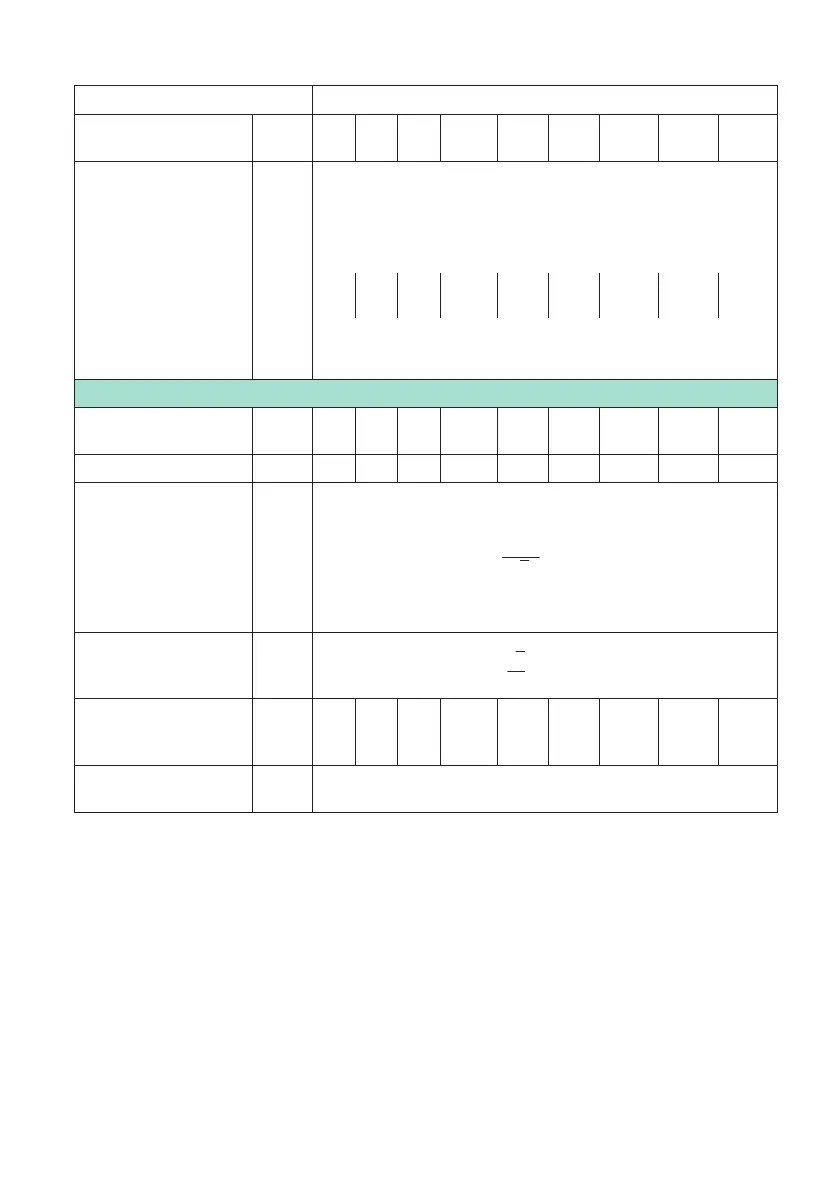
SPECIFICATIONS
Type T210
Nominal (rated) torque
M
nom
Nm 0.5 1 2 5 10 20 50 100 200
Load limits
1)
Limit torque, relating to
M
nom
% 200
Breaking torque, relat
ing to M
nom
% ≥300
Axial limit force N 200 350 500 1,100 1,750 2,500 5,000 7,000 9,500
Lateral limit force
2)
N 4 6 10 15 30 50 100 150 250
Oscillation width as
per DIN50100 (peak-
to-peak)
3)
%
80
Mechanical values
Torsional stiffness c
T
Nm/
rad
46 89 133 585 1,367 2,933 10,893 24,043 50,388
Torsion angle at M
nom
° 0.62 0.64 0.86 0.49 0.42 0.39 0.26 0.24 0.23
Max. permissible
vibration displace
ment of the rotor
(peak-to-peak)
4)
Undulations in the con
nection geometry,
based on ISO7919-3
μm
s
max
+
4500
n
Ǹ
(nin min
*1
)
Effective velocity in
the vicinity of the hous
ing, as per VDI2056
v
eff
+
n
Ǹ
3
(nin min
*1
)
Mass moment of iner
tia of the rotor (around
the rotational axis)
g*cm
2
9.5 9.5 9.5 130 135 140 910 920 930
Balance quality level
as per DINISO1940
G6.3
1)
Each type of irregular stress (lateral or longitudinal force, exceeding nominal (rated) torque) can
only be permitted up to its specified static load limit and provided none of the others can occur at
the same time. If this condition is not met, the limit values must be reduced. If 50% of the lateral
limit force occurs, only 50% of the axial limit force is permissible and the nominal (rated) torque
must not be exceeded. In the measurement result, the permissible irregular stresses can have an
effect of approx. 1% of the nominal (rated) torque.
The specified loads only apply to the measurement shaft and must not be routed or stabilized via
the housing.
2)
Measured on the center of the shaft stub.
3)
The nominal (rated) torque must not be exceeded.
4)
The influence on the vibration measurements caused by radial run-out deviations, eccentricity,
defects of form, notches, marks, local residual magnetism, structural inhomogeneity or material
anomalies must be taken into account and isolated from the actual undulation.


 To Next Page