USER MANUAL | NOVA TRANSMITTERS
15
6. Generic Radio Remote System functionalities
6.1 “Start” Function
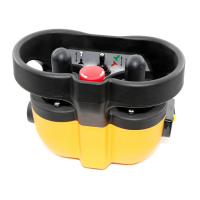
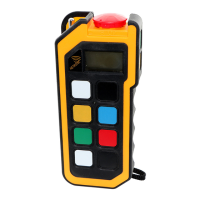
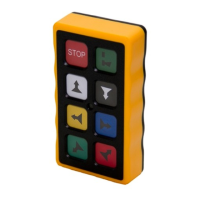
Start switch (#7), generally in green and very close to the key switch, is required to initialize radio remote control. For safety
reasons, the “Start” command must be given to give the receiver control every time there is an interruption in the control
signals. This switch is in many cases paired with the Horn function ◼/.
In order to start up the radio remote control system from the transmitter one has to make sure the stop button (#6) must be
released and all control levers must be in neutral position. The key switch must be turned to the “ON” position (I) on the
transmitter and the “Start’ button (#7) pressed.
6.2 Stop Switch
The most important feature of the radio remote control system is the Stop function. The transmitter sends the Stop status signal
along with the rest of the commands through the telegram. This method confirms that ongoing operations are safe. If the Stop
pushbutton is pressed (Active STOP), the Stop relay in the receiver causes all functions/motions to stop and the receiver goes
into Safe mode.
To restart the system, the Stop button (#6) must be disengaged and the Start/Horn button (#7) is to be pressed again to close
the relays in the receiver and resume function.
The Stop functionality responds faster than any other command. When Stop is engaged, the system ignores any other signal
that is transmitted. The problem must be corrected before the system will respond to any other signal.
The Stop functionality is self-monitoring and redundant in the transmitter and receiver. The system performs a self-test to
ensure the Stop circuit is working properly. If an error is detected, the system automatically goes into Safe mode.
When the transmitter is turned on, it performs a self-test to be sure that communications are within designated parameters. If an
error is detected, the transmitter will not transmit any signals.
Whenever Safe mode is active without having the STOP button pressed, the system is said to be in Passive STOP. This means
that the Stop button (#6) is still disengaged however the relays in the receiver are open so as not to allow any operation.
Possible triggers for Passive STOP (Safe Mode) are:
1. Transmitter Auto shutdown after period of inactivity
2. Radio signal interference
3. Transmitter out of operating range
4. Low battery sends Stop signal after time out elapses
While it is perfectly protected against unintentional collisions, the STOP button is easily accessible and can be quickly operated
with priority.
The STOP button on the transmitter is only a remote stop and will operate only when the transmitter is powered up.
Pressing the STOP pushbutton does not ensure the machine will come to a complete stop. STOP button functionality
is subject to the wiring of receiver STOP relays to machine emergency stop circuit and controlled machine logic
where applicable.
ALWAYS test the STOP function at the beginning of every operation session or when there is change of operator/shift.
6.3 Digital and Proportional Functions
There are two possible types of electronic control that can be operated from the Radio Remote Control; the digital and the
proportional functions.
Digital control (ON-OFF) determines either the opening or closing of a potential-free relay or solid-state switches within the
receiver when the transmitter activates this control. These commands are normally sent from push buttons, toggle switches,
selector switches or digital joysticks.
Proportional control is a function determining a variable output in either current or voltage in a directly proportional way to the
varying of the position of an analogical actuator on the transmitter. This can be a joystick or a simple potentiometer. Cross
joysticks operate on either one, two or three axes (X, Y and Z respectively) depending on the application, with the X and Y axes
having up to 4 mechanical detents in each direction and the Z axis being the rotation the joystick lever on its own axis. When
stepless proportional control is required, the initial movement of the joystick will activate the safety channel before any output
can be obtained. The standard paddle joysticks use the same principle as the cross joysticks, however they operate on one
axis.
Note: In all cases, all joysticks/levers must be in the neutral position for the system to be able to start.


 To Next Page