PSP8620311
Rev. E
44
!
WARNING
!
WARNING
8 — Maintenance
Service Requirements
The Versa-Tech
®
Recloser has been designed for
a minimum mechanical life of 30,000 operations
(Versa-Tech I) and 10,000 operations (Versa-
Tech LT). No routine maintenance is required
(other than occasional firmware upgrade and
battery replacement).
Battery Replacement
The batteries are made of a very stable lithium
chemistry, which is designed with a low self
discharge with a shelf life of 10 years. Hubbell
Power Systems is recommending that users
replace the batteries on a maximum 8 year cycle
(for Versa-Tech I Reclosers with FW 3.xx and
Versa-Tech LT Reclosers).
Note for Versa-Tech I Reclosers with
FW 4.xx only: Versa-Tech I FW 4.xx
was developed for SCADA compatibility.
It does not incorporate low power
optimization since it requires more
diagnostics and data collection. In cases
of lightly loaded lines, battery power is
utilized to perform these functions
resulting in decreased battery life.
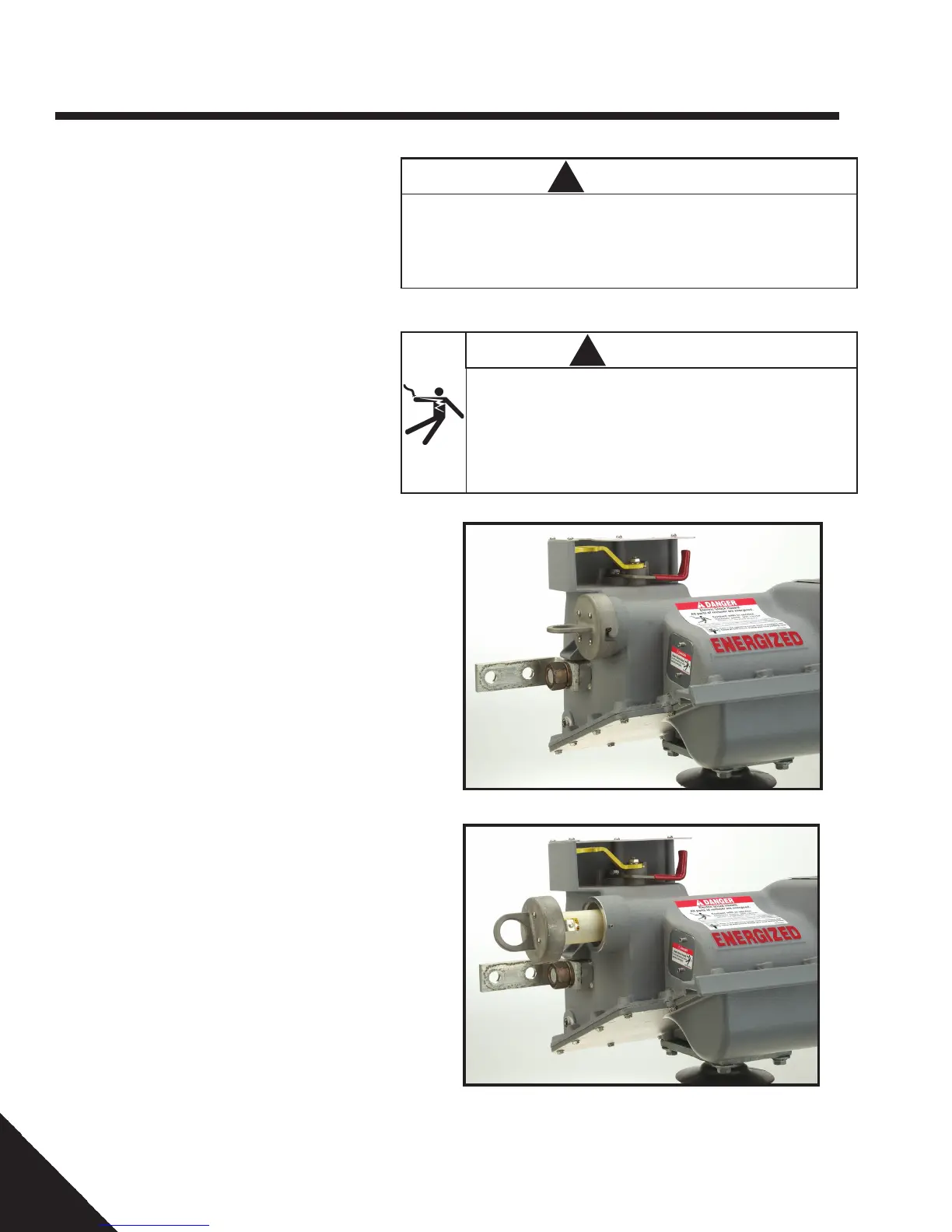
Figures 8-1 and 8-2 show the battery bayonet
and placement in the recloser. The battery
bayonet was designed to be replaced using a hot
stick while the recloser is in service. The battery
bayonet utilizes a twist lock design. It is easily
removed by pushing in slightly and turning.
The date of manufacture of the battery bayonet
is stamped on its end casting. The date format is
"XXXX" where the first two numbers represent
the month and the second two numbers
represent the year.
Figure 8-1 Battery bayonet in the recloser
Figure 8-2 Battery bayonet partially
removed from recloser
Fire, explosion, leakage and severe burn hazard.
Do not recharge or disassemble batteries. Batteries should not be exposed to
temperatures above 212 degrees F. Do not incinerate batteries or expose them to water.
Do not short (+) and (-) terminals of batteries. When discarding batteries, insulate the (+)
and (-) terminals with insulating tape.
High voltage electric contact hazard.
Can cause severe injury or death.
The recloser housing and the battery bayonet are energized when the re-
closer is in service. Follow all of your utility's recommended safety practices
for working with energized apparatus of this voltage class. Use appropriate
length grip-all clamp stick or appropriately rated rubber gloves and personal
protective equipment.
Battery Disposal
Litihium batteries are neither specifically listed nor
exempted from the Federal Environmental Protection
Agency (EPA) hazardous waste regulations as
promulgated by the Resource Conservation and
Recovery Act (RCRA). The only metal of possible
concern in a lithium battery is lithium that is not a listed
or characteristic toxic hazardous waste. Waste lithium
batteries can be considered a reactive hazardous
waste if there is a significant amount of unreacted, or
unconsumed lithium remaining in the spent battery.
The key to disposing of a lithium battery as a non-
hazardous waste is to guarantee that it is fully or
mostly discharged. Once it is discharged it can be
disposed of as non-hazardous waste.


 To Next Page