MAINTENANCE WORK ON CHASSIS AND ENGINE
- 46 -
ENGLISH
BATTERY
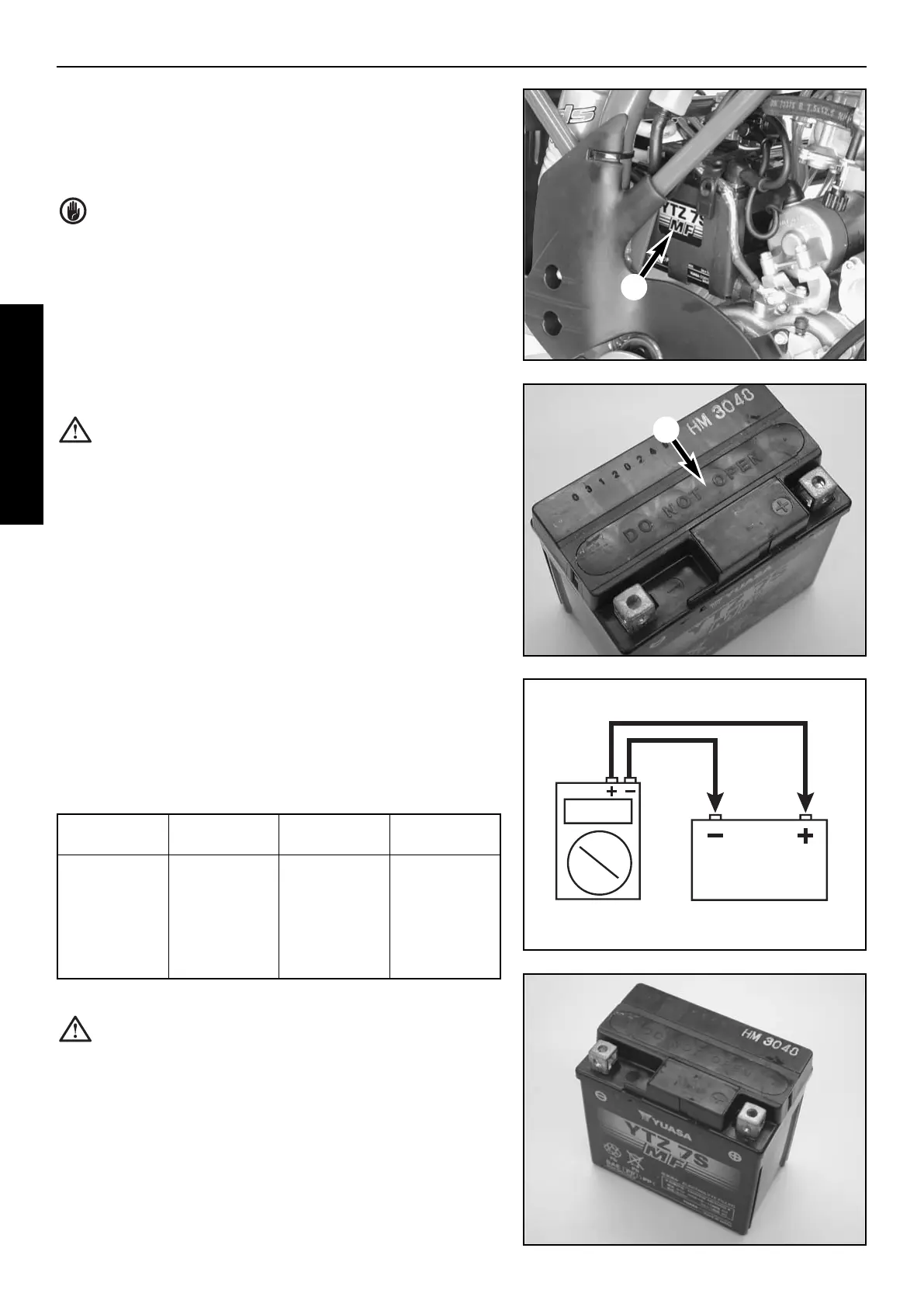
The battery (1) is located in front of the shock absorber and is mainte-
nance-free.
It is not necessary to check the electrolyte level or to add water. Merely
keep the battery poles clean and grease slightly with acid-free grease if
required.
WARNING: If electrolyte (sulphuric acid) leaks from the bat-
tery, proceed with great care. The electrolyte can cause severe
burns.
In the case of skin contact rinse thoroughly with water.
In the case of contact with the eyes, thoroughly rinse eyes-
with water for at least 15 minutes. Immediately consult a
doctor.
The battery is a closed model but can nevertheless emit
explosive gases. Avoid sparks and open fire near the battery.
Defective batteries must be stored out of the reach of child-
ren.Ensure proper disposal of discarded batteries.
CAUTION: To avoid damage, do not remove the locking
bar (2) !
Never disconnect the battery while the engine is running. This
will destroy the rectifier-regulator.
BATTERY STORAGE:
When preparing the motorcycle for a longer period of standstill, remove
the battery and recharge it. Storage temperature: 0 - 35°C (30 - 95°F).
Do not expose to direct sunlight.
CHARGING THE BATTERY
Disconnect the negative pole and check the charging level. Use a
voltmeter to measure the voltage between the battery poles (off-load vol-
tage). Accurate results can only be obtained if the battery has neither been
charged nor discharged during a period of 30 minutes preceding the
measuring.
If the battery is empty, it can be recharged for a maximum period of 10
hours at 0.4 A and a maximum of 14.4 V.
CAUTION: To avoid damage, do not remove the locking
bar.
Always connect the battery to the charging unit before tur-
ning the charging unit on.
When recharging the battery in closed rooms there is suffi-
cient venti-lation. Explosive gases are released during the bat-
tery charging process.
Charging time and charging voltage should not exceed the
stated values. Otherwise electrolyte will be released through
the safety valves.
Avoid quick charging if possible.
1
2
off load voltage
Volt
charging level
%
charging time
0,5 A
charging voltage
>12,7
~12,5
~12,2
~12,0
~11,8
<11,5
100
75
50
25
0
0
––
4 h
7 h
11 h
14 h
20 h
Max.
14,4 V




 To Next Page