MAINTENANCE WORK ON CHASSIS AND ENGINE
- 33 -
ENGLISH
The riding sag should lie between 90 and 105 mm.
If the riding sag is less than 90 mm, the spring is too hard (the
spring rate is too high). If the riding sag is more than 105 mm, the
spring is too soft (the spring rate is too low).
The spring rate is written on the outside of the spring (e.g. 88/250).
The type number of the shock absorber is embossed on the bot-
tom of the tank. The illustrations show which spring should be
installed. The standard spring is shown in bold print. After installing
a different spring, readjust the static sag to 35 mm (± 2
mm).According to our experience, the damping rate of the com-
pression stage can remain unchanged. The damping rate of the
rebound stage can be reduced by a few clicks for a softer spring or
increased by a few clicks for a harder spring.
CHECKING THE BASIC SETUP OF THE TELESCO-
PIC FORK
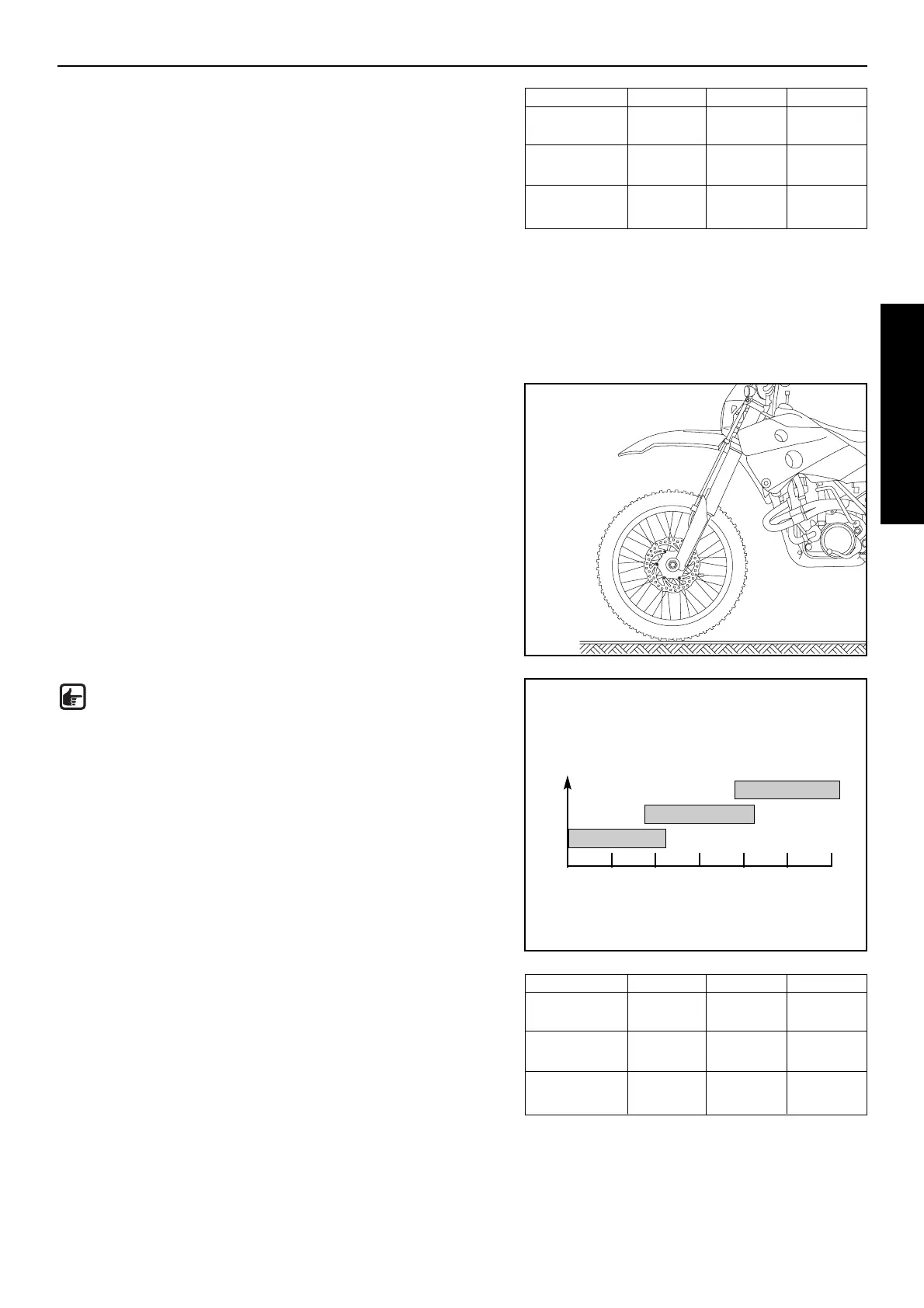
The precise riding sag of the telescopic fork cannot be determined
for various reasons. Similar to the shock absorber, smaller deviati-
ons in your weight can be compensated by adjusting the spring
preload. However, if your telescopic fork bumps frequently (hard
end stop during compression), you should install harder fork
springs to avoid damaging the telescopic fork and frame.
CHANGING THE SPRING PRELOAD ON THE
TELESCOPIC FORK
The telescopic forks for these models must be partly disassembled
to adjust the spring preload (see WP manual). Pretension spacers
are available in heights of 1.5, 2.5 and 5 mm (see spare parts cata-
log). The fork springs may not be pretensioned by more than 20 mm.
NOTE: WP precisely adjusts the spring pressure by inser-
ting pretension spacers. Fluctuations in production are
compensated with pretension spacers in various heights.
This can cause the fork springs in the fork legs to have
different degrees of pretension. Fork springs and preten-
sion spacers should always stay together.
REPLACING FORK SPRINGS
If you weigh less than 70 kg or more than 80 kg, you should install
the respective fork springs. The correct spring rate is shown in the
illustrations. The standard spring is shown in bold print. The type
number of the telescopic fork is embossed on the caps on the top
of the telescopic fork.
If you are uncertain which spring to use, contact your Husaberg
workshop.
According to our experience, the damping rate of the compression
stage can remain unchanged. The damping rate of the rebound
stage can be reduced by a few clicks for a softer spring or increa-
sed by a few clicks for a harder spring.
60
SPRING RATE
65 70 75 80 85 90
RIDERS WEIGHT INCLUSIVE GEARS IN KILOGRAM
4,4 N/mm
4,6 N/mm
4,2 N/mm
for example FC 450, 550
MODELL SOFTER STANDARD HARDER
1245Y721
66-86/260 76-95/260 81-99,5/260
FC 450,550
1245Y722
66-86/260
71,5-90,5/260
81-99,5/260
FE 450,501,550,650
1245Y723
80/250 84/250 88/250
FS 450,650
MODELL SOFTER STANDARD HARDER
1445Y728
4,2 N/mm 4,4 N/mm 4,6 N/mm
FC 450,550
1445Y729
4,0 N/mm 4,2 N/mm 4,4 N/mm
FE 450,501,550,650
1445Y730
– 4,4 N/mm 4,6 N/mm
FS 450,650




 To Next Page