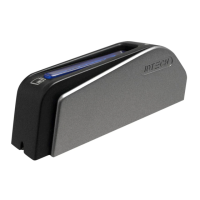
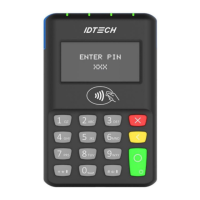
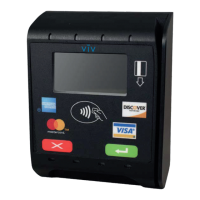
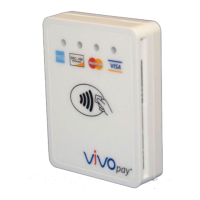
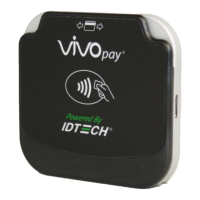
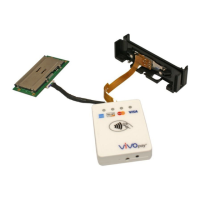
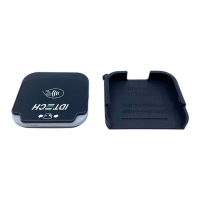
The ID TECH Kiosk V is a compact, one-piece EMV contactless reader designed for a variety of unattended and attended vertical markets, including transit, kiosks, and parking. It supports contactless EMV transactions based on ISO 18092, ISO 14443 Type A/Type B/MiFare compatible cards, fobs, tags, and NFC phones. The device is PCI PTS 6.X certified and is also certified with Visa Ready for Transit, ensuring secure and reliable payment processing.
Function Description
The Kiosk V's primary function is to facilitate secure contactless payment transactions. It incorporates an EMV L2 kernel, making it compatible with a wide range of third-party payment applications. The device supports industry-standard Triple DES or AES encryption with DUKPT-based key management (per ANSI X.9-24), ensuring that data is encrypted at the time of the transaction and never travels in clear-text form. This robust encryption capability makes it suitable for handling financial, pre-paid, loyalty, or gift card transactions with high security.
The device communicates with host systems via USB-C or Bluetooth. For USB communication, it defaults to USB HID emulation mode and is designed to work with Windows, Android, and iOS platforms. The Bluetooth connection supports both Android and iOS devices, utilizing Bluetooth 5.0 (Bluetooth Low Energy, BLE). This allows for flexible integration into various host environments, from mobile phones and tablets to larger kiosk systems.
The Kiosk V includes a self-contained NFC antenna, which is crucial for its contactless reading capabilities. It is designed to provide visual and audible cues through its LEDs and sound indicators, guiding consumers through smooth and seamless transactions. These indicators communicate various statuses, including power management, Bluetooth connectivity, transaction progress, and security alerts.
Usage Features
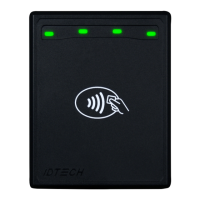
The Kiosk V is designed for consumer intuitiveness, with LEDs and sound providing clear feedback during transactions. When a card or NFC phone is presented, the device is expected to beep, and its four green LEDs will illuminate in sequence, then all together briefly, indicating a successful read. If no reaction occurs, it suggests an unsuccessful test or read.
For Bluetooth pairing, users can enable the Bluetooth device search function on their host smart device. The Kiosk V automatically activates Bluetooth when connected to a power source via USB. If not powered via USB, pressing the device's power button will activate Bluetooth. The device will appear as "IDTECH-BLE-XXXXX" and requires a default password (123456) for pairing. It's important to note that for iOS devices, pairing through the iOS Settings page will show the device as connected but it will not function with a payment app; instead, a compatible payment application should be used, which will automatically connect to BLE devices in range.
The device's power consumption is optimized for various states:
- Working Mode: Consumes <400mA/5V for contactless operations and <200mA/5V when idle.
- Sleep Mode: Consumes <2.5mA/5V and can wake up to normal mode within <500ms.
- Power Off Mode: Consumes <10uA/5V and can wake up to normal mode within <3s.
The Kiosk V is designed to reboot every 24 hours as per PCI requirements. Integrators should be aware of this to check the reboot time for their specific unit.
Maintenance Features
The Kiosk V is built for reliability and ease of troubleshooting. In case of issues, users are advised to check the power supply, the reader itself, and the serial cable. If problems persist, contacting ID TECH support is recommended.
The device provides clear LED and sound indicators for various states, which are crucial for troubleshooting:
- Device FW, certificates, or keys self-test failed: LED4 blinks red, and the device beeps.
- Device Tampered: LED4 blinks red, and the device beeps.
- Device Deactivated: LED4 blinks red, and the device beeps.
- Device Activated: LED4 is on, and no sound.
- Device Key Missing: All LEDs blink, and no sound.
- Ready for Transaction: LED1 blinks, and no sound.
- Connecting to Bluetooth: LED4 blinks, and no sound.
- Bluetooth Connected: LED4 is on, and the device beeps once.
- Bluetooth Connection Failed: LED4 is on, and the device beeps twice.
- Bluetooth Transmitting Data: LED4 is on, and no sound.
- Transaction Started: LED1 is on, and no sound.
- Transaction Successful: All LEDs are on, and the device beeps once.
- Transaction Failed: No LEDs are on, and the device beeps twice.
These indicators help users quickly identify the status of the device and diagnose potential issues. For instance, a blinking red LED4 with beeping indicates a tamper event or a failed self-check, which could be due to an expired certificate or a missing key.
When mounting the Kiosk V, it's important to consider the proximity of metal to the NFC antenna, as this can reduce the effective range. The device should be mounted with the RF emitting surface at least 1cm forward or behind any metal, or flush with metal but maintaining a 1cm distance. For safety, the device should be mounted no higher than two meters from the floor.
Periodic inspection is required for this attended device. Daily checks include:
- Verifying the device overlay is intact.
- Powering on the device to check the beeper and display message, ensuring no tamper-triggered beeping and correct firmware version display.
- Inspecting the device appearance for any holes or suspicious objects around the ICC card slot.
For firmware updates, ID TECH strongly recommends using the Universal SDK. The Universal SDK Demo app can be used to run the Kiosk V in USB mode and provides a platform for firmware updates and command execution.
In cases of RF interference, which can affect contactless payment operations, users are advised to inspect their environment for potential sources such as AM/FM radios, TV transmitters, 2-way radios, pagers, mobile phones, power lines, transformers, medical equipment, microwaves, and electromechanical switches. The Kiosk V is susceptible to RF and electromagnetic interference, so it should not be mounted near large electric motors, computer UPS systems, microwave transmitters (Wi-Fi routers), anti-theft devices, radio transmitters, or other communications equipment.
For PCI-certified devices like the Kiosk V, proper decommissioning is required before disposal to protect sensitive financial card data. Instructions for this process are available on the ID TECH Knowledge Base.


 To Next Page
 General