10
a. On displacement hulls (sailboats, trawlers, etc.) locate the
transducer about 1/3 aft along the waterline. Generally this
provides the best compromise between obtaining aeration-
free water and minimizing propeller noise. Water near the
bow and near the keel can be quite aerated. Since the iScan
180’s transducer can not see through aerated water, it is best
to mount the transducer midway between these two areas.
b. On planing powerboat hulls, the transducer should be
mounted well aft and close to the keel to insure that the
transducer is in contact with the water at higher boat speeds.
Unfortunately, mounting the transducers well aft limits the
maximum forward range in front of the vessel’s bow.
However, the transducers must be in the water to work and if
they are mounted too far forward on a planing hull they will
often lose contact with the water. In this situation, the iScan
180 can only be used at slower vessel speeds which do not
result in planing operation.
DO NOT install a bronze transducer housing directly into an
aluminum or steel hull as electrolytic corrosion will occur.
Using the Fairing Blocks
Nearly all vessels have some dead-rise angle at the transducer
mounting location. If the thru-hull transducers were mounted
directly to the hull, the sound beam from the transducer would
be tilted off the vertical at the same angle as the dead-rise and
would cause errors in the interpretation of the displayed picture.
To correct this situation, most thru-hull installations will require
the use of fairing blocks to insure that the transducer is mounted
in the proper orientation.
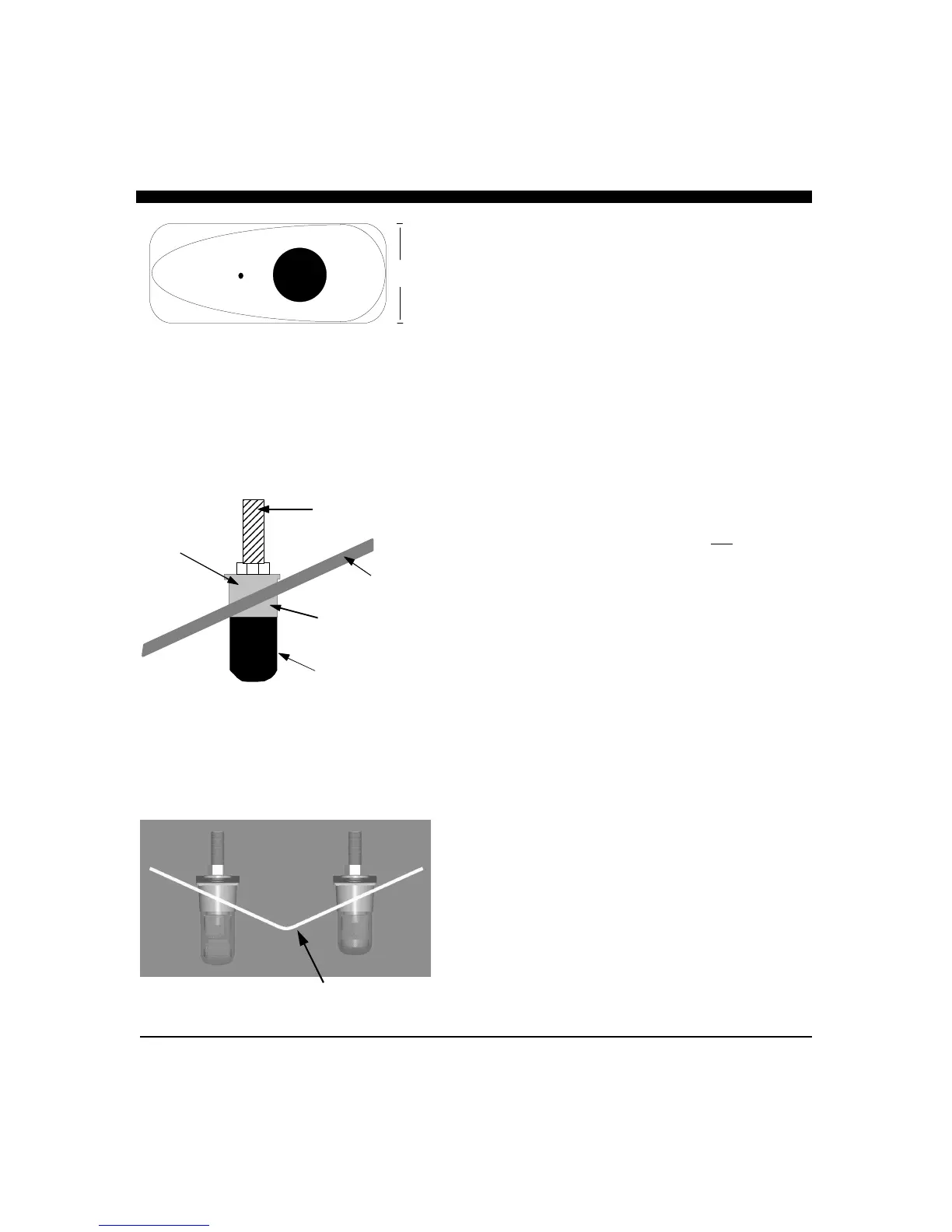
Two custom-molded fairing blocks for the iScan 180
transducers have been included with your system to make
installation as simple as possible.
Measure the dead-rise angle of the hull at the selected mounting
location and cut the block to a shape that fits the exact contour
of the hull. After cutting the fairing block, trial-fit the block to
the hull. The upper part of the block should be inside the hull
and the lower part of the block should be outside the hull to
clamp the assembly in place as shown in the diagram at middle
left.
It is very important that the flat top surface of the transducer be
parallel to the water. Because of the equipment and skill
required, we suggest that your professional boatyard cut the
fairing blocks and install the transducers.
Threaded
Bronze Stem
Boat’s Hull
Fairing Block
(bottom)
Transducer Body
Fairing Block
(top)
Completed Installation
View From Front of Vessel Looking Aft.
Vessel’s Hull
One of two Fairing Blocks included with
your iScan 180 system.



 To Next Page