27
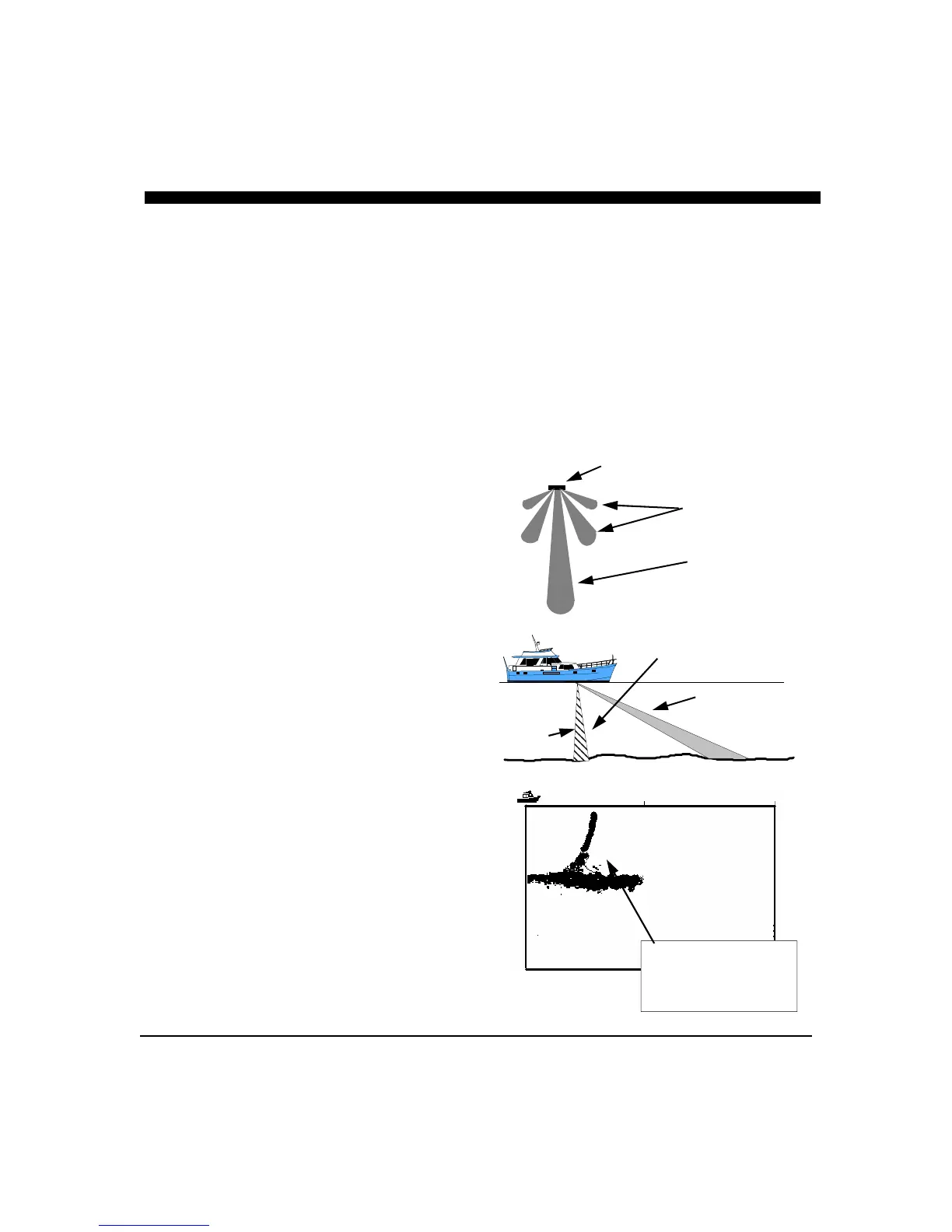
Transducer
Sidelobes
Main Beam
False
Echoes
Main Beam
Sidelobe
“False” Bottom
Echoes Caused by
Sidelobe Returns.
Distance Forward
Under typical conditions, the iScan 180 will show level or
shallowing bottom contours for a distance forward of
between 4X to 6X the depth below the transducer.
Obstructions in the water, such as walls, mud banks, etc. may
be seen at greater distances, subject to the depth below the
transducer and the 1,200 ft. maximum forward range.
Besides the bottom conditions, water conditions will also
affect the iScan 180’s performance. For example, surface
chop, temperature inversion layers (thermoclines) and muddy
water may degrade performance.
Noise and Sensitivity Adjustments
The iScan 180 features an AUTO gain feature where it
continuously adjusts the gain to achieve the optimum picture
quality. The gain can also be adjusted manually to allow for
a reduction in gain to minimize the effect of screen noise, or
to increase the gain to show weaker targets.
In the forward scanning modes, the gain setting is especially
important. Too little gain will cause a loss of far forward
readings and too much gain will cause an increase in screen
noise and display unwanted transducer sidelobe readings.
Transducer Sidelobe Effect
The iScan 180’s transducer, like all acoustic transducers,
does not form a perfect beam of acoustic energy. Some of
the acoustic energy is contained in an area called the
sidelobes. In conventional downlooking depthsounders, the
sidelobes create little problem except to distort the size of the
actual beam angle; however, in scanning sonars they can
create echoes that are not placed on the LCD screen in their
proper position (also known as false echoes).
As the iScan 180 sends off its acoustic beam in a specific
direction, it assumes that any return echoes are within the
main beam. However, if the sidelobe energy strikes a large
object (i.e. the bottom) and creates a strong return echo, the
iScan 180 has no way of knowing that this “false” echo was
not created by the main beam and will go ahead and show it
on the display as if it was located within the main beam. The
most typical display of the sidelobe echoes appears as an arc
at the same distance as the bottom depth, and in the worst
case, from the bottom below to the surface ahead. After
using the iScan 180 in different situations, with different gain
settings, you should become proficient in identifying the
bottom echoes caused by the transducer’s sidelobes. To
minimize the sidelobe effect, the gain should be reduced.



 To Next Page