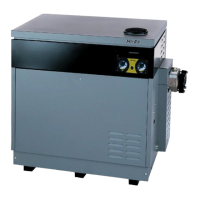
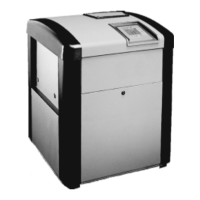
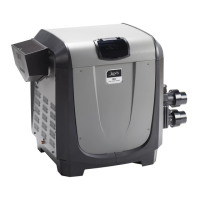
Model LJ Pool and Spa Heater
Page 41
5. Limit Switches - Two limit switches prevent
excessive water temperature - one within the
heat exchanger and one for water leaving the
heater. If either senses excessive temperature,
burner operation is interrupted.
6. Water Pressure Switch - This control senses
whether or not water is available to the heater by
measuring back pressure inside of the heat
exchanger. If the pool water pump fails or the
water filter is blocked, the pressure switch
prevents operation of the burner.
7. Fusible Link - This is a single-use switch which
detects abnormal temperature in the component
vestibule. It is a fusible link which is held to the
inner panel just above the burner tray by a sheet
metal bracket. Excessive temperature in the
component compartment, possibly due to a
blocked flue or flame roll-out, will cause the link
to fail. This opens the safety circuit which shuts
off the gas valve and shuts the heater down.
10.4 Electrical Troubleshooting
This section describes procedures for checking
the electrical power and control components of the
heater one at a time and in the order they appear in the
control circuit.
Note: Pump must be running during the
troubleshooting procedure.
These procedures require a Volt-Ohm meter
with a minimum 0-250 VAC voltage range, and 0-1000
Ohm resistance range. Figure 27 shows the power and
control circuits, and where to take measurements.
Location numbers and letters in circles have been
added, and will be referenced in the following sections.
As stated at the beginning of this manual, some
of these procedures are hazardous. Only a qualified
service technician should service the heater.
10.4.1 Electrical Power Supply
The electrical components of the Lite2 pool
heater are designed to operate with supply voltage
ranging from 98V to 126V at 60 Hz if connected to a
nominal 115 volt power supply or 196V to 253V at 60
Hz if connected to a nominal 230 volt power supply.
Measure supply voltage at the “hot” and “neutral”
screw terminals in the heater electrical junction box
(identified as points A and B on the wiring diagram). If
no voltage is present, correct this external power
supply problem to the heater. Circuit breakers, time
clock settings or similar devices may be the problem.
Voltage outside of the above ranges may be due to
poor wiring, poor connections, other loads such as air
conditioning compressors or to an electric utility
company problem. Arrange for correction of the
voltage as appropriate.
10.4.2 Controller
The controller must be operational in order to
check the control circuits of the heater. If the red LED
on the power distribution board is on but the controller
does not show a display, then it is defective. Replace
the controller. If the LED is not on, then check the
control circuits as outlined in the following sections.
10.4.3 Control Circuit Troubleshooting
The heater controls and sensors are powered by
three major circuits on a power distribution board (PC
board). 115 VAC or 230VAC is brought to the power
distribution board by the heater supply voltage. The
voltage is then transmitted through the board and the
power conversion plug to the igniter and to a trans-
former. When 115V is supplied to the heater, the
power conversion plug passes the signal unchanged to
the igniter and configures the input to the transformer
for 115V. When 230V is supplied to the heater, the
power conversion plug modifies the voltage to 115V
before sending it on to the igniter and configures the
input to the transformer for 230V. It is important to be
sure that the correct side of the power conversion plug
is plugged into the power distribution board. The
transformer converts the 115 volt AC or 230 volt AC
supply into two separate outputs, 24 volts AC and 12
volts AC. These voltages are supplied back to the
power distribution board where the 24 volt signal is
used to power the fireman switch, safety circuit and
gas valve, while the 12 volt signal is used to power the
keypad controller. Troubleshooting is done by probing
for voltage at various points on the power distribution
board, and heater components to determine which
component is preventing operation. Check points are
indicated on Figure 27. The recommended procedure
steps through each circuit in a sequential way, and
each section assumes that components from all
previous sections have been tested and are opera-
tional. However, verifying voltage at any of the
numbered points in that circuit confirms that all prior
components of the circuit are operational. Experienced
technicians may be able to shorten the process by
going directly to one of the intermediate major test
points. For example, if 24 volts is measured at test
point 8, then all components in the circuit prior to test
point 8 (fireman switch and entire safety circuit) are
operational.
10.4.3.1 Transformer
To check the 24 volt transformer output, attach
the black lead of the voltmeter to the transformer
connector where the blue wire enters near the center
of the connector (test point 1 on Figure 27). You will
need to push the voltmeter lead into the back of the
connector along side of the wire pin. Touch the free
lead of the meter to the transformer connector where
the second blue wire is attached at the end of the
connector (test point 2). The meter should show 20-28


 To Next Page