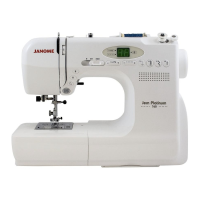
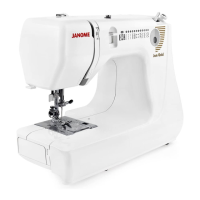
This document is a service manual and parts list for the J30 model, a sewing machine. It provides comprehensive information for maintenance, adjustment, and replacement of components, ensuring the machine operates correctly and efficiently.
Function Description:
The J30 sewing machine is designed for various sewing tasks, including basic stitching, zigzag, and stretch stitches, as well as buttonholes. It features a needle bar, presser bar, feed dog, rotary hook, bobbin winder, and a thread tension mechanism. The machine incorporates electronic components for control and self-diagnostic capabilities, enhancing its ease of use and maintenance.
Important Technical Specifications:
- Needle Drop Position: Standard position is at the center of the needle plate hole. For zigzag stitches, the clearance between the needle and the edge of the needle hole should be at least 0.2 mm on either side.
- Hook Timing: The ascending travel of the needle bar from its lowest position to the point where the tip of the rotary hook meets the right side of the needle should be 3.25 to 3.55 mm.
- Needle Bar Height: When the tip of the hook meets the right side of the needle in the left needle position (as the needle ascends from its lowest position), the distance between the upper edge of the needle eye and the tip of the hook should be 1.6 to 2.0 mm.
- Clearance Between Needle and Tip of Rotary Hook: This clearance should be between -0.1 to +0.05 mm.
- Feed Dog Height: The highest position of the feed dog should be 0.80 to 0.90 mm from the surface of the needle plate.
- Top Tension: The top tension should be between 65 and 80 g when pulling polyester sewing thread #50 (White) at a speed of 110 mm/sec.
- Stretch Stitch Feed Balance: The standard length of 5 pieces of figure 8 stitch should be 33-39 mm.
- Driving Motor (DC Motor) Belt Tension: The belt should deflect 5 mm when applying a 200-gram load to the middle of the belt.
Usage Features:
The manual outlines procedures for various adjustments to ensure optimal sewing performance. These include:
- Needle Drop Position Adjustment: To correct needle alignment for different stitch patterns.
- Hook Timing Adjustment: Critical for preventing skipped stitches and needle breaks.
- Needle Bar Height Adjustment: Ensures proper interaction between the needle and the hook.
- Clearance Between Needle and Tip of Rotary Hook Adjustment: Prevents needle breakage and ensures smooth thread pick-up.
- Feed Dog Height Adjustment: Essential for proper fabric feeding and stitch formation.
- Top Tension Adjustment: Allows users to fine-tune thread tension for different fabrics and threads, preventing upper or bobbin thread breakage.
- Stretch Stitch Feed Balance Adjustment: Corrects distorted stretch patterns for consistent stitch quality.
- Buttonhole Lever Position Adjustment: Ensures accurate buttonhole formation.
The machine also features a self-diagnostic test mode, which helps identify and troubleshoot problems with various components such as the LCD, buzzer, lamp, buttons, buttonhole sensor, bobbin winder switch, presser foot lifter switch, upper shaft positioning sensor, zigzag motor, feed motor, foot control, DC motor, thread tension release solenoid, and thread cutter motor/solenoid. This diagnostic mode provides specific error codes and recommended remedies, simplifying troubleshooting for users and technicians.
Maintenance Features:
The manual provides detailed instructions for replacing external parts and electronic components, as well as mechanical adjustments.
- Changing External Parts: Procedures for removing and attaching the face cover, free-arm cover, front cover, and rear cover are clearly described, often involving the removal of specific screws and disengaging hooks.
- Replacing Electronic Components: Step-by-step guides are provided for replacing the printed circuit board A, F2, F1, and L, as well as the driving motor (DC motor) and switching regulator unit. Emphasis is placed on proper handling of connectors to avoid damage.
- Troubleshooting Guide: A "What To Do When" section lists common problems (e.g., skipping stitches, fabric not moving, thread breaking, needle breaks, noisy operation, deformation pattern) along with their causes and corresponding solutions, often referencing specific mechanical adjustment pages.
- Self-Diagnostic Test: This feature is a key maintenance tool, allowing users to check the functionality of various sensors, motors, and electronic boards. It helps pinpoint defective parts quickly, reducing diagnostic time. The test displays "OK" or "NG" for EEPROM condition, and specific error codes for other components.
- Program Version Display: The machine can display its program version, which can be useful for support and updates.
- Lubrication: The manual suggests oiling all moving parts to address noisy operation, indicating the importance of regular lubrication for smooth functioning.
Overall, the J30 sewing machine is designed with both user convenience and serviceability in mind, offering detailed guidance for both operation and maintenance.

 Need help?
 General

 To Next Page