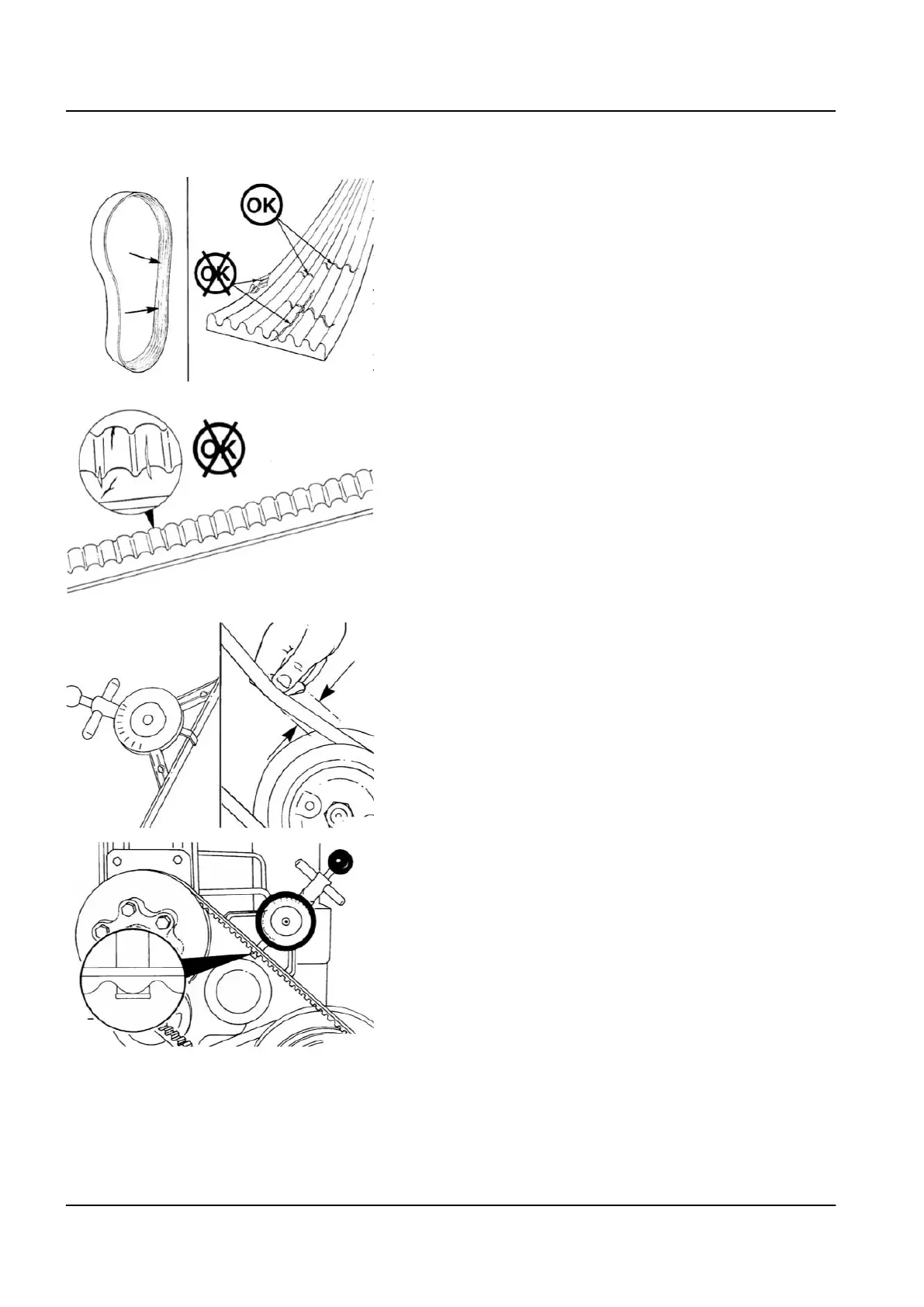
Examine drive belts
1 Inspect the drive belt for damage.
Transverse (across the belt) cracks are acceptable.
Longitudinal (direction of belt ribs) cracks that intersect with
transverse cracks are not acceptable.
2 If the belt is frayed, punctured, or material is missing, the belt
is unacceptable for reuse and must be replaced.
Belt damage can be caused by:
•
Incorrect tension
•
Incorrect size or length
•
Pulley misalignment
•
Incorrect installation
•
Severe operating environment
•
Oil or grease on the side of the belts.
3 Measure the belt tension in the center span of the pulleys.
An alternate method (deflection method) can be used to
check belt tension by applying 110 N (25 lbf) force between
the pulleys on v-belts. If the deflection is more than one belt
thickness per foot of pulley center distance, the belt tension
must be adjusted.
4 For cogged belts, make sure that the belt tension gauge is
positioned so that the center tensioning leg is placed directly
over the high point (hump) of a cog. Other positioning will
result in incorrect measurement.
6 1 Engine – 1.5 Mechanical components of the engine
TL2 Maintenance Manual
591 003 Default



 To Next Page