19
● For multiple measurements in succession
Placing a sample onto a sample dish which is already warm may cause moisture from the sample to evaporate
before the test is begun and cause errors to occur in measurement. Always be sure to use a cool sample dish
when performing a second or subsequent measurements.
You should also take care to allow an even amount of time to elapse between measurements, as errors in
measurement may occur if the temperature of the internal scale of the unit does not remain at a constant level.
* Two sample dishes are supplied with this unit.
● How to use sample dish and aluminium foil sheet
It is impossible to obtain accurate measurements if residue from the sample last measured remains on the sample
dish. To avoid such problems, either wipe the sample dish clean of any dirt or soil (see “9. Maintenance” on page
40 for further instructions) or use disposable aluminium foil sheets to protect against residues, soil, or dirt.
* Ten disposable aluminium foil sheets are supplied with the unit.
● Measurement of powdered, particulate, and viscous samples
The easier it is to heat the surface of a sample material, the easier it is for projecting portions of the material or
for material at the top of a mound of material to become burnt. If the material is placed in a mound on the dish or
if the material is not at and evenly laid out, this is likely to happen, thus making it impossible to obtain accurate
measurements.
Note that while the precision of measurement improves the more flatly and evenly samples are placed and
the higher the amount of sample material used, the quantity of sample material used is too great if the surface
becomes burned before lower layers are fully dried.
Always be sure to lay out samples atly and evenly as indicated in the diagram below.
● Measurement of liquid sample
Virtually all liquid materials will coagulate after being dried, and when working with such materials they should be
placed on the provided sheets of aluminium foil. Note that these aluminium foil sheets are water-permeable, thus
making it possible to obtain wide and even placement and making them effective for use in shortening measuring
times and obtaining accurate measurements.
Depending on the sample in question, the use of sand to speed up drying (Silica sand or ocean sand with a mesh
of 20 or so) may be even more effective.
● Measurement of large particulate sample
A long time may be required to thoroughly dry samples if the sample grains are large. In
addition, the sample surface may be burned, thus making accurate measurement impossible.
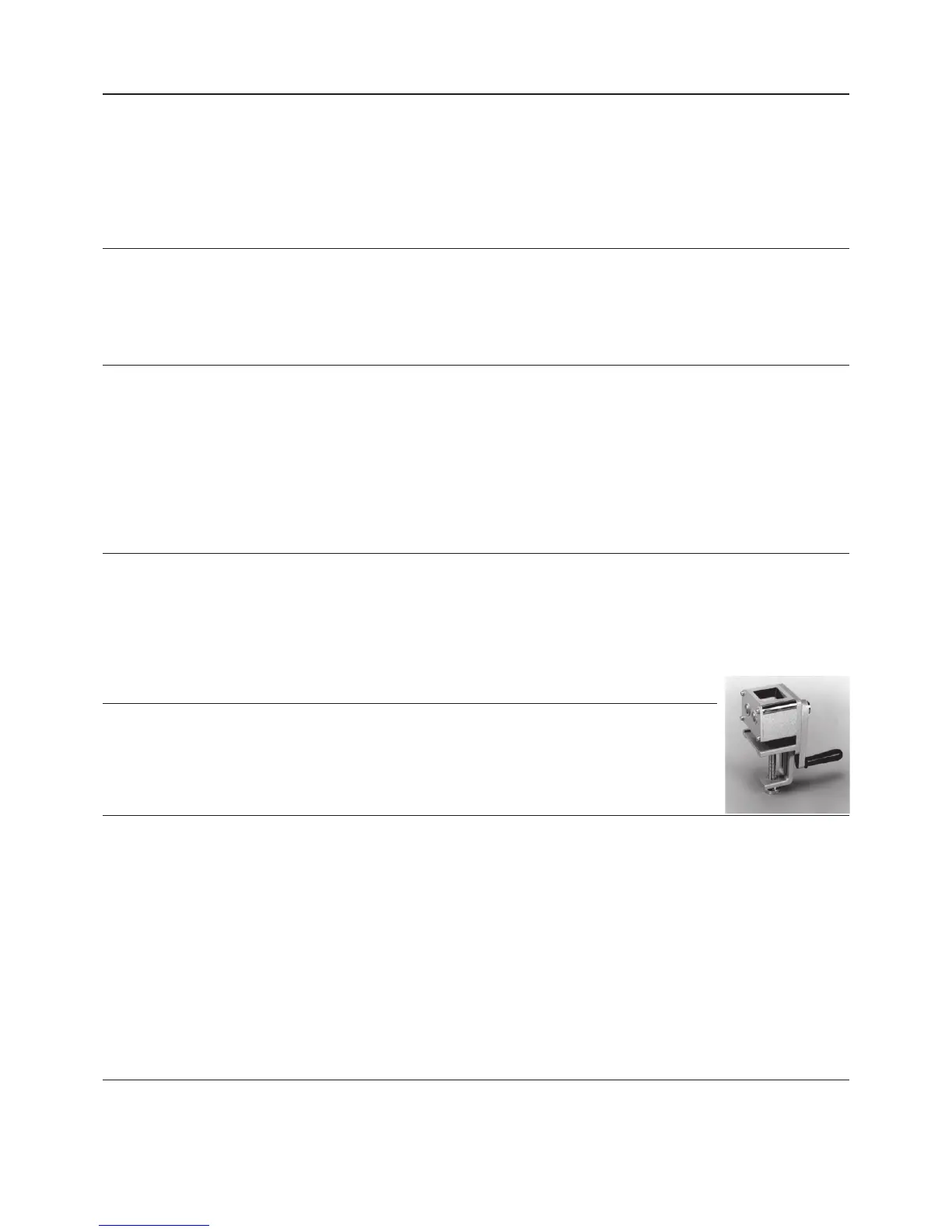
For this reason you should always crush samples to an appropriate size. The Sample Crusher
TQ-100 (option) is excellent for this purpose.
● Removal of soil, sample gas, and others
Depending on the sample, oil and volatile substances may stick to the temperature sensor and on the inside of the
heater base when the sample is being dried.
If the sample is in the form of a powder, under certain circumstances, the powder may accumulate on the upper
side of the heater lid or in the space between the heater and lid. These types of powder substances can change
the temperature around the sample and the air ow in the dryer section of the machine, resulting in an error in
measured moisture.
A substantial error can easily arise if the upper side of the heater lid gets clogged with deposited material.
Frequently clean the end of the sensor, the inside of the heater base, the upper side of the heater lid, and the
space between the heater and lid. Remove any dirt or sample residue.
• Wipe off the dirt with a dry, soft cloth.
• If dirt remains, wipe with a damp cloth (not dripping) with a water/neutral detergent mix. Then, dry the instrument
after rinsing the cloth in running water, wringing it well, and wiping off the detergent.
● Deodorizing windshield case
If the impact of exterior wind (from air-conditioners etc.) on the body is unavoidable, or if the sample generates a
bad odor during moisture content measurement, or if the device is in an environment that will accumulate powder
on its body from the sample, it is possible to lower reduce the impact of these problems by placing the device
inside the deodorizing windshield case FW-100 (option).
TQ -100


 To Next Page