7.d - Alarm mode details
7. Alarm / relay settings
7.d.1 - Definitions
Setpoint
The setpoint is a limit which, on being reached and/or exceeded , activates an alarm or energizes a relay (in negative
security, see page 14 for more details).
Time-delay
Once the setpoint is reached and/or exceeded, the time-delay postpones the alarm activation (or relay excitation) for a
short period (in seconds). Once this period is elapsed, and if the setpoint is still exceeded, then the alarm is activated or
the relay is energized (in negative security).
Action type
For alarm activation or relay excitation, you can choose the action type: rising or falling action.
• Rising action: the alarm is activated once the measurement goes over the setpoint
• Falling action: the alarm is activated once the measurement goes below the setpoint
7.d.2 - Available configurations
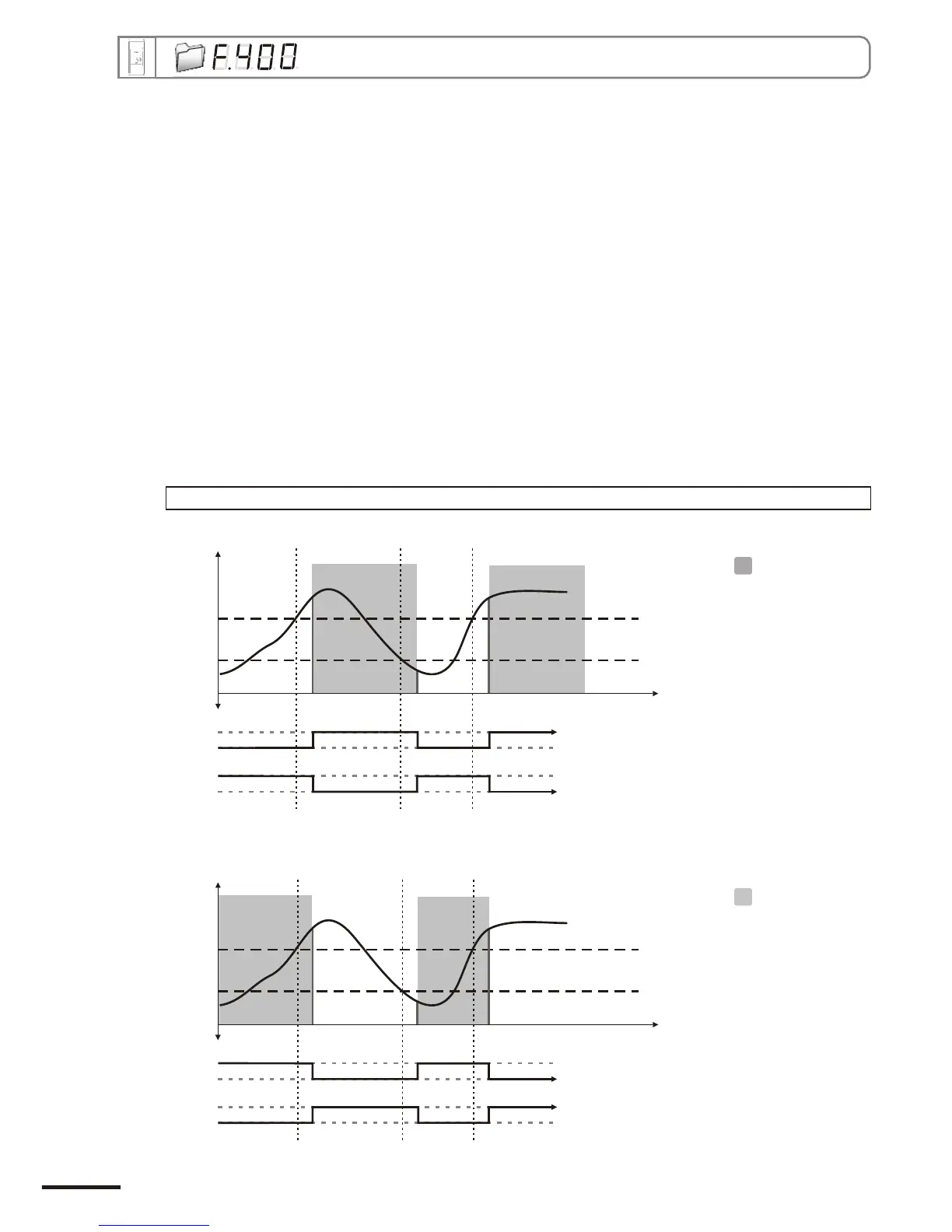
Seuil 1
Seuil 2
Temps
Measurement
Energized
Not energized
Relay status
Negative security
Energized
Not energized
Relay status
Positive security
<T> <T> <T>
<T>
Alarm set
Time-delay
Setpoint 1 > Setpoint 2
Setpoint 2
Setpoint 1
Time
Measurement
Energized
Not energized
Relay status
Negative security
Energized
Not energized
Relay status
Positive security
<T> <T> <T>
<T>
Alarm set
Time-delay
Setpoint 2 > Setpoint 1
Page 14
Configuration N°1 : 2 setpoints and time-delay activated (Control Mode)
Control mode (or
regulation mode)
=>you can regulate the
measurement within a
range determined by 2
setpoints.
CPE 300 transmitter configuration via remote control / Modbus


 To Next Page