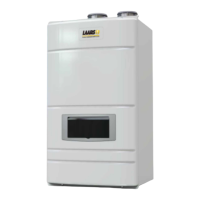
The FT Series Floor Standing, Combination Boiler
Page 85
SECTION 9 Installation Check
9.1 Quick View
Before Installing
- Make sure that there is enough space for installing
DHW hot and cold, possible DHW recirc, space
heating and gas piping.
Verify vent/air termination is located as required.
- Propane boilers require a propane conversion kit,
conversion parts and documentation are included.
Install Water Piping
- Boiler loop piping must be sized to the minimums
listed in the Boiler manual. Using smaller piping will
cause performance problems.(page 34)
Install Vent & Air Piping
- Slide the air inlet pipe and vent pipe into the Boiler
vent connectors.
- Make sure the terminations are placed as required
in the manual and that air intakes are at least 12
inches above normal snow line.
- Refer to the material check list in this guide for a list
of items needed.
Install Condensate Piping / Tubing & Components
- Fill out the material check list in this guide to
ensure you have the tubing or PVC pipe and all
components needed for the condensate piping.
- Connect internal components that are supplied
with the Boiler.
- For closet installations, a condensate pump can be
placed inside the cabinet. A condensate discharge
hose can exit the cabinet either near oor level via
provided knock-outs, or via a knock-out in the upper
right rear corner of the top panel. Route the 3/8”
discharge hose carefully from the top into the boiler
cabinet. The condensate pump can be plugged into
the electrical outlet located on the inner back panel.
Install Gas Piping
- Install a union and shuto valve.
Wire the Boiler
- Connect power wiring and control wiring per boiler
manual wiring diagram.(Section 4.19)
Start up, Adjust & Test
- Follow the Boiler manual instructions to clean
the system if needed, then ll and check water
chemistry.
Some items to consider are
• Consider the eects of reduced heat transfer and
an increase in head pressure against the system
circulator. For example: A 30% mixture of glycol will
result in a BTU output loss of 15% with a 5% increase
in head against the system circulator.
• Glycol mixtures should not exceed 40%. A 50%
mixture of glycol will result in a BTU output loss of
30% with a 50% increase in head against the system
circulator. Glycol concentrations above 40% by
volume can lead to short cycling of the burner.
• The glycol solution should be tested as
recommended by the glycol manufacturer but not
less than annually. Some items of concern are pH
additive breakdown, inhibitor reduction, etc.
• Glycol/antifreeze solutions expand more than water;
therefore, system design must take this into account.
For example: a 40% by volume solution expands
4.8% in volume for a temperature increase from 32◦F
to 180◦F, while water expands 3% over the same
temperature rise.
CAUTION
It is highly recommended to follow the manufacturers
recommended concentrations, expansion requirements,
and maintenance recommendations. You must carefully
calculate the additional friction loss in the system as
well as the reduction in the heat transfer coecients.
__________________________________________
Freeze Protection (continued)
NOTICE
Do not exceed a 40% glycol concentration by volume
as it may result in short cycling of the burner.
WARNING
Do NOT use automotive antifreeze or
ethylene glycol. Use only inhibited propylene
glycol solutions which are specially
formulated for hydronic systems. Ethylene
glycol is toxic and can attack gaskets, seals,
and metallic components used in hydronic
systems. A correct glycol concentration and
inhibitor level is critical.



 To Next Page