LaCie 5big Network RAID and Disks
User Manual page 52
5.3. RAID 5
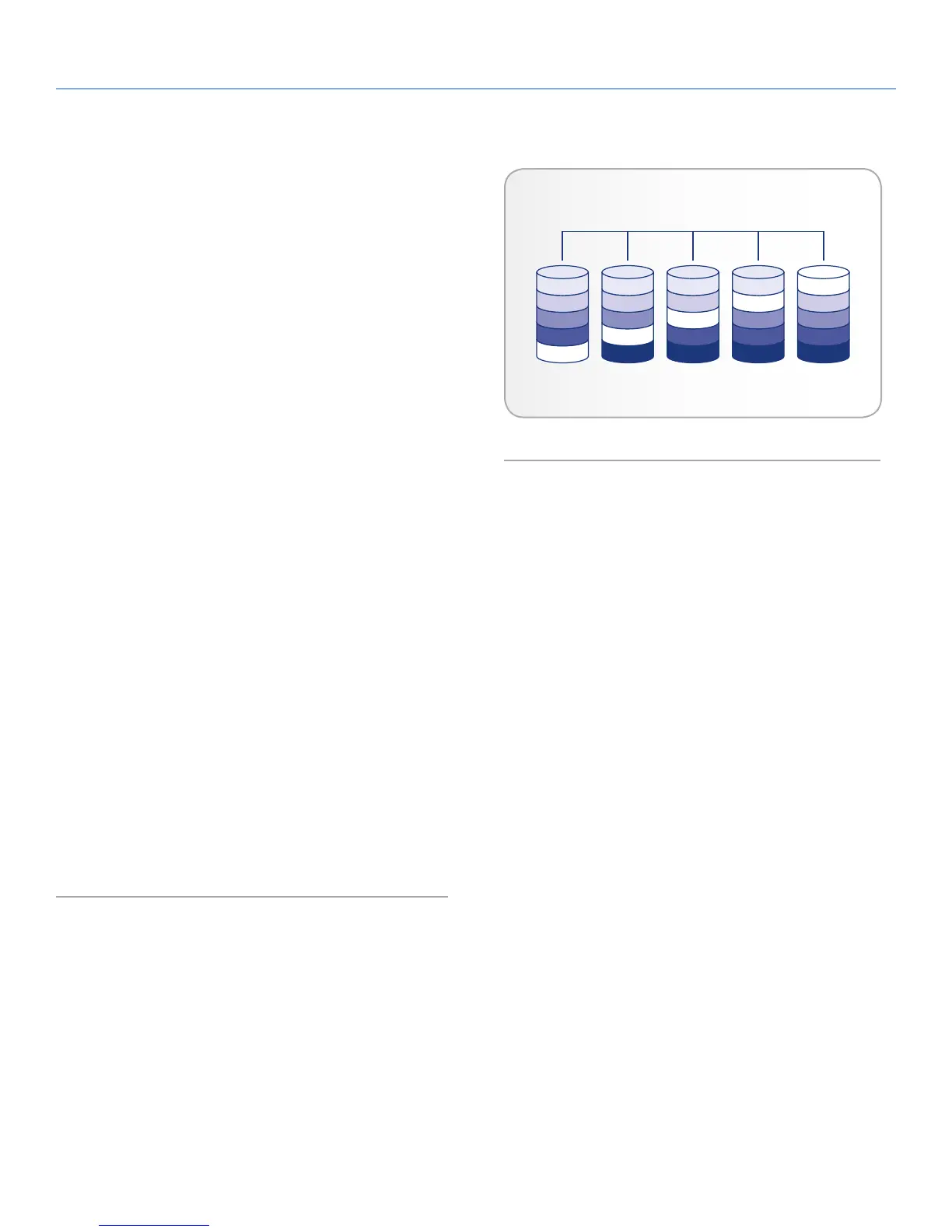
In RAID 5, data is striped across all disks (minimum of three) and a
parity block for each data block (P in Fig. 85) is written on the same
stripe.
If one physical disk fails, the data from the failed disk can be rebuilt
onto a replacement disk. No data is lost in the case of a single
disk failure, but if a second disk fails before data can be rebuilt to a
replacement drive, all data in the array will be lost.
Applications
RAID 5 combines data safety with efficient use of disk space. Disk
failure does not result in a service interruption because data is read
from parity blocks. RAID 5 is useful for archiving and for people
who need performance and constant access to their data, like video
editors.
How RAID 5 Capacity Is Calculated
Each disk in a RAID 5system should have the same capacity.
Storage capacity in a RAID level 5 configuration is calculated by
subtracting the number of drives by one and multiplying by the disk
capacity, or
C = (n-1)*d
where:
C = available capacity
n = number of disks
d = disk capacity
For example, in a RAID 5 array with four drives each with a capac-
ity of 1000GB, the total capacity of the array would be 3000GB:
C = (4-1)*1000
RAID 5
Disk 2
A2
B2
D1
Cp
Disk 1
A1
B1
C1
D1
Ep
A2
B2
C2
Dp
E1
Disk 3
A3
C2
D2
Bp
Disk 4
B3
C3
D3
Disk 5
A3
B3
Cp
D2
E2
A4
Bp
C3
D3
E3
Ap
B4
C4
D4
E4
Fig. 85


 To Next Page