Blades
Introduction
The selection and use of blades is a very extensive subject and there have been
many books written on the subject. This section of the manual is intended as a
general guide only.
Selecting a blade
Using the correct blade is important, as it is the first step in attaining good
bandsaw performance. The most frequently asked question is "How do I decide
on the correct blade to use?" The answer is not simple, and we will explore it in
this section of the manual. Firstly, there is NO ideal blade that will do
everything. The blades that you choose will be determined by the type of work
that you are doing. Large-tooth wide blades are selected for fast course cuts,
and fine thin blades are used for intricate scrollwork. You will find that you will
need a large selection of blades if you do a lot of varied work and fewer blades
if you are concentrating on one section of band-sawing such as re-sawing.
Using the wrong blade is the best way to abuse it. Using a blade for its intended
purpose allows for maximum efficiency and is the best way to prolong its life.
Blade terms
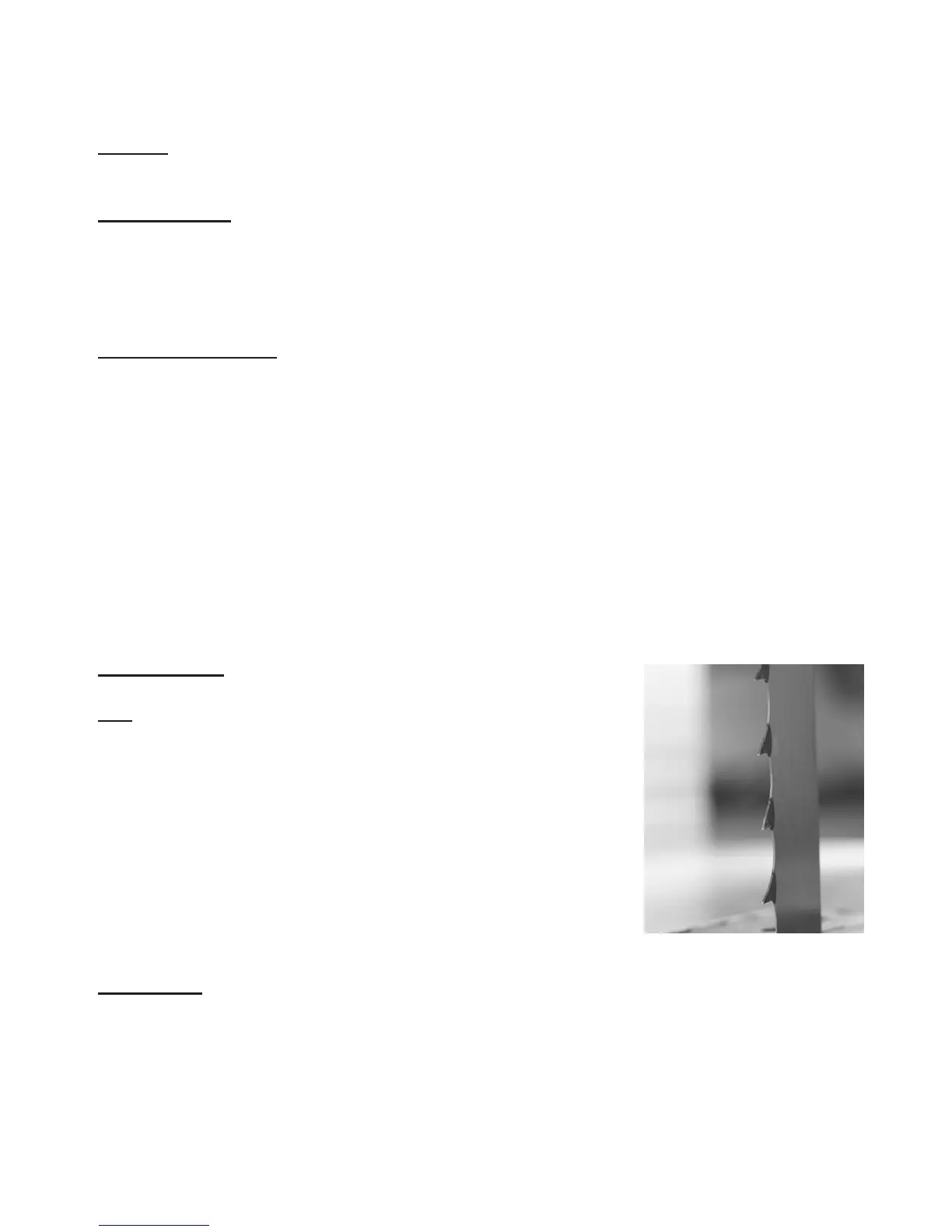
Set
The amount that the teeth are wider than the thickness
of the backing material. The larger the set the larger
the saw cut and the smaller the radius that can be cut.
This can also be an advantage if you are cutting a job
that has a tendency to nip the blade. The smaller the
set, the smaller the saw cut and the larger the radius
that can be cut, but the wood that is wasted is less. On
tipped blades [Resaw king] there is no set as the tip is
wider than the backing material
Thickness
The thicker the blade, the stiffer the blade and the straighter the cut. The
thicker the band the greater the tendency for the blade to break.


 To Next Page