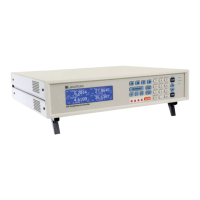
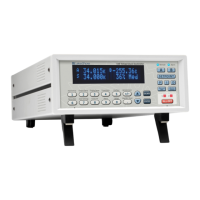
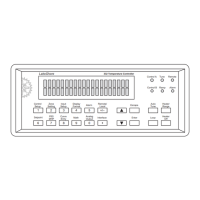
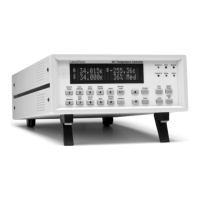
Lake Shore Model 330 Autotuning Temperature Controller User’s Manual
2-6 Installation
2.6.1.4 Measurement Errors Due To AC Noise
Poorly shielded leads or improperly grounded measurement systems can introduce AC noise into sensor
leads. For diode sensors, AC noise appears as a shift in the DC voltage measurement due to the non-linear
current/voltage characteristics of the diode. When this occurs, measured DC voltage is too low and the
corresponding temperature indication is high. Measurement error can approach several tenths of a kelvin.
For Series PT-100 Platinum Sensors, the noise causes no DC shift, but it may still degrade accuracy. To
determine if this is a problem in your measurement system, perform either of the two procedures below.
1. Place a capacitor across the diode to shunt the induced AC currents. Capacitor size depends on the noise
frequency. If the noise is related to the power line frequency, use a 10 microfarad capacitor. If AC-coupled
digital noise is suspected (digital circuits or interfaces), then use a capacitor between 0.1 to 1 microfarad.
In either case, if the measured DC voltage increases, there is induced noise in your system.
2. Measure the AC voltage across the diode with an AC voltmeter or oscilloscope. Most voltmeters do not
have the frequency response to measure noise associated with digital circuits or interfaces (which operate
in the MHz range). See the paper “Measurement System-Induced Errors In Diode Thermometry,” J.K.
Krause and B.C. Dodrill, Rev. Sci. Instr. 57 (4), 661, April, 1986 for a thorough discussion of this potential
problem, and the magnitude of error which may result. It is available from Lake Shore.
To greatly reduce the potential for this error, connect twisted leads (pairs) between the controller and the diode
sensors, preferably Duo-Twist™ Cryogenic Wire, which features phosphor bronze wire, 32 or 36 AWG,
twisted at 3.15 twists per centimeter (8 twists per inch). Duo-Twist wire is available from Lake Shore. See the
Lake Shore Product Catalog or contact Lake Shore for details.
2.6.2 Thermocouple (Model 330-4X) Connections
The thermocouple input has a thermal block to connect thermocouple wires. The positive and negative
terminals correspond to V+ and V– and should match the polarity of the thermocouple used. Tighten the screw
terminals carefully; loose connections result in unstable readings and control. For details on thermocouple
operation, see Paragraph 3.5.
2.6.2.1 Thermocouple Compensation
The thermocouple input has a thermal block for connecting thermocouple wires and for temperature
compensation. Thermocouple response curve tables within the instrument are normalized to the ice point of water.
Obtain accurate readings by one of two methods: use an ice bath with a reference junction with the internal room
temperature compensation turned OFF, or, more conveniently, eliminate the reference junction and ice bath, and
use the internal electronic room temperature compensation by turning internal compensation ON.
When a new or different thermocouple is attached to the controller, adjust the offset to compensate for
discrepancies in thermocouple material, leads, and connections. Offset adjustment trimpots are provided
inside the Model 330 to allow offset calibration of the thermocouple. See Paragraph 5.12.
2.6.2.2 Thermocouple Wire Types at Cryogenic Temperatures
Below are recommended thermocouple wire types for cryogenic temperatures. The ANSI color code for
thermocouples is red for the negative lead, while the type of thermocouple determines the positive lead color:
purple (Type E), black (Type J), yellow (Type K), and blue (Type T). For details on thermocouples or other
sensors, see the Lake Shore Temperature Sensor Guide.
Chromel™ vs. Gold with 0.03% or 0.07% Atomic Iron
(0.03% not currently sold by Lake Shore)
Consists of Gold (Au) doped with 0.03 or 0.07 atomic percent Iron (Fe) as the negative thermoelement and
a Ni-Cr alloy (Chromel™) as the positive thermoelement. This thermocouple has relatively high temperature
sensitivity below 25 K, and usable sensitivity below 10 K. It is widely used in cryogenic applications due to its
relatively high thermoelectric sensitivity (>15 µV/K above 10K). Recommended useful temperature range for
the 0.03% Fe is 4 K to 325 K, and for the 0.07% Fe is 1.4 K.


 To Next Page