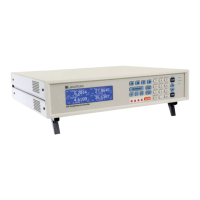
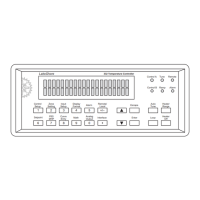
Lake Shore Model 330 Autotuning Temperature Controller User’s Manual
4-2 Remote Operation
4.1.2.1 Bus Control Commands
A Universal Command addresses all devices on the bus. Universal Commands include Uniline and Multiline
Commands. A Uniline Command (Message) asserts only a single signal line. The Model 330 recognizes two
of these messages from the BUS CONTROLLER: Remote (REN) and Interface Clear (IFC). The MPS sends
one Uniline Command: Service Request (SRQ).
REN (Remote) – Puts the Model 330 into remote mode.
IFC (Interface Clear) – Stops current operation on the bus.
SRQ (Service Request) – Tells the bus controller that the Model 330 needs interface service.
A Multiline Command asserts a group of signal lines. All devices equipped to implement such commands do
so simultaneously upon command transmission. These commands transmit with the Attention (ATN) line
asserted low. The Model 330 recognizes two Multiline commands:
LLO (Local Lockout) – Prevents the use of instrument front panel controls.
DCL (Device Clear) – Clears Model 330 interface activity and puts it into a bus idle state.
Finally, Addressed Bus Control Commands are Multiline commands that must include the Model 330 listen
address before the instrument responds. Only the addressed device responds to these commands. The Model
330 recognizes three of the Addressed Bus Control Commands:
SDC (Selective Device Clear) – The SDC command performs essentially the same function as the DCL
command except that only the addressed device responds.
GTL (Go To Local) – The GTL command is used to remove instruments from the remote mode. With some
instruments, GTL also unlocks front panel controls if they were previously locked out with the LLO command.
SPE (Serial Poll Enable) and SPD (Serial Poll Disable) – Serial polling accesses the Service Request
(SRQ) Status Register. This status register contains important operational information from the unit requesting
service. The SPD command ends the polling sequence.
4.1.2.2 Common Commands
Common Commands are addressed commands which create commonalty between instruments on the bus.
All instruments that comply with the IEEE-488 1987 standard share these commands and their format.
Common commands all begin with an asterisk. They generally relate to “bus” and “instrument” status and
identification. Common query commands end with a question mark (?). See Paragraph 4.3 for a list of all
Model 330 common commands.
4.1.2.3 Interface and Device Specific Commands
Device Specific Commands are addressed commands. The Model 330 supports a variety of Device Specific
commands to program instruments remotely from a digital computer and to transfer measurements to the
computer. Most Device Specific Commands perform functions also performed from the front panel. This
section discusses Common and Device Specific commands. Device Specific Commands consist of Interface,
Display, Channel, Control Process and Curve commands. See Paragraph 4.3 for a list of all Model 330
interface and device specific commands.
4.1.3 Status Registers
There are two status registers: the Status Byte Register (Paragraph 4.1.3.1), and the Standard Event Status
Register (Paragraph 4.1.3.2).
4.1.3.1 Status Byte Register and Service Request Enable Register
The Status Byte Register consists of one data byte containing six bits of information about Model 330 status.
STATUS BYTE REGISTER FORMAT
Bit – 7 6 5 4 3 2 1 0
Weighting – 128 64 32 16 8 4 2 1
Bit Name –
Not Used
SRQ ESB OVI
Not Used
CLE CDR SDR


 To Next Page