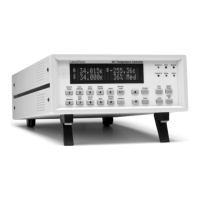
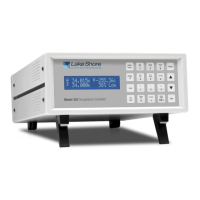
Lake Shore Model 330 Autotuning Temperature Controller User’s Manual
4-8 Remote Operation
4.2.1 Serial Interface Hardware Configuration
The Model 330 operates at two different Baud rates: 300 or 1200. Hold the Baud key and press the t key to
cycle between 300 and 1200. The remaining communication parameters are fixed as defined in Table 4-3.
The serial interface connector is a standard 6-wire RJ-11 (telephone) jack. Lake Shore offers the optional
Model 2001 10-foot Cable Assembly, Model 2002 RJ-11 to DB-25 Adapter, and the Model 2003 RJ-11 to DE-9
Adapter, as shown in Figure 4-2. To make your own cable, see Figure 5-6.
Table 4-2. Serial Interface Parameters
Transmission: Three-Wire Baud Rate: 300 or 1200
Connector: RJ-11 Modular Socket Bits per Character: 1 Start, 7 Data, 1 Parity, 1 Stop
Timing Format: Asynchronous Parity Type: Odd
Transmission Mode: Half Duplex Terminator: CR (0DH) LF (0AH)
Data Interface Levels: Transmits and Receives Using EIA Voltage Levels
4.2.2 Sample BASIC Serial Interface Program
The program in Table 4-3 is a sample interactive serial poll routine for the Model 330 Serial Interface written in
QuickBASIC V4.0. Below are examples using this program. (User-supplied input appears in bold type.)
ENTER COMMAND? CUNI K Set Control Units to kelvin units.
ENTER COMMAND? CUNI? Control Units Query. Controller returns appropriate unit, where K = kelvin.
K
ENTER COMMAND? CDAT? Sensor Data Query. Controller returns appropriate sensor reading.
+77.6
ENTER COMMAND? TUNE 3 Set Autotuning Status. Controller sets Autotuning to PID.
ENTER COMMAND? TUNE? Autotuning Status Query. Controller returns appropriate setting, where
0 = Manual, 1 = P, 2 = PI, and 3 = PID.
ENTER COMMAND? RANG 0;RANG? Combination command. Sets heater to off and requests heater
status where 0 = off and 1 = on.
ENTER COMMAND?
4.2.3 Notes on Using the Serial Interface
• To chain commands together, insert a semi-colon (;) between them. Multiple queries cannot be chained.
• Queries generally use the same syntax as the associated setting command followed by a question mark.
They usually return the same information that is sent.
• Add a query to the end of a command string to confirm command execution. For example, CUNI K;CUNI?
commands the Model 330 to set temperature units to kelvin then requests the Model 330 return the
temperature units to confirm the change.
• A correctly spelled query without a "?", returns nothing. Misspelled commands and queries are ignored
• When the term free field is used, it indicates that the decimal point is a floating entity and can be placed at
any appropriate place in the string of digits.
• Leading zeros and zeros following a decimal point are unneeded in a command string, but they are sent in
response to a query. A leading “+” is not required, but a leading “–” is required.
• [term] indicates where the user places terminating characters or where they appear on a returning
character string from the Model 330.


 To Next Page