6. Autostart Operation
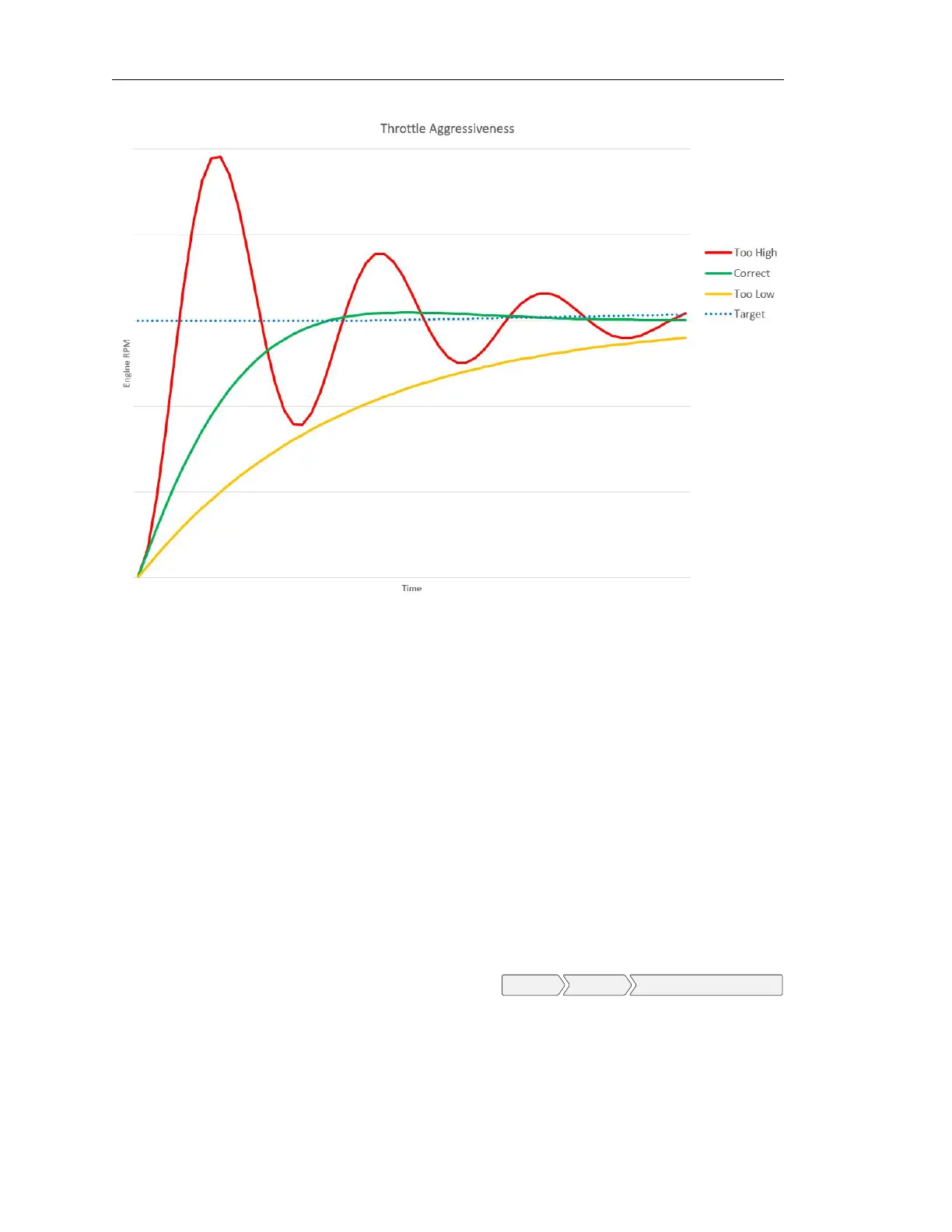
A fast-responding system will need a lower aggressiveness value. Otherwise, the engine RPMs will
overshoot and undershoot the target value as depicted in the graph by the red ”Too High” throttle
aggressiveness line. Ideally, the engine’s RPM should quickly ramp up and home in on a small
RPM range to maintain the target value as depicted in the graph by the green ”Correct” throttle
aggressiveness line. However, if the gain is set too low, the engine’s RPM may never get to the
proper range to maintain the target value as depicted in the graph by the yellow ”Too Low” throttle
aggressiveness line. The full screen Throttling Line Graph (see section) can be utilized to observe
the behavior to determine if the throttling aggressiveness is correct.
6.4.4 Configuring Start and Stop Delays
In situations where start or stop conditions may be met briefly yet repeated start/stop cycles of the
engine need be avoided, two settings allow a delay to be added before a specific input condition is
recognized. An example of such use is where a float switch is installed in choppy water. The float
switch may repeatedly open and close based on the water’s surface waves. Rather than repeated
engine start and stop cycles, it is better to wait for the float switch to be continuously closed for a
duration before the start or stop event is declared.
The Start and Stop Delays can be configured by going to
Autostart Behavior Start Delay or Stop Delay
.
Page 28 LOFA document No. 463-3002-59 Page 28


 To Next Page