OPERATING CONTROLS AND INSTRUMENTATION
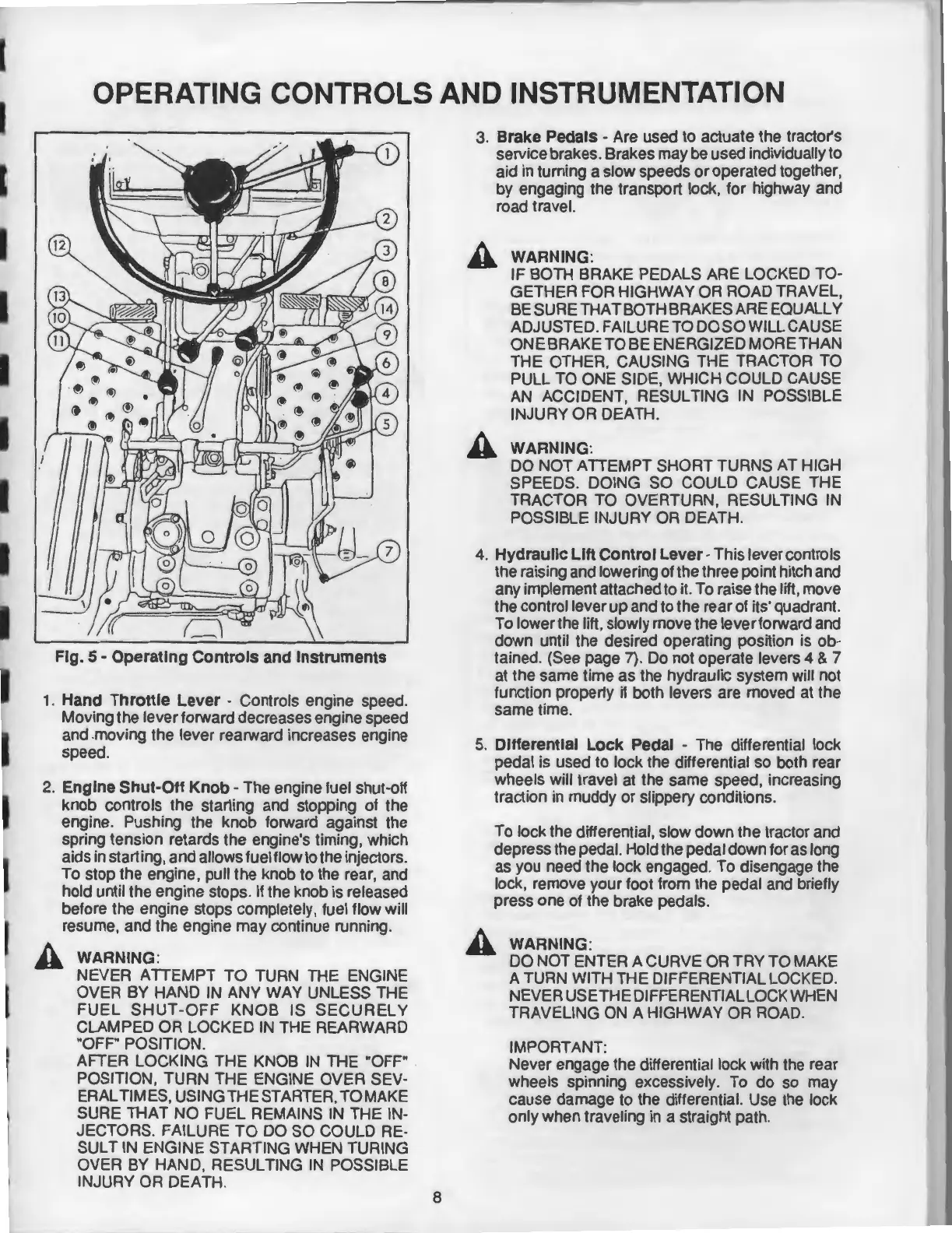
Fig.
5 -
Operating
Controls
and
Instruments
1.
Hand
Throttle
Lever
- Controls engine speed.
Moving the lever forward decreases engine speed
and .moving the lever rearward increases engine
speed.
2.
Engine
Shut-Off
Knob-
The engine fuel shut-off
knob controls the starting and stopping of the
engine. Pushing the knob forward against the
spring tension retards the engine's timing, which
aids in starting, and allows fuel flow to the injectors.
To stop the engine, pull
the
knob to the rear, and
hold until the engine stops. If the knob is released
before the engine stops completely, fuel flow will
resume, and the engine may continue running.
WARNING:
NEVER
ATTEMPT
TO
TURN THE ENGINE
OVER BY
HAND
IN
ANY
WAY
UNLESS THE
FUEL
SHUT-OFF
KNOB
IS
SECURELY
CLAMPED
OR
LOCKED
IN
THE REARWARD
"OFF" POSITION.
AFTER LOCKING
THE
KNOB
IN
THE "OFF"
POSITION,
TURN
THE
ENGINE OVER SEV-
ERAL TIMES, USING THE STARTER, TO MAKE
SURE
THAT
NO
FUEL REMAINS IN THE IN-
JECTORS. FAILURE
TO
DO SO COULD RE-
SULT IN ENGINE STARTING WHEN TURING
OVER BY HAND, RESULTING IN POSSIBLE
INJURY OR DEATH.
8
3.
Brake
Pedals
- Are used to actuate the tractor's
service brakes. Brakes may
be
used individually to
aid in turning a slow speeds
or
operated together,
by
engaging the transport lock, for highway and
road travel.
WARNING:
IF BOTH BRAKE PEDALS ARE LOCKED TO-
GETHER FOR HIGHWAY OR ROAD TRAVEL,
BESURETHATBOTHBRAKESAREEQUALLY
ADJUSTED. FAILURE
TO
DO
SO
WILL CAUSE
ONE
BRAKE
TO
BE ENERGIZED MORE THAN
THE
OTHER, CAUSING
THE
TRACTOR TO
PULL TO ONE SIDE, WHICH COULD CAUSE
AN ACCIDENT, RESULTING IN POSSIBLE
INJURY OR DEATH.
WARNING:
DO
NOT
ATTEMPT
SHORT
TURNS
AT
HIGH
SPEEDS. DOING SO COULD CAUSE THE
TRACTOR
TO
OVERTURN, RESULTING IN
POSSIBLE INJURY OR DEATH.
4.
Hydraulic
Lift
Control
Lever-
This lever controls
the raising and lowering of the three point hitch and
any implement attached to it. To raise the lift, move
the control lever
up
and to the rear of its' quadrant.
To lower the lift, slowly move the lever forward and
down until the desired operating position is ob-
tained. (See page
7). Do not operate levers 4 & 7
at
the
same time as the hydraulic system will not
function properly if both levers are moved at the
same time.
5.
Differential
Lock
Pedal - The differential lock
pedal is used to lock the differential so both rear
wheels will travel at the same speed, increasing
traction in muddy
or
slippery conditions.
To lock the differential, slow
down
the tractor and
depress the pedal. Hold the pedal down for as long
as you need the lock engaged.
To
disengage the
lock, remove your foot from the pedal and briefly
press one of the brake pedals.
WARNING:
DO
NOT
ENTER A CURVE OR TRY TO MAKE
A TURN WITH THE DIFFERENTIAL LOCKED.
NEVER USE THE DIFFERENTIAL LOCK WHEN
TRAVELING ON A HIGHWAY OR ROAD.
IMPORTANT:
Never engage the differential lock with the rear
wheels spinning excessively. To do so may
cause damage to the differential. Use the lock
only when traveling
in
a straight path.


 To Next Page