Maeving | RM1S Owner’s Handbook
70
MAINTENANCE AND ADJUSTMENT
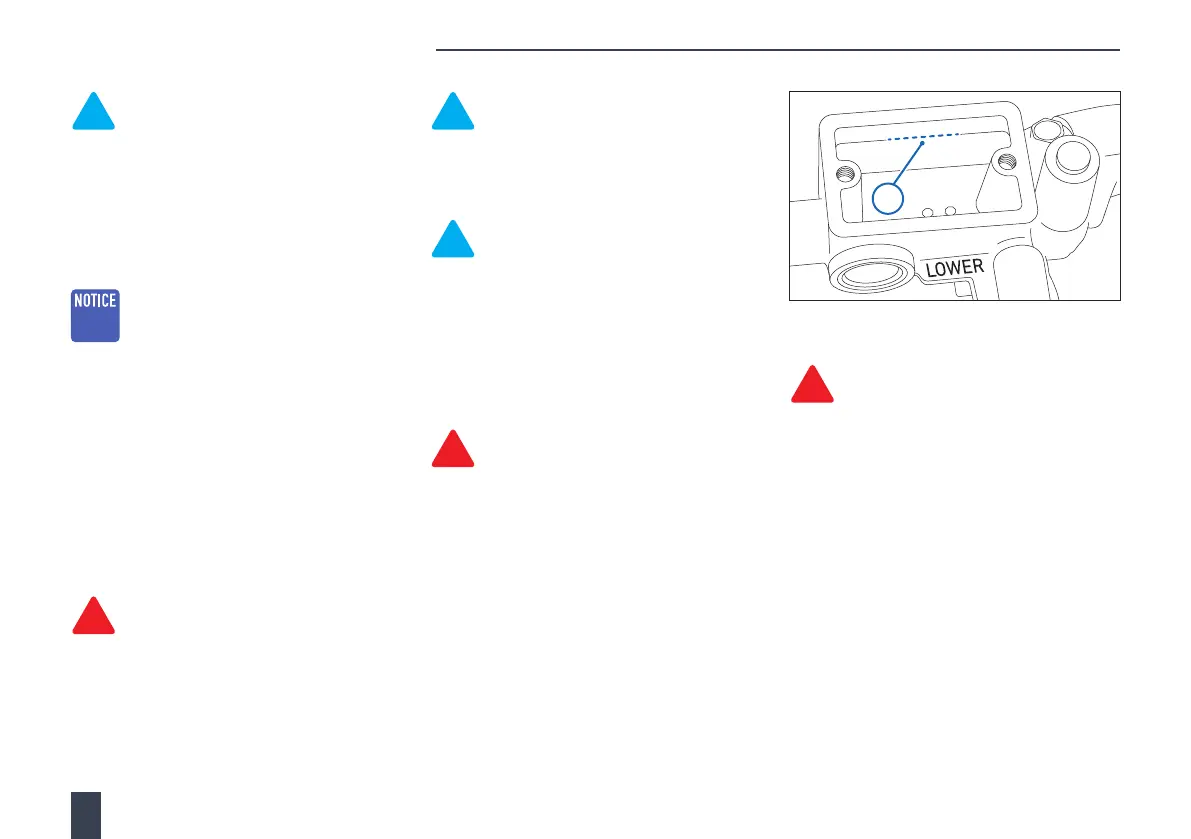
Note: The brake fluid level must
remain above the minimum (lower-
level) indicator (1) on both brake
master cylinder reservoirs.
To adjust the brake fluid level:
1. Place a protective cloth around the area
to prevent brake fluid from making
contact with any painted surface.
NOTICE: When topping up the brake
fluid, make sure you do not spill or
splash any onto the painted surfaces
of your motorcycle, as it can damage
paintwork and other surfaces.
2. Thoroughly clean around the top of the
reservoir cover on the brake master
cylinder.
3. Remove the screws (2) securing the
cover and remove the cover and
diaphragm seal.
4. Top up the brake fluid to the maximum
level line (3).
WARNING: Never overfill the reservoir
on the brake master cylinder. Doing
so may cause dangerous riding
conditions that could result in loss of
control and an accident, causing injury
or death.
Note: Only use the recommended brake
fluid from a new and sealed container.
5. Refit the diaphragm seal and the cover to
the brake master cylinder reservoir.
Note: Make sure the diaphragm seal
is positioned correctly between the
master cylinder body and the cover
before refitting.
6. Refit the screws to the cover.
7. Tighten the screws to 2-3 Nm.
8. Thoroughly clean around the reservoir’s cover.
9. Remove the protective cloth.
WARNING: If there has been an
excessive drop in the brake fluid level
and the brake pads are within their
serviceable limits, you may have a
brake fluid leak. Riding with a brake
fluid leak is very dangerous and may
cause a reduction in brake performance
or failure of the brakes, resulting in
an accident and potentially causing
injury or death. Check the hoses, hose
joints and around the caliper seals,
and consult the Maeving
Workshop
Team, a Maeving Workshop Partner
or a qualified person or business with
an extensive technical knowledge of
motorcycles. For further information,
see Contacts on page 6.
Brake light switches
WARNING: It is illegal and dangerous
to ride your motorcycle with a
defective brake light. Riding with a
defective brake light could cause an
accident and injury to the rider or
other road users.
The brake light is independently activated by
the front or rear brakes when the ignition is in
the ON position.
Before you ride your motorcycle, apply the
front brake and the rear brake separately and
make sure you physically see the brake light
illuminate.
If the brake light does not illuminate during
your checks, please contact the Maeving
Workshop Partner or a qualified person
or business with an extensive technical
knowledge of motorcycles.
3



 To Next Page