Need help?
Do you have a question about the Mase Generators IS 6.1 and is the answer not in the manual?
An assembly of an internal combustion engine and an alternator for electrical energy self-production.
Comprises power supply circuits of user equipment, including sectioning, handling, and protection devices.
A system with rated voltage greater than 50 V and smaller than 1000 V.
Numerical values characterizing machine requirements from an electrical circuit or mechanical device.
Main cut-out device opening automatically by thermal effect.
Main cut-out device opening automatically by differential effect.
A person with technical know-how to avoid dangers inherent in electricity.
A person evaluating job tasks and recognizing dangers based on training and experience.
A body supplying equipment or services related to the machine.
Action affecting an output variable of a system to achieve a goal.
Control where variable change is produced by manual human intervention.
Control where variable change is produced by a device without human intervention.
Source of possible harm or damage to health.
Guard or device to protect persons from present or potential danger.
Part assuring protection against external influences and contact.
Live parts not fully covered, insecure connections, or oxide development.
Contact of persons or animals with live parts.
Circuit used to control machine operation.
Materials, devices, accessories used with an electrical installation.
Specifies the generator's intended use for autonomous electric energy production within declared limits.
Emphasizes careful manual consultation and the consequences of not following specifications.
Details the manual's purpose for safety, proper use, and maintenance information.
Generator is suitable for independent electrical energy production within declared limits; intended for marine use.
Identifies potential risks like contact with hot parts, electrocution, noise, lubricants, and fuel fire.
Explains Danger, Warning, and Caution symbols indicating different levels of risk.
Defines Information and Optional symbols for important instructions and non-inclusive parts.
Warns about severe injury or death from contact with hot engine and exhaust system parts.
Warns of injury or death from accidental starting; advises disabling procedures.
Warns of severe injury or death from rotating parts; advises keeping guards in place.
Provides guidelines for preventing fires, including fuel use, refueling, and flammable materials.
Details fire risks, including ignition sources and extinguishing procedures.
Covers risks related to the exhaust system, including carbon monoxide poisoning.
Details carbon monoxide risks and precautions for exhaust system installation.
Warns about severe injury or death from hazardous voltage and electrocution risks.
Provides safety procedures for grounding, disabling the generator, and battery short circuits.
Warns of explosion risk and severe injury from battery short circuits.
Advises on safe handling of battery acid, ventilation, and avoiding sparks.
Recommends protective gear for fuel spray and blowing air hazards.
Lists applicable EC directives and standards for generator conformity.
Details the information found on the generator identification plate.
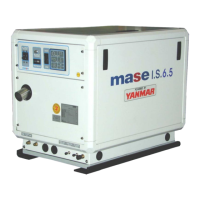
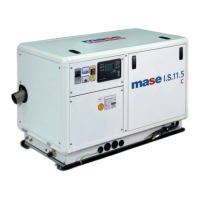
Describes generator design for marine use, reliability, quiet operation, and alternator type.
Lists the main components of the generator unit with numerical references.
Details the components of the instrument panel for commands and controls.
Specifies ventilation, temperature, and humidity requirements for the generator's installation location.
Provides precautions and procedures for safely lifting and handling the generator.
Details requirements for anchoring the generator and ensuring proper air intake ventilation.
Describes direct and baffled seawater intake systems and their operational considerations.
Details components like intake, ball cocks, water filter, and antisiphon valve for the cooling system.
Illustrates typical seawater circuit installation with the generator above the waterline.
Illustrates typical seawater circuit installation with the generator below the waterline.
Diagrams for installing the generator above waterline with a water/gas separator.
Diagrams for installing the generator under waterline with a water/gas separator.
Illustrates installations above waterline using GENSEP water/gas separator.
Illustrates installations under waterline using GENSEP water/gas separator.
Covers exhaust pipe length, backflow prevention, noise reduction, and carbon monoxide risks.
Describes optional components like mufflers, silencers, and water/gas separators.
Details fuel inlet/outlet connections and required fuel pipe specifications.
Describes the fuel filter location and the electric fuel pump with its protective filter.
Provides step-by-step instructions for connecting the 12V starter battery.
Explains how to connect the optional remote control panel using its cable.
Describes how AC connection is made via the power terminal board.
Details generator earthing requirements and warns about electrical shock hazards.
Lists essential checks like oil level, connections, and utilities status before starting.
Outlines safe procedures for fuelling, including engine status and ventilation.
Step-by-step guide for starting the generator, including preheating and timing.
Explains how to stop the generator using the control panel or switch.
Describes how to use the emergency stop switch and reset the system.
Details information displayed and signals monitored by the CBU engine protection module.
Identifies the five fuses protecting the engine protection module.
Explains generator protection against short-circuits and electrical overload.
Lists alarm codes, symbols, names, and descriptions for the CBU module.
Recommends following engine manufacturer instructions and adhering to safety precautions.
Indicates that periodic engine operations are detailed in a 'Service schedule'.
Describes how to check the engine oil level using the dipstick and ensuring horizontal positioning.
Provides instructions for topping up and changing engine oil, including disposal advice.
Details the procedure for removing and replacing the engine oil filter cartridge.
Instructs to follow the specific manual for the type of fuel filter installed.
Explains the automatic bleed valve and manual bleeding procedure for the fuel system.
Describes the dry air filter and recommends cleaning it annually with diesel fuel.
Outlines the steps to drain the seawater intake circuit for maintenance.
Recommends periodic checks and replacement of the zinc anode to protect heat exchangers.
States that the brushless alternator requires minimal maintenance, mainly cleaning moisture and oxidation.
Covers battery activation, electrolyte level checks, and storage precautions.
Lists essential spare parts for the generator, available as an optional kit.
Provides detailed operations for storing the generator during long periods of inactivity.
Lists common engine start problems and their potential causes and remedies.
Addresses issues like excessive smoke, irregular running, and low voltage.
Covers low voltage, no power delivery, and flat battery troubleshooting steps.
Advises using original spare parts and contacting the authorized assistance network.
Provides instructions for protecting the generator during transport and storing it properly.
Details precautions and methods for safely lifting and handling the packed generator unit.
Outlines the generator guarantee period and conditions, including exclusions.
Defines customer responsibilities for safety, reliability, and performance.
Specifies how to dispose of packaging, electrical components, painted parts, and other waste.
Presents the wiring diagram for the standard version of the generator.
Presents the wiring diagram for the insulated pole version of the generator.
 General
| Rated power (kVA) | 5.5 |
|---|---|
| Rated power (kW) | 4.4 |
| Maximum Power (kVA) | 6.1 |
| Voltage (V) | 230 |
| Frequency (Hz) | 50 |
| Fuel | Diesel |
| Starting System | Electric |
| Fuel Consumption at 75% Load | 1.2 l/h |
| Phase | Single |
| Engine Type | 4-stroke |
| Noise Level at 7 m | 68 dB(A) |

 To Next Page