
 Need help?
Do you have a question about the Masterclock GMR1000 and is the answer not in the manual?
Details on reference sources and signal outputs for the GMR1000, including NTP, NMEA, and time codes.
Additional capabilities of the GMR1000, such as internal oscillator, configuration software, and network compatibility.
Details on reference sources and signal outputs for the GMR5000, including NTP, NMEA, and time codes.
Additional capabilities of the GMR5000, such as display, relay closure, and network compatibility.
Highlights of GPS/GNSS receiver options, including satellite lock and accuracy.
Specifications for GPS and GPS+GNSS receiver capabilities, including channels and accuracy.
Details on antenna types, gain, mount, and operating parameters for GPS systems.
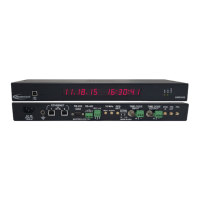
General description of the GMR1000 and GMR5000 as high-precision time and frequency reference generators.
Details on GPS/GLONASS receiver options and their accuracy.
Information on TCXO, OCXO, and Rubidium oscillator options for enhanced stability.
Description of PTP capabilities, including grandmaster and slave configurations.
Functionality of the Time Code Reader module for SMPTE and IRIG time codes.
Capabilities of the Time Code Generator module for various time code formats.
Details on Pulse Per Second (PPS) and Programmable Pulse Output (PPO) functionalities.
Information on 10 MHz frequency, Sync-In, and programmable dry contact relay options.
Description of the front panel LED display options for GMR1000 and GMR5000.
Description of Ethernet ports and SMA connector types for various signals.
Details on BNC connectors, USB ports, and RS232 serial port interfaces.
Overview of the WinDiscovery GUI application for device detection and management.
Information on using Telnet and Secure Shell for command-line configuration.
Configuration of passwords for security and understanding UTC time reference.
Details on the factory-set configuration parameters for the GMR devices.
Procedure for restoring the GMR device to its original factory default settings.
Step-by-step guide for installing necessary drivers to control GMR via USB.
Essential checks and information required before installing the GMR on a network.
Instructions for connecting the GMR and initiating the startup sequence.
Guide on how to install the WinDiscovery software application on a computer.
Instructions for discovering, accessing, and managing Masterclock devices via WinDiscovery.
Configuration for the NTP client to synchronize system time via NTP servers.
Settings for the Time Code Reader module to decode incoming time code signals.
Configuration for the NMEA client to decode NMEA 0183 messages for time synchronization.
Settings for the NENA client to synchronize with NENA messages.
Configuration options for synchronizing the device to a pulse input.
Configuration for the GMR to act as an NTP server, including stratum levels.
Settings for generating SMPTE, IRIG-A, IRIG-B, and IRIG-E time codes.
Configuration for outputting NMEA messages via RS232 or Ethernet.
Configuration for NENA, Truetime/Kinematics, and Programmable Pulse Output.
Manually setting time/date and configuring device passwords.
Enabling/disabling global passwords for multiple devices.
Resetting device, installing options, managing leap seconds, and email config.
Connecting the GPS antenna and initiating satellite acquisition.
Options for antenna cable length compensation and types like inline amplifiers.
Guidance on choosing antenna types and optimal placement for signal reception.
Considerations for cable delay, lightning arrestors, and advanced installation planning.
Common issues with GPS lock and step-by-step solutions for troubleshooting.
Information on NMEA messages and RS-232 interface pin assignments.
Configuring additional NMEA messages with GPS option and streaming data via PuTTY.
Introduction to PTP, its goals, and configuration approaches.
Configuring PTP parameters using the WinDiscovery application.
Details on PTP data sets and configuration via Telnet/SSH.
Resolving problems related to network topology, firewalls, and UDP broadcasts.
Troubleshooting WinDiscovery detection, status updates, and device responsiveness.
Addressing IP address conflicts, periodic resets, and Telnet connectivity issues.
Resolving NTP client errors, invalid time, and lost password issues.
Statement of compliance for the GMR1000 with CE directives and standards.
Statement of compliance for the GMR5000 with CE directives and standards.
Details on memory type, accessibility, and requirements for the GMR1000.
Details on memory type, accessibility, and requirements for the GMR5000.
 General
| Type | GPS Master Clock |
|---|---|
| Display | LCD |
| Mounting | Rack mount |
| Time Accuracy | ±100 ns |
| Outputs | IRIG, NTP, Serial Time Code |
| Network Protocols | NTP, SNTP |
| Power Supply | 100-240 VAC, 50-60 Hz, 20W |
| Operating Temperature | 0°C to 50°C |
| Dimensions | 19" rack mount, 1U height |

 To Next Page
