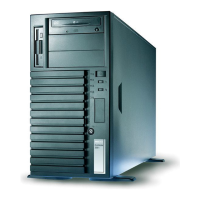
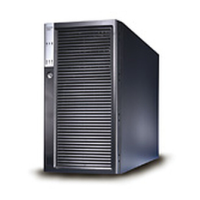
MAXDATA PLATINUM Server Board
To ensure EMC product regulation compliance, the system must be used with a shielded
The server board uses the Intel
Fast Ethernet Controller, 82546EB, and supports two
10Base-T/1000Base-TX network subsystems.
The 82546EB controller supports the following features:
32-bit PCI master interface
Integrated IEEE 802.3 10Base-T, 100Base-TX and 1000Base-TX compatible PHY
IEEE 820.3u auto-negotiation support
Full duplex support at 10 Mbps, 100 Mbps, and 1000 Mbps operation
On the MAXDATA PLATINUM Server Board, NIC 1 can be used as both a network interface
and server management interface.
NIC Connector and Status LEDs
The E82546 controller drives LEDs on the network interface connector that indicate
and speed of operation. The green status LED indicates network
connection when on and TX/RX activity when blinking. The speed LED indicates 1000 Mbps
when amber, 100 Mbps when green, and 10 Mbps when off.
The keyboard/mouse controller is PS/2-compatible. If specified through the System Setup
(SSU), the server may be locked automatically if there is no keyboard or mouse activity
for a predefined length of time. Once the inactivity (lockout) timer has expired, the keyboard
and mouse do not respond until the previously stored password is entered. A Y-cable can
be used if both a PS/2 mouse and keyboard are required at the same time.
The rear RJ-45 serial port is a fully functional serial port that supports any standard serial
device and provides support for serial concentrators. For server applications that use a serial
concentrator to access the server management features of the baseboard, a standard 8-pin
CAT-5 cable from the serial concentrator is plugged directly into the rear RJ-45 serial port.
The 8-pins of the RJ-45 connector can be configured to match either of two pin-out standards
used by serial port devices. To accommodate either standard, the J5A2 jumper block located
directly behind the rear RJ-45 serial port must be jumpered appropriately according to the
By default, the RJ-45 serial port is configured to support a DSR signal.
For serial devices that require a DSR signal (default), the J5A2 jumper must be configured
in position 3-4 (Figure 3, B).
For serial devices that require a DCD signal, the jumper must be in position 1-2 (Figure 3, A).



 To Next Page