Need help?
Do you have a question about the Menvier Security TS900+ and is the answer not in the manual?
Describes the TS790+/TS900+ alarm control units, their zone capacity, and programming features.
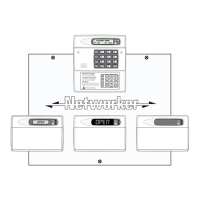
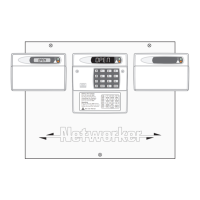
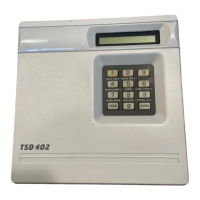
Details the overall system layout and components including control panel, nodes, and keypads.
Describes the main control panel's facilities, power supply, and memory storage.
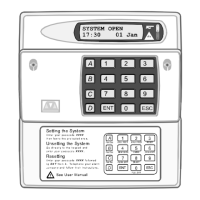
Lists and describes the four types of remote keypads: NETLCD, NETSTAR, NETLED, and NETARM.
Explains the TS900 IDNode's function, connection options, and zone capacity.
Details the TS700 LEC for expanding detection circuits and programmable outputs.
Provides general, electrical, and physical specifications for the TS790+ and TS900+ systems.
Guidelines for routing cables, ensuring separation from mains and telephone lines.
Wiring instructions for XNodes in TS900+ systems, including daisy-chain and star configurations.
Details wiring for devices on the remote network using 6-core cable.
Wiring for remote keypads connected after XNodes using 8-core cable.
Step-by-step procedure for installing the control panel, including cable entry and securing.
Diagram and explanation of the main PCB layout, terminals, and connections.
Description of jumper plugs (JP) and indicator LEDs on the main PCB.
Details on connecting the mains power supply, including fuse and regulations.
Requirements for connecting the system's standby battery and fault indication.
Overview of remote keypad usage and text programming capabilities.
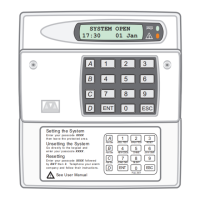
Description of the NETLCD keypad with 32-character display.
Description of the NETSTAR keypad with 8-character display.
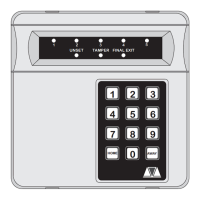
Description of the NETLED keypad with 4-character LED display.
Description of the NETARM arming station for setting/unsetting.
PCB layout diagrams for NETLCD, NETLED, and NETARM keypads.
Steps for installing a remote keypad, including jumper settings and connections.
How to use a standard remote keypad as an engineer's keypad with an interface lead.
Description of the XNode module, its circuits, and outputs.
Wiring instructions for the XNode, including daisy-chain and star configurations.
Details on the XNode's two programmable outputs and their ratings.
Diagram of the XNode layout, showing connections and selectors.
Procedure for installing an XNode, including tamper switch and I/D selector settings.
Installation details for the obsolete TS900 Node, its circuits, and outputs.
Diagram of the obsolete TS900 Node layout, showing connections.
Procedure for installing the TS700 LEC, including I/D selector and connections.
Methods for wiring detection circuits: End Of Line (EOL) or Double Pole (DP).
Description of the Double Pole wiring method for detectors and tamper contacts.
Description of the End Of Line wiring method, including resistors and loop resistance.
Details on connecting external sounders, strobes, and bells using provided terminals.
Diagram showing typical external sounder connections to the control panel.
How to connect sounders using XNode outputs and relay modules.
Tamper protection for auxiliary devices like power supplies and loudspeakers.
Connecting extension loudspeakers to the control panel and volume control.
Connecting digital communicators, RedCARE STU, or Paknet interface cards.
Installing plug-on digicoms (DC54, DC58) for remote interrogation and programming.
Installing output modules for indicating circuit alarms or mimic activations.
Connecting printers (CPA6 or RS232) to the system for printouts.
Instructions for using DATAC/RS232 printers, including required settings.
Overview of programmable output functions for driving relays, LEDs, etc.
Details on the control panel's four programmable outputs.
Details on the XNode's two programmable outputs.
Details on programmable outputs for remote keypads and TS700 LECs.
How to configure the system to monitor a power supply unit using the 519FM.
Final checks before powering up the system, ensuring correct wiring and connections.
Steps for the first power-up of the system, including factory reset and sounder operation.
Checks to perform after initial power-up, including voltage measurements and current consumption.
Table of default NVM settings for users, outputs, digicom channels, circuits, and system timers.
Explains the purpose of Engineer's Menu 1 and how to navigate it.
Lists the hotkeys and corresponding pages for Engineer's Menu 1 options.
How to program control panel and remote keypad outputs using output types.
How to program digicom outputs 1-8 and plug-on pins 1-7.
How to program the 8 plug-on digicom channels using output types.
Table listing and describing programmable output types (000-007).
Continues the description of programmable output types (008-045).
Continues the description of programmable output types (046-081).
How to program detection circuits for TS790+ (16) and TS900+ (56).
Descriptions of available circuit types (0-9) and their functions.
Continues descriptions of circuit types (0-9).
How to assign attributes (1-7) to circuits to alter their operation.
Continues descriptions of circuit attributes (1-7).
How to program circuits to generate a two-tone chime sound.
Overview of system timers (00-05) and their functions.
Continues descriptions of system timers (06-18).
Continues descriptions of system timers (19-28).
How to configure system setting modes (Final Exit, Exit Terminator, Timed Exit, Instant, Deferred, Lock Set).
Continues descriptions of setting modes (Lock Set).
How to print system parameters if a printer is connected.
How to set the remote reset algorithm number for overriding engineer site visits.
Options for system configuration (00 Bell is an SAB, 01 User 1 Limited).
Continues system configuration options (02-16).
Explains how to access Engineer's Menu 2 from Menu 1.
Lists the hotkeys and corresponding pages for Engineer's Menu 2 options.
How to view the status and resistance of detection circuits.
How to set the system time in 24hr format.
How to set the system date in day/date/month format.
How to change the engineer's passcode.
How to program circuits as chime, allowing alternative programming.
How to assign circuits with 'Omittable' attribute to the 24hr group.
How to print a selected number of events from the system log.
How to assign circuits to different wards (System, A, B, C) for part-set configurations.
How to view the system log events by scrolling backwards and forwards.
How to reset the master user (user 01) passcode to the factory default.
How to initiate an upload sequence to a remote site using a DC58M digi-modem.
Explains how to access Engineer's Menu 3 from Menu 2.
Lists the hotkeys and corresponding pages for Engineer's Menu 3 options.
How to program three programmable time switches with on/off times and days of the week.
How to define part set group operations, assigning combinations of wards.
How to define code set group operations for setting and unsetting wards.
How to assign a 7-character name to user 00 for display in log options.
How to assign 32 characters of text to each part set group for display during setting.
How to assign up to 16 characters of text to each detection circuit.
How to edit custom text messages like reset messages and banner messages.
How to program a 32-character location message for control panel details.
How to program a 32-character printer header message for log printouts.
How to program a 16-character message for the top line of the display during part set.
How to program the two outputs on each XNode to any of the output types.
Diagnostic routines available: Current Consumption, System Voltage, Circuit Resistance, Digi Test.
Continues descriptions of built-in tests: Voltage, View Circuit Resistance, Test Digi Outputs, View Inactive Circuits.
How to check the battery charging voltage at the control panel.
How to measure the resistance for each detection circuit.
How to test digi channels and outputs programmed as FIRE, P.A., ALARM, SET.
How to view circuits with the 'Flagged' attribute that have not been activated.
How to program both custom outputs using logic circuits.
Options for modem configuration: Call Back numbers, Password, Site No., Program Digicom.
How to set the modem password for security of remote communications.
How to set the Modem site number (4-digit) for site reference.
How to program plug-on digicoms (DC54, DC58, DC58M) via the control panel.
Flowchart illustrating the programming steps for digicoms.
How to reset the digicom if it has been changed or removed from the system.
Explains Contact ID extended reporting format and usage with DC58/DC58M.
Details Contact ID reporting format: CCCC Q EEE GG ZZZ.
Procedure to reset the engineer's passcode back to 1234 if forgotten.
Example of using part-set buttons to set different areas of a 3 bedroom house.
Method for configuring part-set groups by omitting specific wards.
Method for configuring part-set groups by arming specific wards.
Example of part-set configuration for commercial premises using wards.
Continues the commercial part-set example, assigning circuits to wards.
Example of using a 3-position keyswitch for system control.
Continues the keyswitch application example with circuit programming.
How the system handles alarm abort and sequential confirmation.
Details on how the alarm abort output is triggered and transmitted.
Details on how sequential confirmation is transmitted when zones activate.
Explanation of keypad functions for text entry (cursor movement, case change).
Explanation of normal text editing cursor and number cursor.
How to set up new users, assigning user types and passcodes.
Continues the setup of new users, detailing user types like Master, Standard, Holiday, Set Only.
Quick reference guide for Engineer's Menu 1 options.
Quick reference guide for Engineer's Menu 2 and 3 options.
Quick reference list of programmable output types (No. and Output Type).
 General
| Model | TS900+ |
|---|---|
| Type | Control Panel |
| Power Supply | 230V AC |
| Communication | PSTN, Ethernet, GPRS, GSM, SMS |
| Input Voltage | 230V AC |
| Battery Backup | 12V 7Ah |
| Operating Temperature | -10°C to +55°C |
| Outputs | programmable outputs |
| Compatibility | Compatible with various Menvier security devices |


 To Next Page