Properties of the residual-current device
The residual-current device (RCD) must have the following properties:
• Filter for filtering out RF currents.
• ‘Time delayed’ trip characteristic for RCD devices with trip threshold >30mA: prevents RCD being tripped by
charging currents of capacitors and parasitic capacitances when appliance is switched on.
• ‘Leakage current protection, Type SI’ trip characteristic for RCD devices with trip threshold >30mA: insensitive
to nuisance tripping.
Circuit Breakers
• Establishments with standard (Type ‘B’) circuit breakers are sensitive to ‘surges’ which occur on switching on
freezers, refrigerators and other catering equipment, including microwave combination ovens. Because of
this, a Type ‘D’ circuit breaker (designed specifically for this type of equipment) must be fitted. An individual,
suitably rated circuit breaker should be fitted for each appliance installed.
Low impedance electrical supply
• This commercial combination microwave oven complies with EN 61000-3-11. However, when connecting
sensitive equipment to the same supply as the appliance, the user should determine in consultation with the
supply authority, if necessary, that a low impedance supply is used.
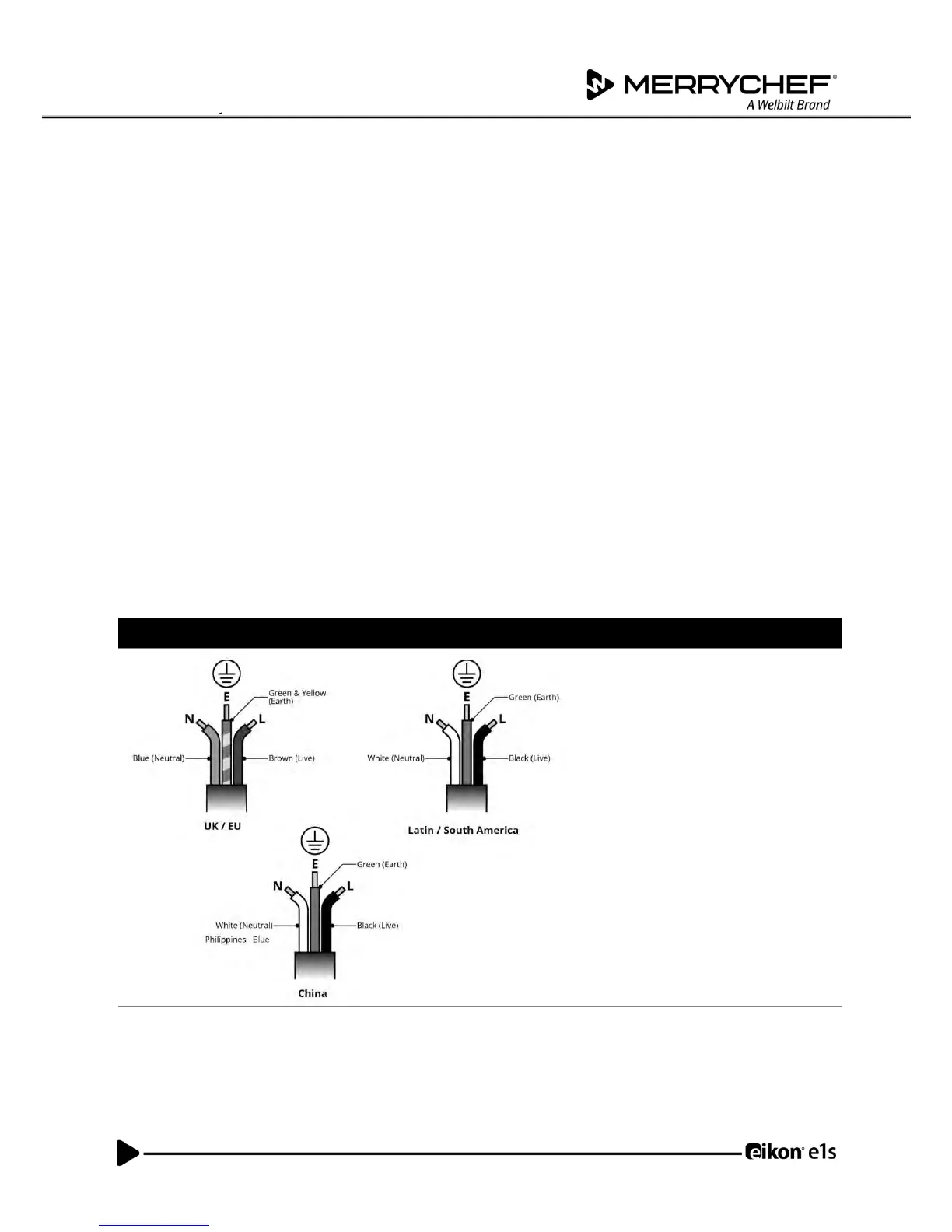
Electrical supply
• The e1s microwave combination oven is only available as a single-phase model and is designed to draw 13
amps maximum in all configurations, as shown in Table 2.2.
Phase: Single
16 A Breaker for 15/16 A plug
configurations and be Time Delay, Motor
Start Type (European Type D).
UK 13 A models are fitted with a
moulded plug to BS1363, fused at 13A.
EU13 A models are fitted with a
moulded plug to CEE 7/7 (Type F Schuko)
rated at 16 A.
ROW 13 A models are fitted with country
specific 15/16 A plugs.
Please contact your local Welbilt
representative for further information.


 To Next Page