MDS 05-2415A01, Rev. A GENERAL 1-3
software (such as PCPLUS™, PROCOMM™, PCTALK™, etc.). As a third alternative, any
terminal with an RS-232 serial port can also be used.
With one of these devices connected, the user can program the transmit and receive
frequencies, RTS/CTS delay time, PTT delay, soft carrier dekey, time-out-timer, loopback
code and the MDS-patented Squelch Tail Eliminator circuit. In addition, an internal message
field (up to 27 characters) can be entered to label each transceiver with its own identity.
Password security and several other functions are also programmable.
Diagnostic functions that can be measured through the diagnostic module include received
signal strength indication (RSSI), various critical voltage levels, internal temperature,
forward power, and antenna/feedline VSWR. When equipped with the remote maintenance
module and used in a system with an MDS 4100 Series Master Station, several of these
diagnostic measurements can be sent over-the-air back to the master station for display by the
associated PC diagnostic software.
The internal micro-controller also provides basic indication of operating parameters and
values. While not a substitute for calibrated test equipment, this is useful for quick field
evaluations.
SOFT CARIER DEKEY
This feature can be used to keep the transmitter keyed for a short period of time (typically up
to 5 ms) after the last data bit has been transmitted. This period of silence provides a clear
indication that the message has ended and helps ensure no errors are introduced into the data
stream as a result of the transmitter unkeying too soon. The soft carrier dekey feature can be
selected or modified by using the HHT.
CONTROL INPUTS AND OUTPUTS
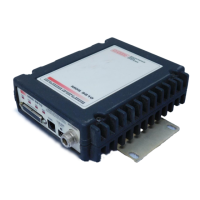
Four control inputs and outputs are provided on the MDS 4310 Data Transceiver’s 25-pin
“D” INTERFACE connector. They are:
1. Receiver Squelch. This output goes low when the receiver is squelched, and is
pulled high when the receiver squelch is open. When the squelch is open, this pin
supplies +8 Vdc through a 1 kΩ resistor.
2. Out-of-Lock Alarm. When this output is low (less than 0.5 Vdc), it indicates normal
operation. A logic high (greater than 4 Vdc) indicates a failure in the phase lock loop
signal source, or a transmitter time-out condition.
3. Received Signal Strength Indicator. This analog signal output supplies a received
signal strength indicator (RSSI) voltage on Pin 21 of the DB-25 connector. The RSSI
voltage is proportional to the strength of the signal present at the antenna connector,
and provides a useful indication of signal levels between –120 dBm and –60 dBm.
This can be especially helpful during installation to aid in aiming the station antenna
for maximum received signal strength.
4. Radio Disable. When this input on Pin 12 of the
INTERFACE connector senses a
ground, it disables or “turns off” most circuits in the radio, including transmit,
receive, modem and diagnostic functions. This reduces power consumption, yet
preserves the radio’s ability to be brought quickly online. Total current drain in the
disabled state is less than 14 mA.
The annunciator or LED indicator panel on the transceiver’s face shows the radio’s basic
performance without removing the housing cover. For transceivers without a built-in modem,
front-panel indicators are provided for primary power on, receive carrier detect, out-of-lock


 To Next Page