General Information Cha
ter Three: Overview
38
Set Point Signal
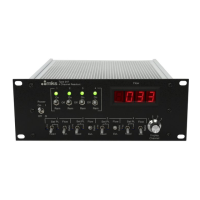
The set point circuitry operates independently of the flow circuitry. The source of the set point
signal is selected by the three position SET POINT SOURCE SWITCH on the front panel (refer
to Figure 7, page 39), as either FLOW, RATIO, or EXT. The FLOW and RATIO positions of
this switch are driven by the output of the SET POINT CONTROL; the EXT position is driven
by a externally applied voltage. Refer to
Set Point Source Switch
, page 40, for more information.
The set point signal can be generated by:
•
An internal +5 V reference
Use the internal reference to manually control individual gas flows based on
the 246 unit’s Set Point, or to ratio the gas flow from multiple 246 units to
the flow from a master 246 unit.
•
A voltage signal from an external controller
Use an external voltage signal to control individual gas flows, or to ratio the
gas flow from multiple 246 units, using the external signal for the master
unit and the Set Point Controls for the slave 246 units.
•
An externally applied voltage
The set point signal flows through a switch circuit, which is controlled by the front panel FLOW
CONTROL SWITCH or a TTL logic level on connector J9, and is applied to the MFC. When
the circuit is turned on, the set point signal is applied to the MFC and flow begins. The flow rate
is determined by the magnitude of the set point signal with +5 V corresponding to full flow.
When the switch circuit is turned off, the flow stops.



 To Next Page