NEOX User manual - Edition 03-2016 5
WHAT IS ASSISTED PEDALLING?
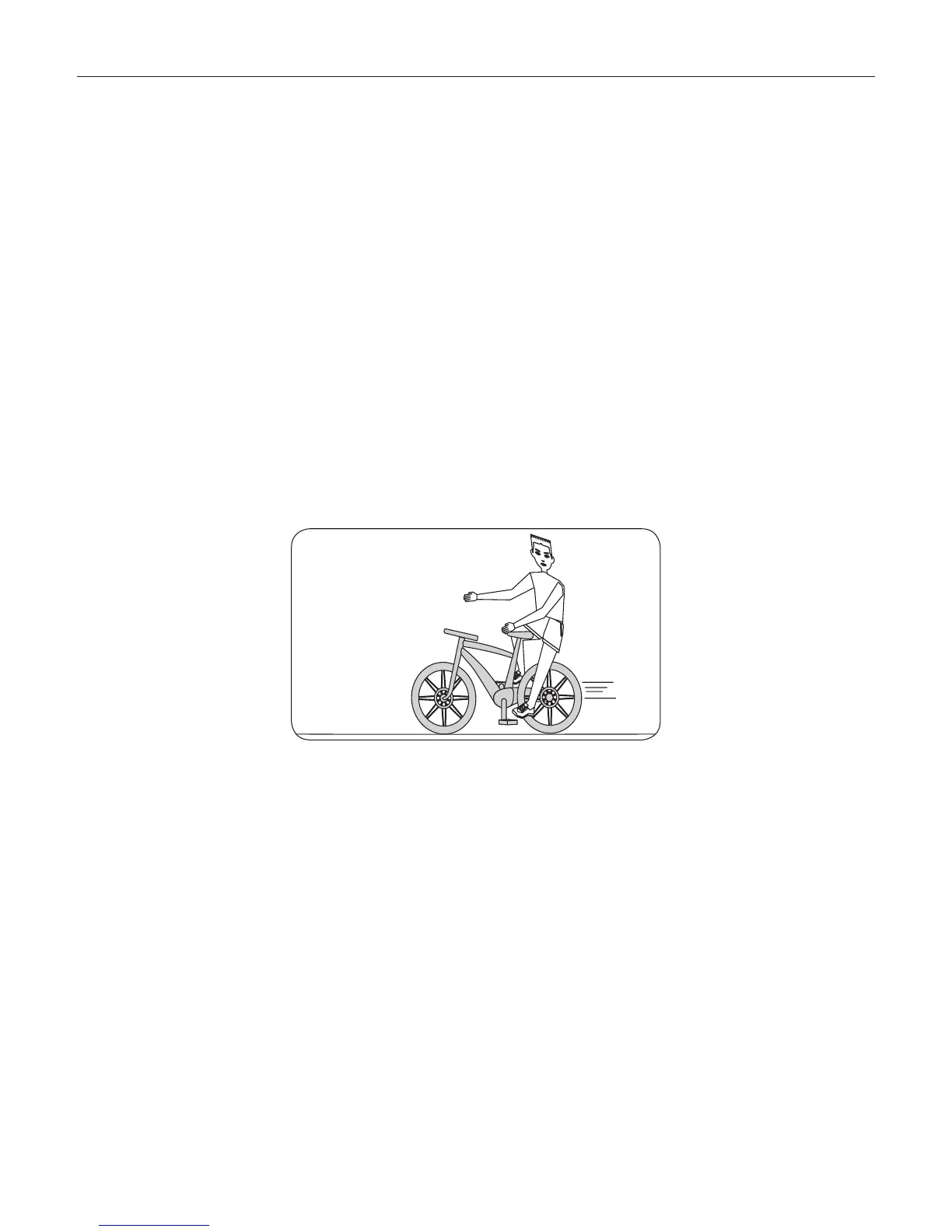
This bicycle is equipped with an electric assisted pedalling system. The motor assists
the eort made by the cyclist. To activate the assisted pedalling it is necessary to
begin pedalling and impart force on the pedal and, consequently, the torque sensor.
Conversely, if the rider does not pedal, the motor remains inactive. It is possible to
modulate the power of the assisted pedalling by selecting the most appropriate level
on the display.
Everything you need to know about assisted pedalling:
When the assisted pedalling is activated, starting use of the bicycle is dierent from
that of a normal bicycle. Setting o is easier and much more immediate. Therefore, be-
fore using this bicycle in trac, it is necessary to learn how to use it so as to avoid any
surprises when setting o.
When the bicycle is stopped, we recommend using the ECO assisted pedalling pro-
gram when setting o to avoid accidental falls.
When the assisted pedalling is switched o, the bicycle will require additional pedalling
strength. It is therefore possible to use it as a normal bicycle, even when the battery is
low, provided it is switched on, as Neox is equipped with electronic gears.
By law, assisted pedalling should not exceed a speed of 25 km/h and, therefore, once 23
km/h has been reached, the assisted pedalling decreases gradually before completely
turning o at 25 km/h.
The range of the bicycle depends on the user, the circumstances and the type of
route. The main factors that may aect the operating range are: the weight of the
rider, the cruising speed, the slope of the route, the tyre pressure, the wind direction,
the number of gear changes and braking (in the city) and the outside temperature.
Very low temperatures adversely aect the operating range. It is important to take
this into account.



 To Next Page