The travelling autonomy of the bicycle with the aid of the assisted pedalling PAS, can
vary depending on the dierent conditions of use and the dierent weights being
transported, up to a maximum of 80/100 Km (ECO and NO ASSIST cycle) according to
the model.
For example, a prolonged climb with a gradient of more than 7%, with transported
weight of 100 kg will drastically reduce the autonomy to even 20/25 Km. The electric
motor will absorb more power with increased weight and when climbing hills, riding
against the wind and repetitive stopping and changing gear, thereby reducing the dis-
tances that can normally be travelled.
To increase the autonomy, do not use the assisted pedalling on flat or downhill stretch-
es of road.
IMPORTANT NOTE: The pedal assisted cycle requires “joyous and fluid” and not “hard
and strangled” pedalling. Pedalling quickly, over 70/80 revolutions per minute and with
an appropriate gear ratio, allows the motor to work at maximum eciency and with
minimum power consumption for the same torque delivered.
If the cyclist is skilled at making the motor operate at maximum eciency, this drasti-
cally lowers the electric energy absorption and consequently optimises consumption.
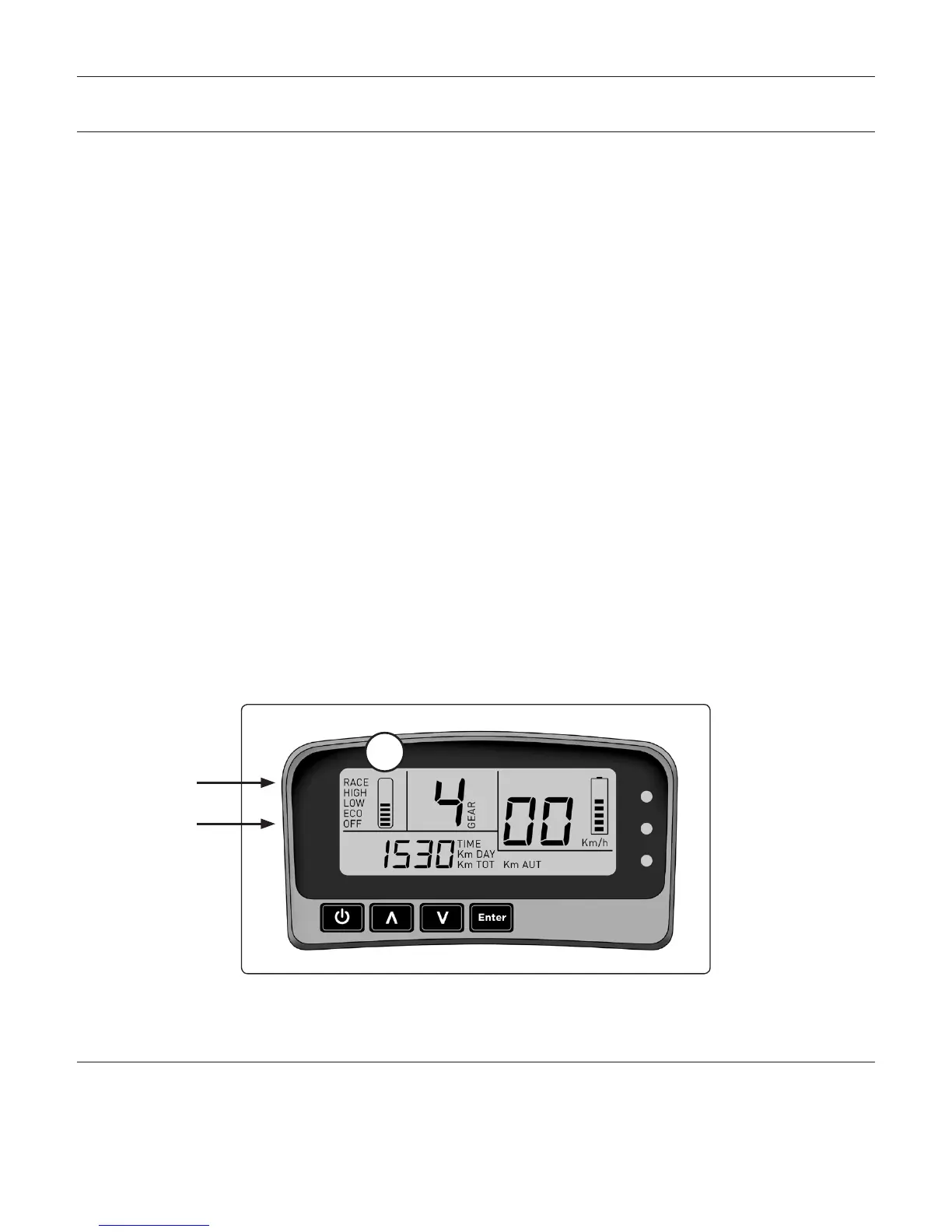
The power consumption level is highlighted on the display. Being able to pedal in such
a way that keeps this string low, leads to optimized and lower consumption.
• The rider must be able to ride a bicycle, i.e. they must have a basic knowledge of using
bicycles with the necessary sense of balance to ride and control a bicycle.
• The rider, from a stationary position, should be able to get on and o safely and must
be able to touch the ground with their feet.
+
-
1



 To Next Page