6000 Vortex Series Principles of Operation • 49
Principles of Operation
Overview
Traditional diode-laser technology provides high reliability, high
electrical efficiency, and a wide range of available wavelengths in a
compact package. By using an external cavity built around a diode
laser, the Vortex enhances the performance of off-the-shelf diode
lasers, guaranteeing single-mode operation with narrow linewidth and
precise wavelength tuning. The short-term linewidth of the Vortex
laser is <300 kHz (over a 50-msec time interval), compared with typical
linewidths for Fabry-Perot diode lasers of 10–500 MHz.
General Theory
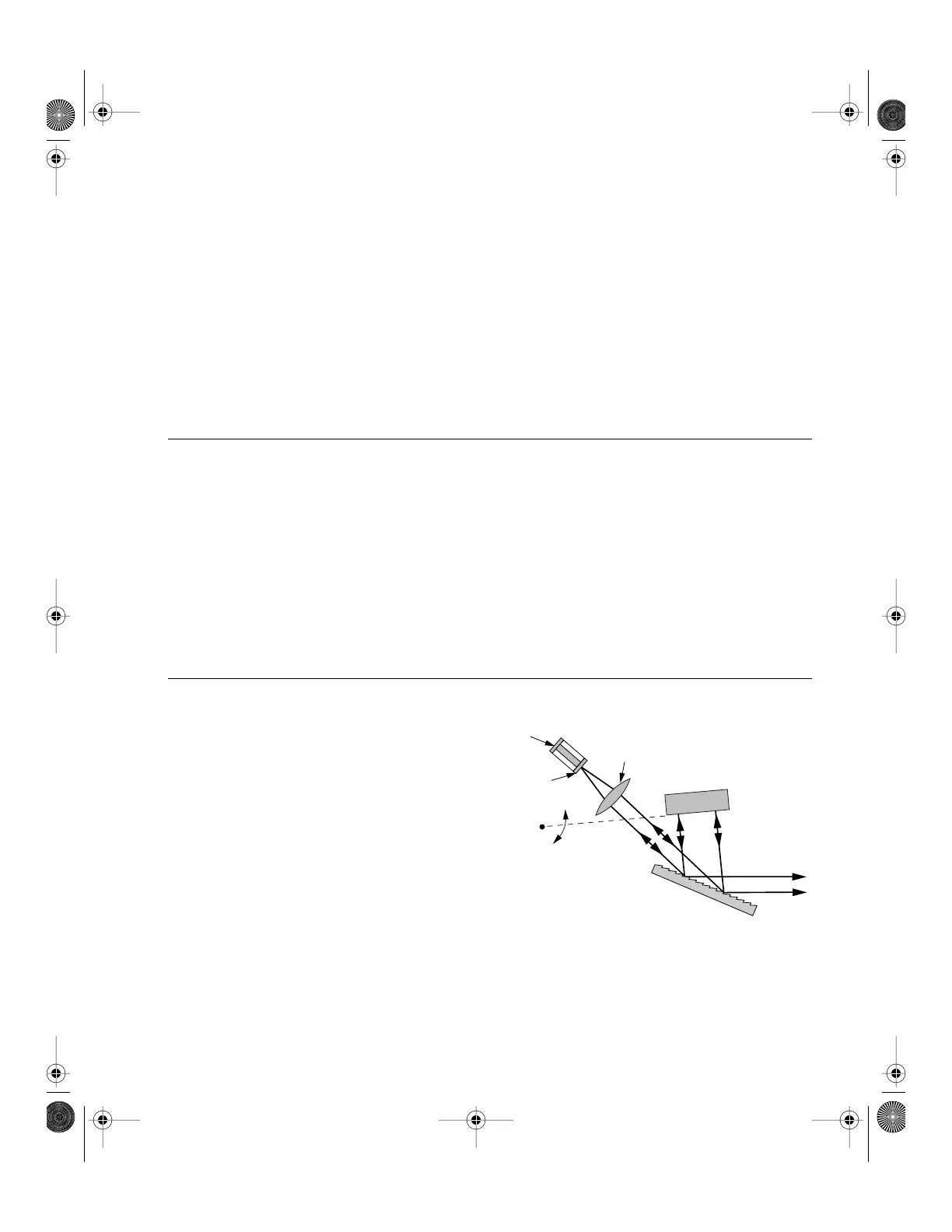
The Vortex laser cavity is
based on the Littman-
Metcalf design (see refs.
on page 51), which uses a
diffraction grating at
grazing incidence to
provide wavelength
selectivity. Essential to
the performance of
tunable external-cavity
diode lasers (ECDLs) is a high-quality anti-reflection (AR) coating on
the front facet of the diode. The AR coating turns the diode into purely
a gain element. A collimating lens directs the output of the diode across
a diffraction grating at grazing incidence. The end mirror of the laser
cavity reflects the first-order diffraction off the grating to provide
Pivot
Point
Laser Diode
Chip
HR
Coating
AR
Coating
Collimating Lens
Retroreflector
Diffraction
Grating
Laser
Output
Wavelength
Tuning
Littman-Metcalf Laser Cavity
Vortex6000.book Page 49 Tuesday, February 19, 2002 3:25 PM
Artisan Technology Group - Quality Instrumentation ... Guaranteed | (888) 88-SOURCE | www.artisantg.com


 To Next Page