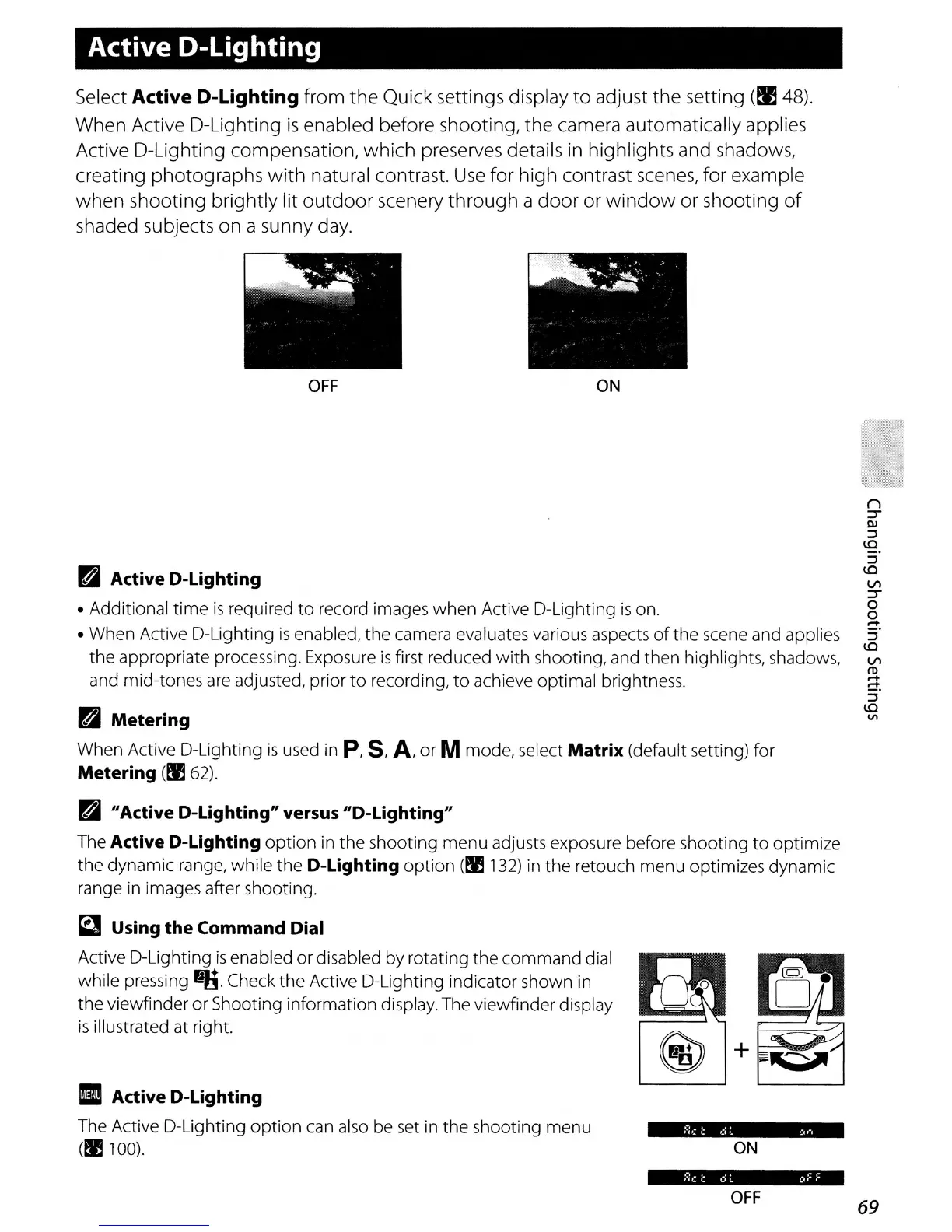
Active D-lighting
Select Active D-Lighting from
the
Quick settings display
to
adjust the setting
(~48).
When Active D-Lighting
is
enabled before shooting, the camera automatically applies
Active D-Lighting compensation, which preserves details in highlights and shadows,
creating photographs with natural contrast.
Use
for high contrast
scenes,
for example
when shooting brightly lit
outdoor
scenery through a door or
window
or shooting
of
shaded subjects on a sunny day.
OFF
ON
n
::J
QJ
::J
lO
::J
lO
V\
::J
o
o
~
.
::J
lO
V\
ro
....
~.
::J
lO
'"
ON
:=:.;!:
.;::.
0'·'
11II
Active D-Lighting
The Active D-Lighting
option
can also be set in
the
shooting menu
(~
100).
ml
Active D-Lighting
• Additional time
is
required
to
record images when Active D-Lighting
is
on.
• When Active D-Lighting
is
enabled, the camera evaluates various aspects
ofthe
scene and applies
the appropriate processing. Exposure
is
first reduced
with
shooting, and then highlights, shadows,
and mid-tones
are
adjusted, prior
to
recording,
to
achieve optimal brightness.
ml
Metering
When Active D-Lighting
is
used
in
P,
S,
A,
or M mode, select Matrix (default setting) for
Metering
(~62).
ml
"Active D-Lighting" versus "D-Lighting"
The Active D-Lighting
option
in
the
shooting menu adjusts exposure before shooting
to
optimize
the
dynamic range, while the D-Lighting
option
(!Il132)
in
the
retouch menu optimizes dynamic
range
in
images after shooting.
a Using
the
Command Dial
Active D-Lighting
is
enabled or disabled by rotating
the
command dial
while pressing
flIri.
Check
the
Active D-Lighting indicator shown in
the viewfinder or Shooting information display. The viewfinder display
is
illustrated at right.
OFF
69



 To Next Page