IV Microscopy (Detailed Procedure)
23
IV
The settings of each part in orthoscopic microscopy and conoscopic microscopy are
summarized below.
Orthoscopic Observation Conoscopic Observation
Purpose of
observation
To investigate the vibration direction
and birefringence of observation
light by observing the extinction and
interference color due to the
specimen.
To distinguish between uniaxial
and biaxial properties and
observe the optic-axial angle
and optical characteristics in
minerals.
10x or
higher
IN
Top lens of the
condenser
4x or
lower
OUT
IN
Bertrand lens OUT (Turret position: O) IN (Turret position: B)
10x or
higher
70 - 80% of the
numerical aperture
of the objective
Aperture
diaphragm
4x or
lower
Fully opened
Circumscribed the
circumference of the
conoscopic viewfield (or fully
opened)
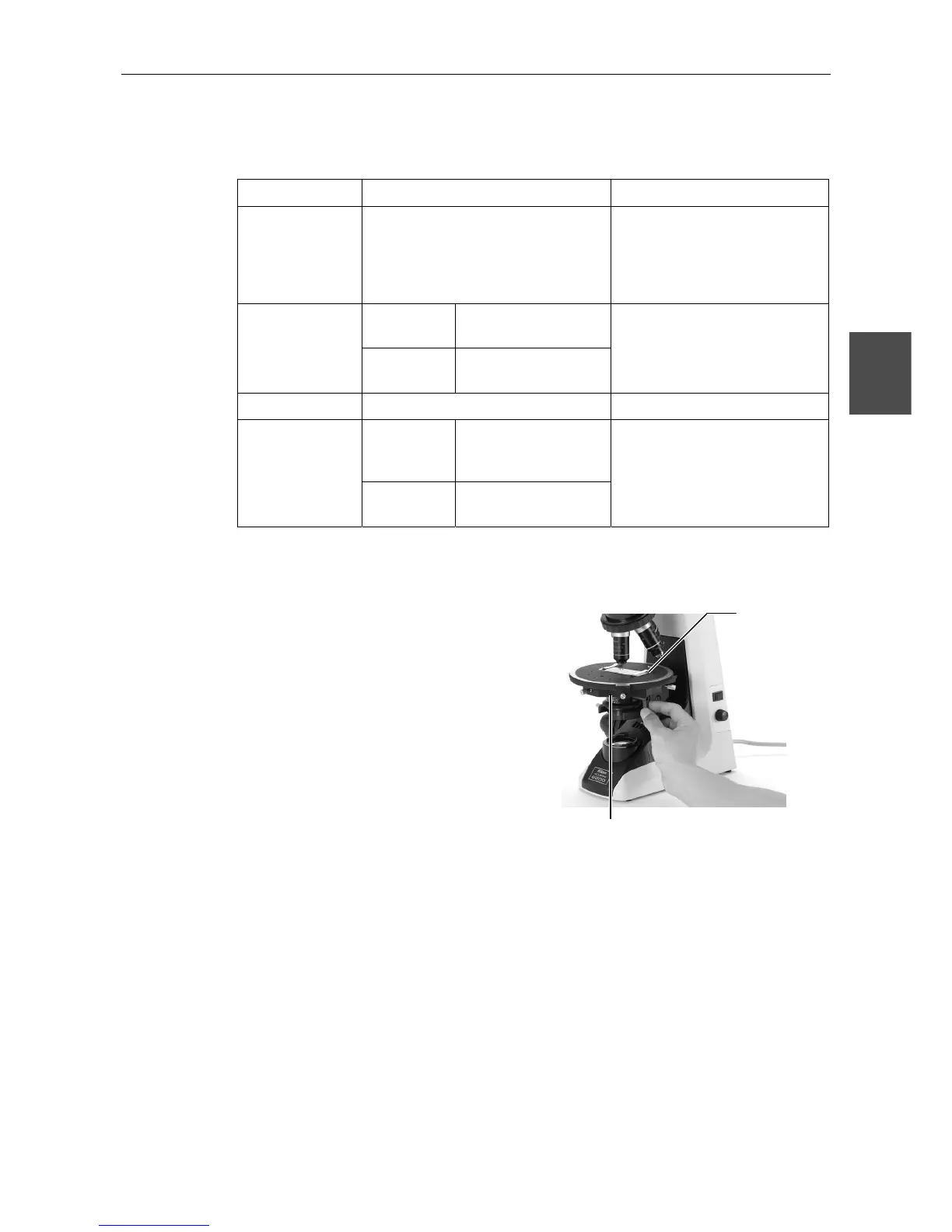
Swing-Out the Top Lens of the Condenser
9
The top lens of the swing-out condenser can be
moved outside the optical path with the swing-out
knob.
During normal orthoscopic microscopy or
conoscopic microscopy, the top lens is used while
positioned in the optical path. During orthoscopic
microscopy using a low-power objective of 4x or
lower, swing out the top lens.
During measurement of retardation or evaluation
by interference color, swing out the top lens (the
condenser aperture diaphragm may be stopped
down) and illuminate with light that is as parallel to
the optical axis as possible.
10
Filters
Filters of φ45mm can be placed on the top of the field lens.






 To Next Page