4
MULTIPLE I/O TERMINAL Section 1-1
1-1-4 Communications Units and I/O Units
Communications Unit The Communications Unit interfaces the I/O Units to the DeviceNet.
• It controls the I/O Units in response to I/O refresh requests from the
DeviceNet Master.
• It automatically recognizes the configuration of the I/O Units when the I/O
Unit interface is initialized.
• It notifies the connection status or the status information for the I/O Units
to the DeviceNet Master Unit.
• It provides a DIP switch to set the node number and baud rate of the
MULTIPLE I/O TERMINAL as a DeviceNet Slave.
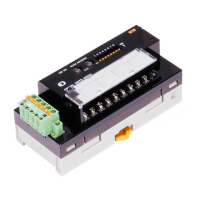
I/O Units There are various I/O Units that can be connected to the I/O Unit interface.
• I/O Units are connected to the Communications Unit using an I/O Unit
Connecting Cable (included with the I/O Unit, a 1-m I/O Unit Connecting
Cable (GCN1-100) is also available).
• No address or baud rate settings are required.
• The connection order of I/O Units is flexible.
I/O Unit interface
Output area
(Master → Commu-
nications Unit)
Input area
(Communications
Unit → Master)
0
Example:
Outputs
DeviceNet Master Unit
DeviceNet Network
0
1
Status
2
1
Example:
Outputs
2
Example:
Inputs
Units with Connectors
Transistor Input Unit
Transistor Output Unit
Relay Output Unit
End connector
I/O Unit Connecting Cables
Included with Unit: 40 mm
GCN1-100: 1 m (sold separately)
Units with Terminal Blocks
Transistor Input Unit
Transistor Output Unit
Units with High-density
Connectors
Transistor Input Unit
Transistor Output Unit
Analog Input Unit
Analog Output Unit
Communications Unit



 To Next Page