2
PROTECTIVE SAFETY FOOTWEAR USER INFORMATION
It is necessary you read and apply the following information, to guarantee the best possible protection and comfort when wearing this product
.
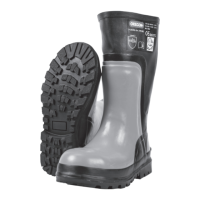
1. Chainsaw rubber safety boots YUKON ref #: 295385
2. Safety footwear meets the requirements of the Personal Protective Equipment EU REGULATION 2016/425 (solidity, safety, innocuousness,
comfort), as well as standards EN ISO 20345:2011 (Personal protective equipment. Safety footwear) and EN ISO 17249:2013 (Safety
footwear with resistance to chain saw cutting).
This PPE is certied by CTC - 4, rue Hermann Frenkel - 69367 Lyon Cedex 07 – France
This PPE is submitted to an EC quality guarantee system of the production with supervision (module C2). The supervision is entrusted by
CTC - 4, rue Hermann Frenkel - 69367 Lyon Cedex 07 – France (NB0075)
This safety footwear is equipped with protection against cutting by hand-held chain saws, Level 3.
Safety footwear is tted with toecap which must withstand at least 200 J impact and 15 kN compression.
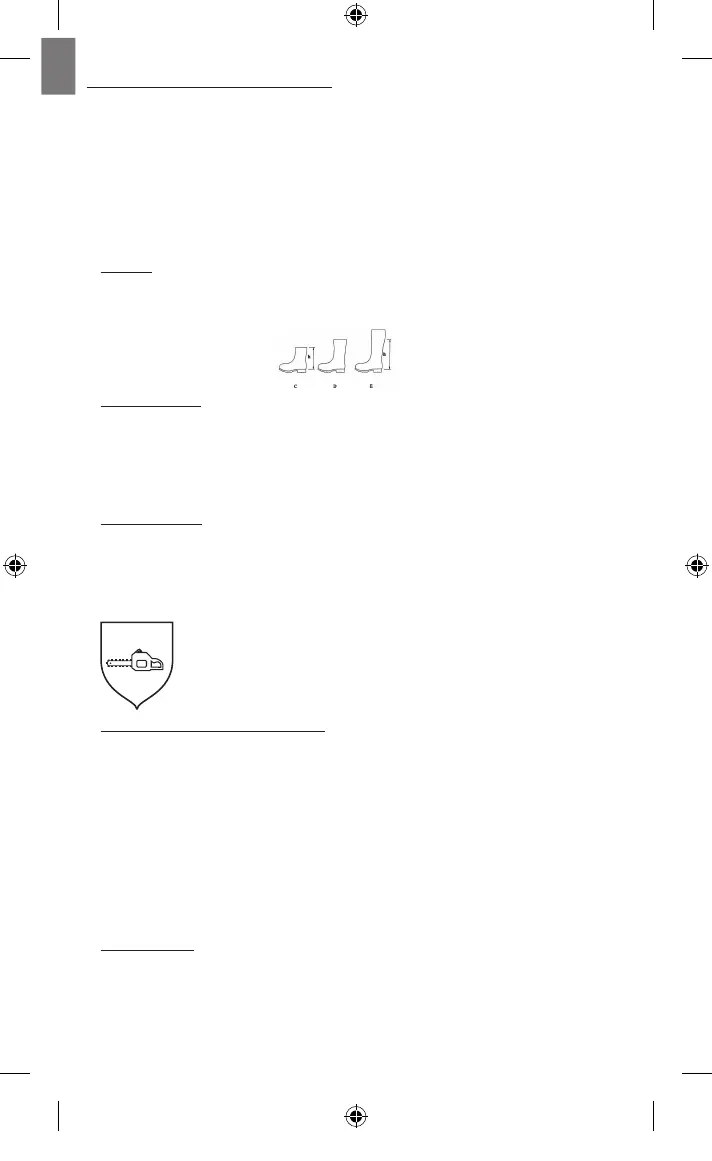
3. Classication
This footwear is of Classication II by material and D by design.
I Footwear made from leather and other materials (excluding all-rubber or all-polymeric footwear)
II All-rubber (i.e. entirely vulcanized) or all-polymeric (i.e. entirely moulded) footwear
Design
C Half-knee boot
D Knee-height boot
E Thigh boot
4. APPLICABLE STANDARDS
This safety footwear has been tested and complies with the following standards, for the types of protection dened on the product, by
markings explained below. However, always ensure that the footwear is suitable for the intended use.
Also, carefully read all safety instructions of your chain saw.
EN ISO 20345:2011 Personal protective equipment. Safety footwear
EN ISO 17249:2013 Safety footwear with resistance to chain saw cutting
SB Basic requirements
5. ADDITIONAL STANDARDS
E Energy absorption of heel area ≥ 20 J
SRA Resistance to slip on tiling oor (solution NaLS)
Markings for safety footwear with resistance to chain saw cutting
Protection against chain saw cutting – Pictogram
Level of protection Chain speed (m/s)
Level 1 20
Level 2 24
Level 3 28
6. WARNING! PROTECTION AGAINST CHAIN SAW CUTTING: No personal protective equipment can provide 100% protection against cuts
caused by a hand held chain saw because, under laboratory conditions, resistance against cutting of chain saw is only required for the
front of the shoe (tongue and toecap) and, even in these areas, cut injuries are possible. Nevertheless, experience has shown that it is
possible to design a protective equipment that oers a specic level of protection.
Protection can be achieved by using several operating principles such as:
- The sliding of the chain at the contact, so that the chain does not cut the material;
- Filling: bres are driven by the chain towards the pinion and block the movement of the chain;
- The braking of the chain: the bres have a great resistance to the cutting and absorb the kinetic energy, slowing down the speed of the
chain.
Many of these principles are often applied simultaneously.
Three levels of performance are available, corresponding to several levels of resistance of the chain saw.
It is recommended to choose the shoes according to the speed of the chain saw.
It is important that the pants and shoe protective material overlap. Safety shoes should always be used with socks.
7. INSTRUCTIONS FOR USE
Test to be performed by the user before wearing the shoe
Safety footwear resistant to chain saw cuts should be assessed regularly, but at least before each use, by inspection, and should be
replaced if any of the signs of deterioration identied below is established. Some of these criteria may vary depending on the type of
shoes and materials used.
- Beginning of pronounced and deep crack aecting half of the upper material thickness (Figure A.1 a)
- Strong abrasion of the constituent material of the upper, particularly if the toe-cap becomes visible (Figure A.1 b)
- The upper shows areas with deformations, burns, fusions or bubbles or split seams or damage caused by contact, e.g. with the
chainsaw (Figure A.1 c)
- The outsole shows cracks, higher than 10 mm long and 3 mm deep (Figure A.1 d) Separation of the upper and sole, over 10 to 15 mm
in length and 5 mm in width (depth)
- Stud height in the exing area lower than 1.5 mm (Figure A.1 e)
- Original insole (if any) showing pronounced deformation and crushing
- The fastening system is in working order (zip, laces, eyelets, touch and close system)
It is convenient to check manually the inside of the footwear from time to time, aiming at detecting destruction of lining or sharp borders
of the toe protection which could cause wounds (Figure A.1 f)
8. COMPATIBILITY
To optimize protection, in some instances it may be necessary to use this footwear with additional PPE such as protective trousers or
over gaiters. In this case, before carrying out the risk-related activity, consult your supplier to ensure that all your protective products
are compatible and suitable for your application. It is important that the selected footwear for wear must be suitable for the required
protection in the working environment concerned. When the working environment is unknown, it is very important that consultation is
carried out between the seller and the purchaser to ensure, wherever possible, that the correct footwear is provided.
9. FITTING AND SIZING
To put on and take o the footwear, always fully undo the fastening systems. Only wear footwear of suitable size. Product which is either
too loose or too tight will restrict movement and will not provide the optimum level of protection. The size of this product is printing
inside the boot.
10. CLEANING
To assure a longest life of the footwear, it is important to wash with warm water regularly. Do not use any strong washing detergent or
caustic cleaning agents which can limit the life of the boot. Footwear subjected to wet conditions should be allowed to dry naturally in a
cool and dry environment. Force drying can cause deterioration of the upper and lining materials.
11. DAMAGE AND REPAIR
Avoid damaging this safety product with pointed or sharp objects (e.g. saw chain, spikes, metal tools etc.) or contact with aggressive
uids such as acids, oil, solvents, fuel etc. Warning! If you spill fuel, oil, grease or any other ammable substance on your boots, stop work
immediately and clean the boots as specied in order to reduce the risk of re. If the footwear becomes damaged, it will NOT provide the
optimum level of protection, and therefore should be disposed of and replaced with new footwear as soon as possible. Never knowingly
wear damaged footwear while carrying out a risk related activity. If in doubt about the level of damage, consult your supplier before
using the footwear.
12. STORAGE AND TRANSPORT
When not in use, store the footwear in a well-ventilated area away from extremes of temperature. Never store the footwear underneath
heavy items or in contact with sharp objects. If the footwear is wet, allow it to dry slowly and naturally away from direct heat sources
before placing it into storage. Use suitable protective packaging to transport the footwear.
13. LIFETIME
The lifetime of the footwear will depend on how and where it is worn, suitability for the intended working environment, damages
caused, as well as how it is cared for. It is therefore very important that you carefully examine the footwear before use and replace as
soon as it appears to be unt for wear. The lifetime of the footwear is 3 years from the date of manufacture if the product is properly worn
and cared for (see internal stamp)
14. SIZE RANGE: 37 to 48
EU CONFORMITY DECLARATION can be found at the following internet address: http://www.oregonproducts.eu/doc/
Further information may be obtained from: Oregon Tool Europe S.A / Rue Emile Francqui, 5 / B-1435 Mont-Saint-Guibert / BELGIUM
PRE-USE INSPECTION
WARNING
Do not wear the footwear if t he signs of wear identified below are found:
1. Beginning of pronounced and deep cracking affecting half of the upper material thickness (Figure a)
2. Strong abrasion of the upper material, especially if t he toepuff or the toecap is revealed (Figure b).
3. The upper shows areas with deformations, burns, fusions or bubbles, or split seams in t he leg (Figure
c).
4. The outsole shows c racks higher than 10 mm long and 3 mm deep (Figure d).
5. Upper/sole separation of more than 10 mm-15 mm long and 5 mm wide (deep).
6. Cleat height in the f lexing area lower than 1.5 mm (Figure e).
7. Original insock (if any) showing pronounced deformation and crushing
8. It is convenient to c heck manually the ins ide of the footwear from time to time, aiming at detecting
destruction of the lining or sharp borders of the toe protection which could cause wounds (F igure f)
9. The fastening system is in working order (zip, laces, eyelets, touch and close system).
10. The obsolescence deadline should not be exceeded.
11. The footwear durability depends on the level of use and remarks made above (it is remember ed that
the date of obsolescence of footwear containing polyurethan e is 3 years).
Figure a
Figure b
Figure c
Figure d
Figure e Figure f
(Sign of Wears)
Level 3
Boots_Rubber_295385_[MAN].indd 2Boots_Rubber_295385_[MAN].indd 2 2/11/21 15:022/11/21 15:02


 To Next Page
 Loading...