18
Surround Sound Systems
Stereo reproduction normally uses left and right speakers, but Digital Theater System and Pro Logic Surround
go further, adding a centre and other channels so you are immersed in sound and special effects.
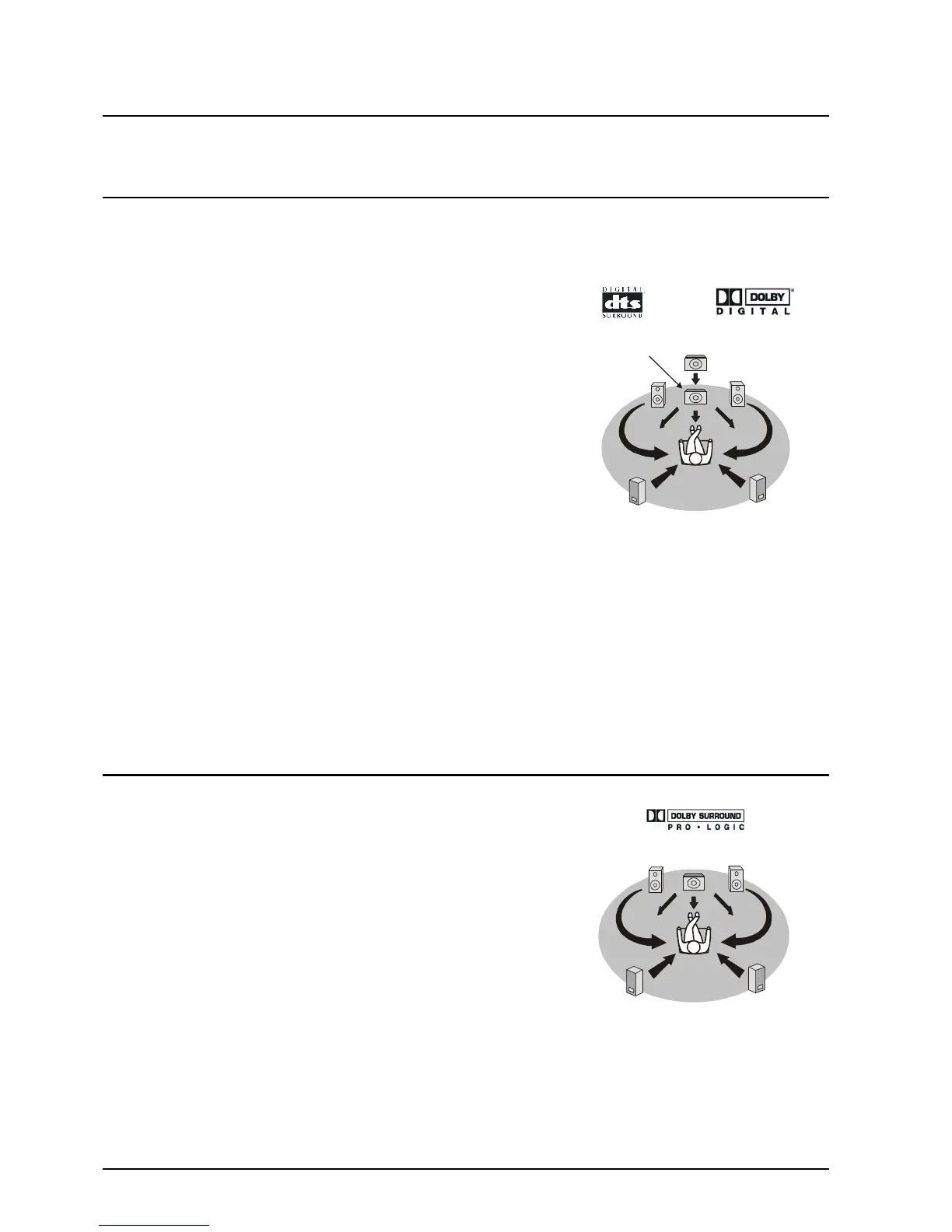
Digital Theater Systems (DTS) I Dolby Digital
Both DTS and Dolby Digital split soundtrack information into 6
separate channels of sound which are output through the speaker
setup: five full range channels (left, center, right, left surround,
right surround) and a ‘0.1’ (i.e.: limited range) bass channel. This
gives you superb sound quality from DTS / Dolby Digital encoded
tracks when a compatible speaker system is connected to your
TV. Most dialogue comes from the centre channel, which enhances
dialogue and focuses it so it seems to come from the action on
screen. The separate rear left and right channels give a dramatic
sense of space, with sounds travelling in all directions between
front, centre and rear channel speakers (e.g.: a rocket going
overhead starts behind you to the left and explodes in front of you
to the right). The ‘0.1’ Low Frequency Effects (LFE) channel gives
impact to bass sounds and to special effects more felt than heard
(e.g.: the thud of a dinosaur footfall or the rumble of thunder). While
DTS and Dolby, Digital are both high quality, ‘5.1’ channel surround
systems, the two systems differ in how they break down and store
sound information They also differ in how they work with existing
speaker setups. Dolby Digital has been designed to be backwardly
compatible with Dolby Pro Logic and conventional stereo setups.
DTS on the other hand, focuses on the high quality, 5.1 channel
surround output choosing not to develop backward compatibility
with existing sound systems.
Note:
External equipment is usually connected to the TV via one of the AV terminals to provide pictures and sound
(e.g. a VCR player connected to AV2). To receive a DTS or Dolby Digital encoded soundtrack from compatible
equipment (e.g.: a DVD player, a set top box) you will also need to connect an optical or coaxial cable to one of
the TV’s digital audio sockets. See page 42 for connection details. Also see the Digital Audio option in the
SOUND menu, page 16.
Dolby Pro Logic
Dolby Pro Logic surround uses four channels of sound: left, right,
centre and a rear channel giving excellent reproduction of Pro Logic
encoded tracks when a compatible speaker system is connected
to your TV. Most dialogue comes from the centre channel, which
enhances dialogue and focuses it so it seems to come from the
action on screen. The rear channel is used to immerse you in
atmosphere and special effects, the same output is sent to both
rear speakers.
As with Dolby Digital, Pro Logic is backwardly compatible with a
conventional stereo speaker setup.
Note:
To get Pro Logic information from Pro Logic encoded TV programmes; you must be able to receive stereo
transmissions. If stereo transmissions are not transmitted in your area then the Pro Logic information will not be
present on TV transmissions and Pro Logic decoding will only produce a centre channel output.
Surround Sound Operation (TX-76PW10A only)
Left
Speaker
Front
Centre
Speaker
Subwoofer /
LFE Speaker
Right
Speaker
Front
Left
Surround
Speaker
Rear
Right
Surround
Speaker
Rear
DTS/Dolby Digital setup
Left
Speaker
Front
Centre
Speaker
Right
Speaker
Front
Left
Surround
Speaker
Rear
Right
Surround
Speaker
Rear
Dolby Pro Logic setup




 To Next Page