Peak Atlas DCA Pro User Guide June 2019 – Rev 1.7
Page 18
Darlington Transistors
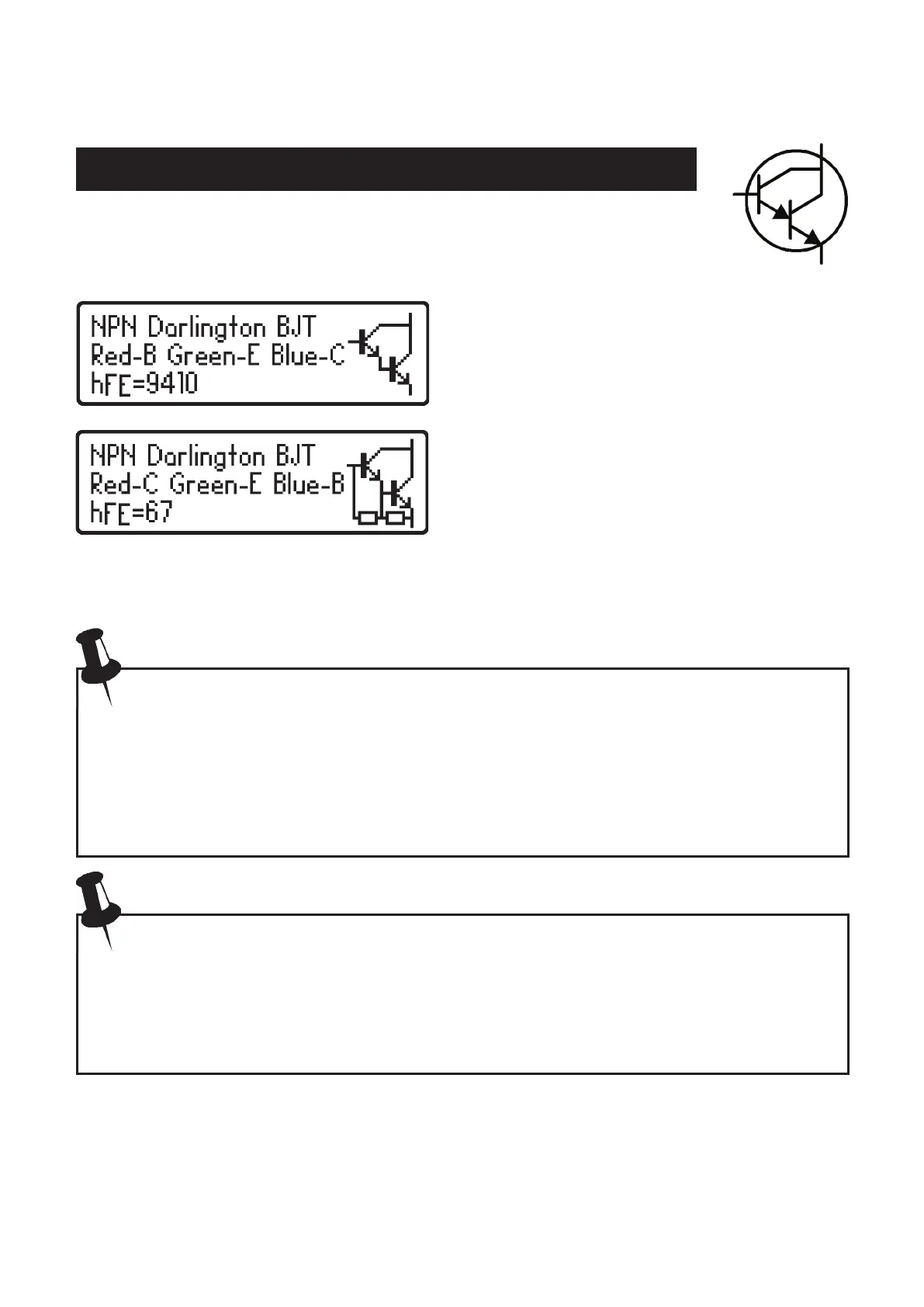
If the device is a Darlington transistor (two BJTs connected
together), the unit will display a similar message to this:
Darlington devices that do not have
internal resistors can exhibit very high
gain (h
FE
).
This second example (left) shows the
display for a Darlington transistor that
has internal resistors connected to the
base-emitter connections. This causes
the h
FE
measurement to become much
lower at the test currents used by the DCA Pro. This is normal and is not a fault
with the transistor or the DCA Pro.
It is important to note that if a Darlington does contain a base-emitter
shunt resistor network, any measurements of current gain (h
. This is due to the
resistors providing an additional path for the base current. The readings
for gain however can still be used for comparing transistors of a similar
type for the purposes of matching or gain band selecting.
will determine that the transistor under test is a
Darlington type if the base-emitter voltage drop at 5mA is greater than
1.00V for devices with a base-emitter shunt resistance of greater than
60kΩ or if the base-emitter voltage drop is greater than 0.80V for
devices with a base-emitter shunt resistance of less than 60kΩ.


 To Next Page