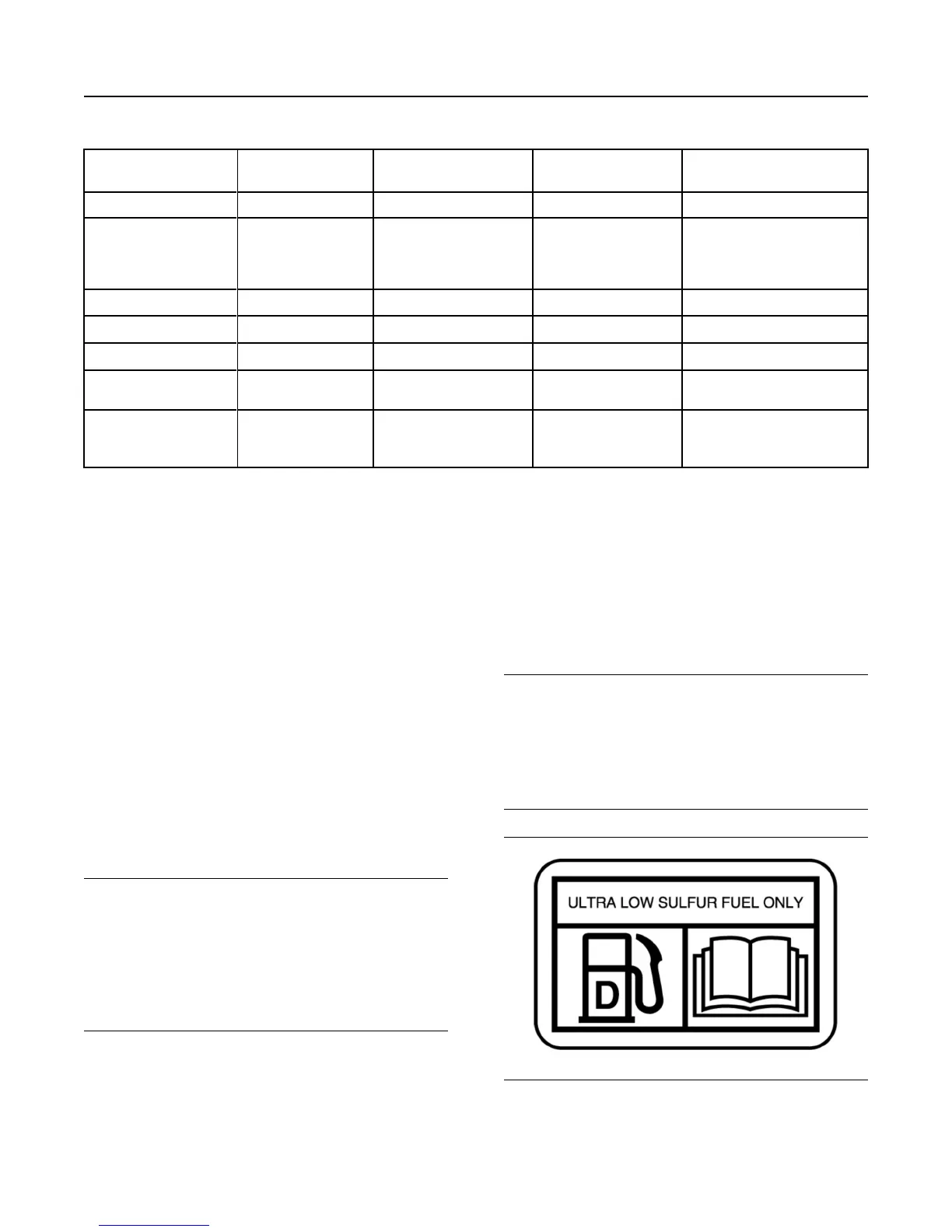
(Table 23, contd)
Pour Point °C 6 °C (42.8 °F) minimum be-
low ambient temperature
D97 ISO3016
Sulfur
(1)
%mass 0.0015 D5453/D26222 ISO 20846ISO 20884
Kinematic Viscosity
(4)
mm
2
/s (cSt) The viscosity of the fuel that
is delivered to the fuel injec-
tion pump. “1.4 minimum/
4.5 maximum”
D445 ISO3405
Water and sediment % weight 0.1% maximum D1796 ISO3734
Water % weight 0.1% maximum D1744 No equivalent test
Sediment % weight 0.05% maximum D473 ISO3735
Gums and Resins
(5)
mg/100mL 10 mg per 100 mL
maximum
D381 ISO6246
Lubricity corrected wear
scar diameter at 60 °C
(140 °F).
(6)
mm
0.52 maximum D6079 ISO12156-1
(1)
This specification includes the requirements for Ultra Low Sulfur Diesel (ULSD). ULSD fuel will have ≤ 15 ppm (0.0015%) sulfur. Refer to
ASTM D5453, ASTM D2622, or ISO 20846, ISO 20884 test methods.
(2)
A fuel with a higher cetane number is recommended in order to operate at a higher altitude or in cold weather.
(3)
“Via standards tables, the equivalent API gravity for the minimum density of 801 kg / m
3
(kilograms per cubic meter) is 45 and for the maximum
density of 876 kg / m
3
is 30”.
(4)
The values of the fuel viscosity are the values as the fuel is delivered to the fuel injection pumps. Fuel should also meet the minimum viscosity
requirement and the fuel should meet the maximum viscosity requirements at 40 °C (104 °F) of either the ASTM D445 test method or the ISO
3104 test method. If a fuel with a low viscosity is used, cooling of the fuel may be required to maintain “1.4 cSt”or greater viscosity at the fuel in-
jection pump. Fuels with a high viscosity might require fuel heaters in order to lower the viscosity to “1.4 cSt” at the fuel injection pump.
(5)
Follow the test conditions and procedures for gasoline (motor).
(6)
The lubricity of a fuel is a concern with ultra low sulfur fuel. To determine the lubricity of the fuel, use the ISO 12156-1 or ASTM D6079 High
Frequency Reciprocating Rig (HFRR) test. If the lubricity of a fuel does not meet the minimum requirements, consult your fuel supplier. Do not
treat the fuel without consulting the fuel supplier. Some additives are not compatible. These additives can cause problems in the fuel system.
Engines that are manufactured by Perkins are
certified with the fuel that is prescribed by the United
States Environmental Protection Agency . Engines
that are manufactured by Perkins are certified with
the fuel that is prescribed by the European
Certification. Perkins does not certify diesel engines
on any other fuel.
Note: The owner and the operator of the engine has
the responsibility of using the fuel that is prescribed
by the EPA and other appropriate regulatory
agencies.
NOTICE
Operating with fuels that do not meet the Perkins rec-
ommendations can cause the following effects: Start-
ing difficulty, reduced fuel filter service life, poor
combustion, deposits in the fuel injectors, significantly
reduce service life of the fuel system, deposits in the
combustion chamber and reduced service life of the
engine.
NOTICE
The Perkins 1200 series of diesel engine must be op-
erated using Ultra Low Sulfur Diesel. The sulphur
content of this fuel must be lower than 15 PPM. This
fuel complies with the emissions regulations that are
prescribed by the Environmental Protection Agency
of the United States.
Illustration 58 g02157153
Illustration 58 is a representation of the label that will
be installed next to the fuel filler cap on the fuel tank
of the application.
SEBU8732 83
Refill Capacities
Fluid Recommendations





 To Next Page