126 KENR9126
Troubleshooting Section
•
Not OK – The resistance is more than ten Ohms.
There is an open
circuit or excessive resistance in
the circuit. There may be a problem in a connector.
Repair: Repai
r the wiring and/or the connector.
Replace part, if necessary. Verify that the problem
is resolved.
STOP.
Test Step 5.
Check the Mini Marine Power
Display
A. Connect the mini marine power display to another
engine.
B. Operate the engine and monitor the mini marine
power disp
lay.
Expected Result:
The mini marine power display operates properly.
Results:
•
OK – The mini marine power display operates
properl
y on another engine.
Repair: Connect the display to the original engine.
If the di
splayoperatescorrectly,theremaybe
a problem with an electrical connector. Refer to
the diagnostic functional test Troubleshooting,
“Elect
rical Connectors - Inspect”.
If the display does not operate correctly on the
origi
nal engine, there may be a problem with the
ECM.
If the
display does not operate correctly, replace
the ECM. Refer to electronic troubleshooting
Troubleshooting, “Replacing the ECM”.
STOP.
•
Not O
K – The mini marine power display does not
operate properly on another engine.
Repa
ir: Replace the mini marine power display.
Verify that the problem is resolved.
STO
P.
i04010976
Coolant Leve l Sen sor Circuit
- Test
System Opera
tion Description:
Use this procedure to troubleshoot any suspect
problems wi
th the coolant level sensor.
The coolant level sensor monitors the engine coolant
level in ord
er to warn the operator in the event that
the coolant level is low. The coolant level sensor is
located on the side of the expansion tank.
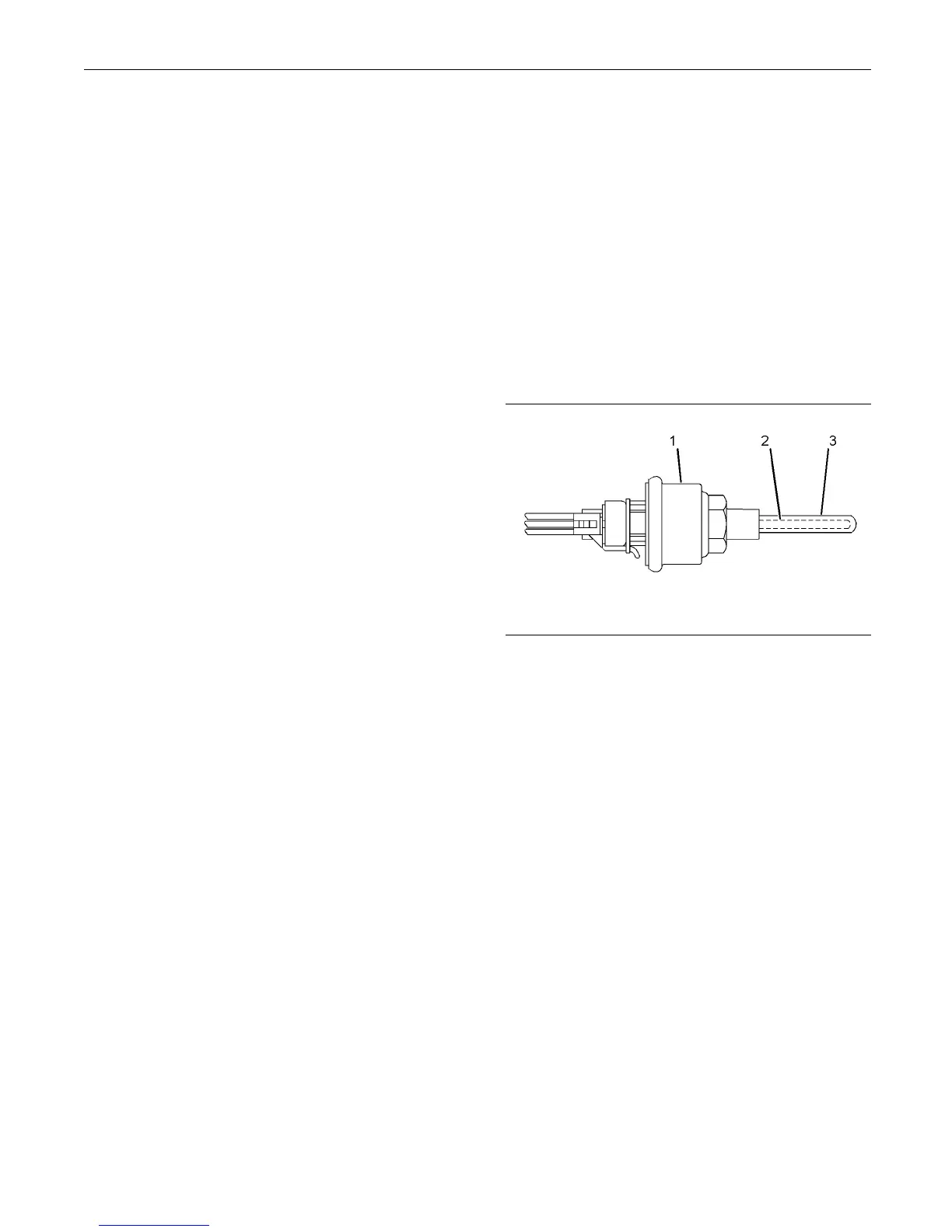
g01132350
Illust
ration 28
Typical example o f a c oolant leve l s ensor
(1) Sensor
(2) Brass rod
(3) Plastic cover
Coola
nt level sensor (1) contains no moving parts.
The sensor detects variations in capacitance. The
sensor's probe contains a brass rod (2) that is
cove
red with plastic (3). The brass rod is one plate
of a capacitor. The plastic cover is the capacitor's
dielectric. The coolant is the other plate of the
capa
citor.
When the probe is immersed in coolant, the sensor
sen
ses a particular capacitance. The sensor
responds by creating a short circuit between the
signal wire and the ground wire.
When the probe is not immersed in coolant, the
capacitance value changes. The change in the
ca
pacitance value is detected by the sensor's
electronic circuits. The circuits apply approximately
+5 VDC to the signal wire. The ECM detects the
vo
ltage and the ECM activates either a E2143-1 or a
E2143-2 event code.
T
he event codes are probably caused by a low
coolant level. The next likely cause is a problem with
awiringharnessorwiththesensor.Theleastlikely
c
ause is a problem with the ECM.



 To Next Page