dog toward the boundary. Your dog may indicate he
hears the warning sound by tilting his head or twitching
his ears.The instant the dog hears the warning sound,
give a tug on the lead and bring him back.
On a retractable lead, press the brake.This will redirect
the dog back into the safe area. Have fun and praise
him.
On days two and three repeat the lesson of day one.
As the training sessions progress through the three
days of lesson one, you'll see that your dog will begin to
anticipate the signal and retreat without prompts.
Day three is successful if your dog retreats with no
prompt from you or he refuses to approach the bound-
a ri e s. Remember to pra i s e, pra i s e, praise proper
behavior.
Lesson 2: - The Correction:
A dog may be tempted to break the rules. To prevent
this, he must understand that there are consequences
for inappropriate behavior.When your dog retreats from
the boundaries on his own, or won’t go into flagged
areas, he is ready to receive the correction.
Before you begin this lesson remove the training probes
and install the standard probes. Make sure the wall
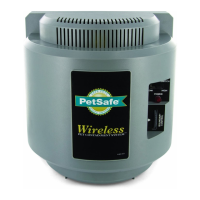
transmitter is turned ON and functioning properly.
Use a 15-foot or a retractable lead.Have a family mem-
ber run through the containment field.Let your dog fol-
low. The distracter must not stop, look back, or call the
dog. After your dog receives the correction, pull him
back to you and lavish him with loud, happy praise.Try
it again.If he responds correctly, praise him, then move
to another boundary area.
Lesson 3 - Distractions:
If your dog is avoiding the boundary, he is ready for dis-
tractions. This is the most important but often short-
changed part of the training.This lesson teaches your
dog that he must resist temptations. When practicing
distractions, never call or pull your dog into the contain-
ment field.
Most dogs have a hard time generalizing concepts so
you can't assume that if your dog won't chase a ball he
won't chase a bicycle.You have to go through a list of
distractions that will tempt your dog the most.Dogs will
learn specifics. If your dog likes to chase, distract with
balls, bikes--anything that moves. If your dog is attract-
ed by children, family members, other dogs--use them
as temptations.
Lesson 4 - Off Lead Supervision:
After several sessions of distractions, your dog should
be ready for off lead play. You must stay in the yard for
off lead training.
In fact, it's wise to spend more quality time in the yard
with your dog.The more your dog stays on the proper-
ty for the first month, the less confused he will be.
If you wish to take your dog off the property, remove the
collar receiver and take him off and back onto the prop-
erty in the car.
Lesson 5 - Off Lead Unsupervised:
When your dog resists distraction of any kind, both on
and off lead, he can be left unattended in the yard but
observed from inside the home.This freedom should be
brief at first. You must frequently go out and check on
your dog. Over the next several weeks, unsupervised
freedom can be gradually increased.
Before and after each unsupervised session, you must
continue the play and praise routine so that your dog
understands that the yard is a happy place to be.
Lesson 6 - Removing the Flags:
After 2 weeks of successful unsupervised containment,
you can begin removing the flags. Start by removing
every other flag every other day until all are gone.
The leads, trainers, flags and the collar receiver signals
are all training clues for your dog.During the last three
weeks of training --one by one--all but the collar receiv-
er will be removed.
As the training clues are removed it is essential that you
continue to use distractions to make sure your dog
retreats from the unmarked boundary.
The correction teaches the consequences of the
improper response. Know your dog and what tempts
him.Gradually extend the amount of unsupervised free-
dom, and finally remove the flags when you are confi-
dent that your dog is fully trained.
If you have any questions about your containment sys-
tem, or about training your dog, please review the video
included with this product.If you still have questions or
concerns, please call us at 800-688-4364.
SECTION 8.
T R O U B L E S H O O T I N G
The fo l l owing table identifies the solutions to common prob-
lems associated with pet containment systems. If a prob-
lem occurs, first check this table and try to determine what
the problem may be.I f, for any reason, your Inv i s i ble Fe n c e
system still does not operate as described in this manual or
if you have any questions or problems not included in this
m a nual, please call Inv i s i ble Fence at 1-800-688-4364.
16.



 To Next Page