SECTION 4.
I N S T ALLING THE IF-100 CONTA I N M E N T
S Y S T E M
A. Creating the Layout - When selecting a layout for your
containment system, keep it simple;complex installations are
more difficult for dogs to learn. Here are some key points to
remember:
• Consider all the obstacles -- gardens, play areas, driveways,
sidewalks, pools, porches, and water crossings.
• Utility companies must be contacted to mark the buried util-
ity lines.
• To avoid future wire breaks caused by landscaping efforts,
the lawn should never be aerated in the vicinity of the con-
tainment wire.
• For your dog's safety, it is recommended to keep the con-
tainment wire at least ten feet from the street.
• Keep in mind that you will want at least an 8- to 12-foot con-
tainment field (8 to 12 feet on each side of the wire).
• It is possible to cancel the containment signal in a portion of
the containment loop by twisting the wires as illustrated
below. This allows the containment wire to cross safe areas
of the yard without causing your dog's collar receiver to deliv-
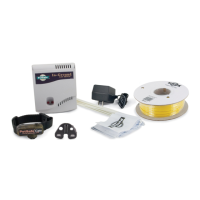
er correction. A spool of pre-twisted wire is included in your
system for this purpose. If you need additional twisted wire,
the single containment wire (green) can be twisted at 3 to 4
twists per foot to achieve the same result.
Described below are several popular containment installa-
tions. You may find these helpful in planning the layout that
will best meet your needs.
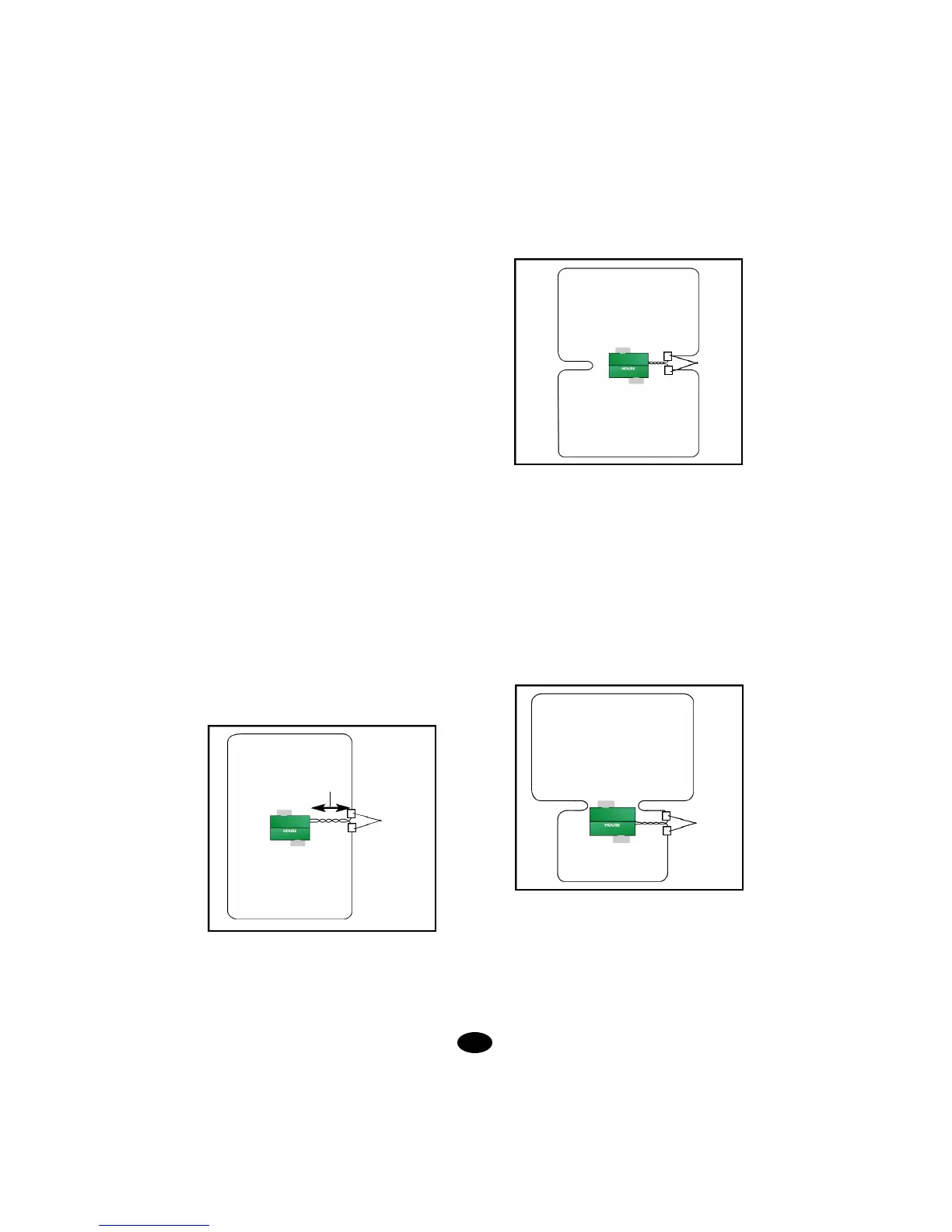
The perimeter loop is the most common installation. The wire
is placed just inside the property line and usually forms a
square or rectangle.
The hourglass design allows your dog to be contained in
either the front or back yard. This layout is similar to the
perimeter loop, except the wire is run close to the house on
two sides. When positioning the wire parallel to itself as it
goes toward the side of the house from the perimeter, keep it
a distance equal to the field width plus three feet from itself.
To prevent your dog from playing in the side yard, keep the
wire a distance equal to the field width less one foot from the
house.
The back yard loop encloses the back yard and uses the back
portion of the house as part of the barrier. After laying wire on
the three sides of the back yard, bring the wire a distance of
the field width less one foot from the back corner of the house
to prevent your dog from playing in the side yard. When run-
ning the containment wire parallel to the side and around the
front of the house, keep the wire a distance from the house
equal to the field width plus three feet to prevent sending a
corrective signal through the walls of the house. Continue
placing wire at this distance from the home until it reaches the
entry hole leading to the wall transmitter. Encircling the house
contains your pet if he bolts out of the front entrance or the
garage door. These areas are usually not flagged.
A double loop installation will provide a barrier in the back
yard without running wire into the front yard. Beginning at the
wall transmitter, lay the containment wire to the nearest
perimeter and proceed around the back yard until you are at
the opposite side of the house. When at a distance from the
corner of the house equal to the containment field width less
one foot, do a hairpin turn and continue positioning the wire a
distance of the field width plus three feet away from itself.
7.
splice
containment signal
cancelled in this area
splice
splice



 To Next Page