
 Need help?
Do you have a question about the Planet IGS-5225 Series and is the answer not in the manual?
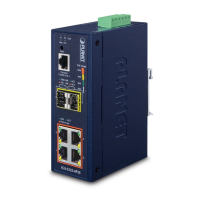
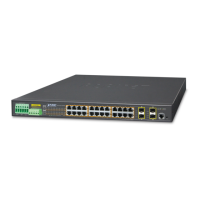
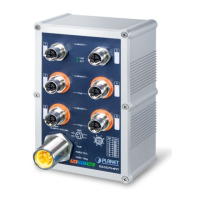
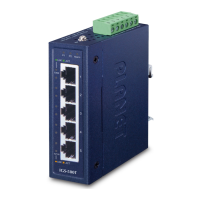
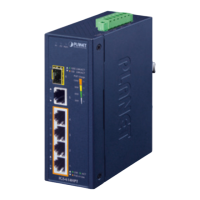
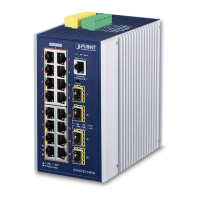
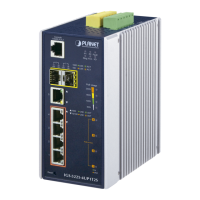
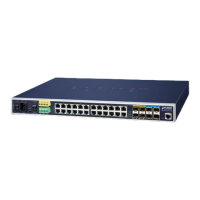
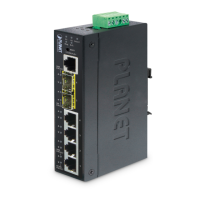
Provides an overview of the PLANET L2+ Industrial Managed Switch Series features and design.
Details the key physical, power, protocol, and case features of the Industrial Managed Switch models.
Describes how to install the Industrial Managed Switch and make network connections.
Provides step-by-step instructions for installing the Industrial Managed Switch and making connections.
Explains how to insert SFP/SFP+ transceivers into the SFP/SFP+ slots without powering down the switch.
Provides instructions on how to safely remove an SFP/SFP+ transceiver module from the switch.
Compares the advantages and disadvantages of Console, Remote Telnet, Web Browser, and SNMP management methods.
Explains system administration via Command Line Interface using remote Telnet or console port.
Details how to access and manage the Industrial Managed Switch via a standard web browser.
Describes how to configure and manage the switch using external SNMP-based applications.
Provides an overview of the web-based interface for configuring and managing the Industrial Managed Switch.
Covers IP configuration, IP interface, and IP routes, supporting up to 128 interfaces and 32 routes.
Provides an overview of current users and allows adding or editing user accounts with privilege levels.
Allows configuration of Network Time Protocol (NTP) servers for synchronizing system clocks.
Configures DHCP Relay to forward DHCP messages between clients and servers on different subnets.
Provides access to the system log information, including ID, level, time, and message for troubleshooting.
Configures fault alarm settings, including enable, record, action, power alarm, and port alarm options.
Configures SNMP mode operation and Engine ID for SNMPv3 communication.
Configures SNMP trap settings, including trap mode, version, community, and destination address.
Manages SNMPv3 users, configuring engine ID, user name, security level, and authentication protocols.
Configures SNMPv3 access control, mapping groups to security models, levels, and read/write MIB views.
Configures RMON Alarm table entries, defining variables, thresholds, and event indices for network monitoring.
Configures DHCP server operation mode globally and per VLAN, enabling or disabling DHCP services.
Defines IP address ranges to be excluded from DHCP server allocation to clients.
Manages DHCP pools, allocating IP addresses and delivering configuration parameters to DHCP clients.
Configures industrial protocols like Modbus TCP for SCADA systems, HMI, and data acquisition.
Configures industrial protocols like Modbus TCP for SCADA systems, HMI, and data acquisition.
Covers switching functionalities, including port management, link aggregation, VLANs, and Spanning Tree Protocol.
Manages switch ports, covering configuration, statistics, SFP module information, and port mirroring.
Configures port connection settings, including speed, duplex, flow control, and frame size.
Displays detailed traffic statistics for a specific switch port, including receive/transmit totals and error counters.
Configures port mirroring to monitor network traffic by forwarding copies of packets to a mirror port.
Allows inspection and configuration of current LACP port settings for link aggregation.
Details IEEE 802.1Q VLAN features, including tagging, port overlapping, and priority tagging.
Configures port VLAN settings, defining tagged and untagged frame behavior and ingress/egress rules.
Explains the Spanning Tree Protocol (STP) for loop detection, backup links, and network topology management.
Configures STP system settings, supporting STP, RSTP, and MSTP protocols for loop prevention.
Explains IGMP Snooping for monitoring IGMP messages and limiting multicast forwarding to group members.
Configures IGMP Snooping, including global snooping, unregistered flooding, SSM range, and proxy settings.
Configures LLDP-MED parameters for managing endpoint devices, including network policy and location details.
Configures MAC address table settings, including aging time, learning modes, and static MAC entries.
Enables loop protection function to prevent broadcast loops, configuring global settings and port actions.
Enables loop protection function to prevent broadcast loops, configuring global settings and port actions.
Configures UDLD mode on ports (Disable, Normal, Aggressive) and message interval for link detection.
Configures basic QoS Classification settings for switch ports, including CoS, DPL, PCP, DEI, Tag Class, DSCP, and WRED.
Configures Queue Policer settings for switch ports, enabling or disabling policers and setting rates.
Configures Policer settings for switch ports, enabling policers and setting rates and units.
Configures Port Scheduler and Shapers for switch ports, defining schedule modes and queue weights.
Configures storm control for unicast, multicast, and broadcast traffic rates across the switch.
Configures basic QoS Port DSCP settings for switch ports, including ingress translation and egress rewrite.
Shows the QoS Control List (QCL), defining QCEs for classifying traffic based on various parameters.
Configures QoS Control Entries (QCEs), defining match criteria and classification actions.
Covers security features, including access security, AAA, port authentication, port security, access control lists, DHCP snooping, IP source guard, and ARP inspection.
Configures access management entries to control switch access via IP address and application type.
Configures SSH mode operation, enabling or disabling SSH access for secure remote management.
Manages Authentication, Authorization, and Accounting (AAA) services, including RADIUS and TACACS+ configuration.
Configures user authentication methods (local, RADIUS, TACACS+) for management access.
Configures RADIUS servers, including global and server-specific settings for authentication and accounting.
Configures TACACS+ servers, including global and server-specific settings for authentication and accounting.
Configures IEEE 802.1X and MAC-based authentication system and port settings.
Manages port security, including limit control, status, and detailed MAC address information.
Configures Port Security global and per-port settings, limiting the number of users (MAC addresses) on a port.
Configures Access Control Lists (ACLs) by defining ACEs with parameters for ingress, frame type, action, and rate limiter.
Configures Access Control Entries (ACEs) with parameters varying by frame type (Ethernet, ARP, IPv4, IPv6).
Configures ACL parameters (ACE) for each switch port, affecting frames received unless matched by a specific ACE.
Configures DHCP Snooping mode and port modes (Trusted, Untrusted) to block unauthorized DHCP replies.
Provides IP Source Guard configuration to restrict IP traffic based on DHCP Snooping Table or IP Source Bindings.
Configures IP Source Guard to restrict IP traffic on untrusted ports using DHCP Snooping Table or IP Source Bindings.
Enhances security by enabling ARP Inspection to block ARP cache poisoning attacks.
Enables ARP Inspection to block attacks by poisoning ARP caches, allowing only valid ARP requests and responses.
Configures PoE system settings, including power management modes (Classification, Allocation) and budget.
Configures PoE port settings, including PoE mode, schedule, priority, and power allocation.
Defines PoE schedule and schedules power recycle for enabling/disabling PoE power feeding at specified times.
Configures PD Alive Check to monitor connected PD status via ping action and restart PoE port power if needed.
Inspects and configures current ERPS settings, including ERPS ID, ports, SF MEP, APS MEP, ring type, and VLAN config.
Facilitates updating switch firmware via the web interface, including upload progress and success notification.
Allows saving the current configuration to startup-config to ensure it is used at the next reboot.
Resets switch configuration to factory defaults, retaining only IP configuration.
Allows issuing ICMP PING packets to troubleshoot IP connectivity issues.
Issues ICMP PING packets to troubleshoot IP connectivity issues, displaying sequence number and roundtrip time.
Runs cable diagnostics on copper cables to test length, operating conditions, and identify faults.
Provides solutions for Link LED issues, suggesting cable checks and duplex mode removal.
Provides steps to troubleshoot network connectivity issues, including LED checks, port testing, and power cycling.
Provides solutions for power-up issues, including checking AC power cord, source, and replacing the cord.


 To Next Page

 General