Need help?
Do you have a question about the Point Grey Grasshopper and is the answer not in the manual?
Overview of the Grasshopper digital camera line, its high megapixel resolution, and IEEE-1394b interface.
Details on image acquisition features, including bandwidth, synchronization, and exposure control.
Information on on-camera image processing like color conversion, sharpness, and image flip.
How to control camera settings, including exposure, gain, and communication ports.
Physical dimensions, weight, and mounting options of the camera.
Guidance on how to navigate and use the technical reference manual effectively.
Detailed technical specifications for various Grasshopper models, including sensor, resolution, and rates.
Outlines recommended and minimum hardware and software requirements for camera operation.
Explains methods for camera control via demo programs, SDK, and third-party applications.
Details on accessing and using the camera's command registers for detailed control.
Essential precautions for handling, cleaning, and caring for the digital camera module.
Information regarding available accessories like lens holders and mounting brackets.
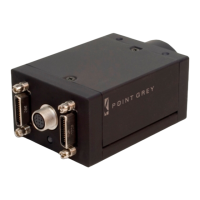
Detailed description of the camera's physical components, connectors, and their functions.
Technical drawings and precise measurements of the camera's physical size and mounting points.
Guidelines for selecting and mounting compatible lenses, including C-mount considerations.
Explanation of the camera's sealed design and protective glass for dust prevention.
Instructions for mounting the camera using its integrated holes or a tripod bracket.
Properties of the IR cut-off filter in color models and its effect on visible spectrum sensitivity.
Details on the 9-pin IEEE-1394b connector, pin configuration, and daisy-chaining capabilities.
Information on IEEE-1394 cable specifications, maximum length, and type requirements.
Information on compatible IEEE-1394 host adapter cards and their differences.
Specifies camera power requirements, voltage input range, and external power solutions.
Explanation of the 8-pin GPIO connector, pin functions, and schematic.
Electrical specifications for GPIO pins, including voltage levels and current limits.
Description of the camera's status indicator LED states and their meanings.
Overview of camera properties like brightness, exposure, gain, and frame rate controls.
Lists supported video formats, modes, and frame rates for various models.
Discusses bandwidth limitations, maximum cameras on a bus, and frame rate calculation.
Details on Format_7 custom modes, including pixel formats, resolutions, and frame rates.
Covers camera power, shutter control, gain, and auto exposure settings for image capture.
Explains color/greyscale conversion, lookup tables, gamma, saturation, and sharpness.
Covers voltage sensing, programmable strobe, RS-232 serial port, memory channels, and firmware upgrades.
Spectral response curve for the GRAS-03K2M camera model, showing relative response vs. wavelength.
Spectral response curves for the GRAS-03K2C model (Blue, Green, Red/Mono) vs. wavelength.
Spectral response curve for the GRAS-03S3M camera model, showing relative response vs. wavelength.
Spectral response curve for the GRAS-14S3M camera model, showing relative response vs. wavelength.
Spectral response curves for the GRAS-14S3C model (Blue, Green, Red/Mono) vs. wavelength.
Spectral response curve for the GRAS-14S5M camera model, showing relative response vs. wavelength.
Spectral response curves for the GRAS-14S5C model (Blue, Green, Red/Mono) vs. wavelength.
Spectral response curve for the GRAS-20S4M camera model, showing relative response vs. wavelength.
Spectral response curves for the GRAS-20S4C model (Blue, Green, Red/Mono) vs. wavelength.
Spectral response curve for the GRAS-50S5M camera model, showing relative response vs. wavelength.
Spectral response curves for the GRAS-50S5C model (Blue, Green, Red/Mono) vs. wavelength.
 General
| Operating Temperature | 0°C to 50°C |
|---|---|
| Lens Mount | C-mount |
| Sensor Type | CMOS |
| Pixel Size | 5.5 µm (depending on model) |
| Bit Depth | 8, 10, 12, or 16-bit |

 To Next Page