Point Grey Research Grasshopper Technical Reference
Camera Operations and Features
Revised 26-Nov-10
Copyright (c) 2010 Point Grey Research Inc.
41
4.5.10.4. Changing Video Modes While Triggering
You can change the video format and mode of the camera while operating the camera in trigger
mode. Note that subsequent triggers may be ignored for a period of time, depending on the
nature of the mode/format change and the frequency of triggering.
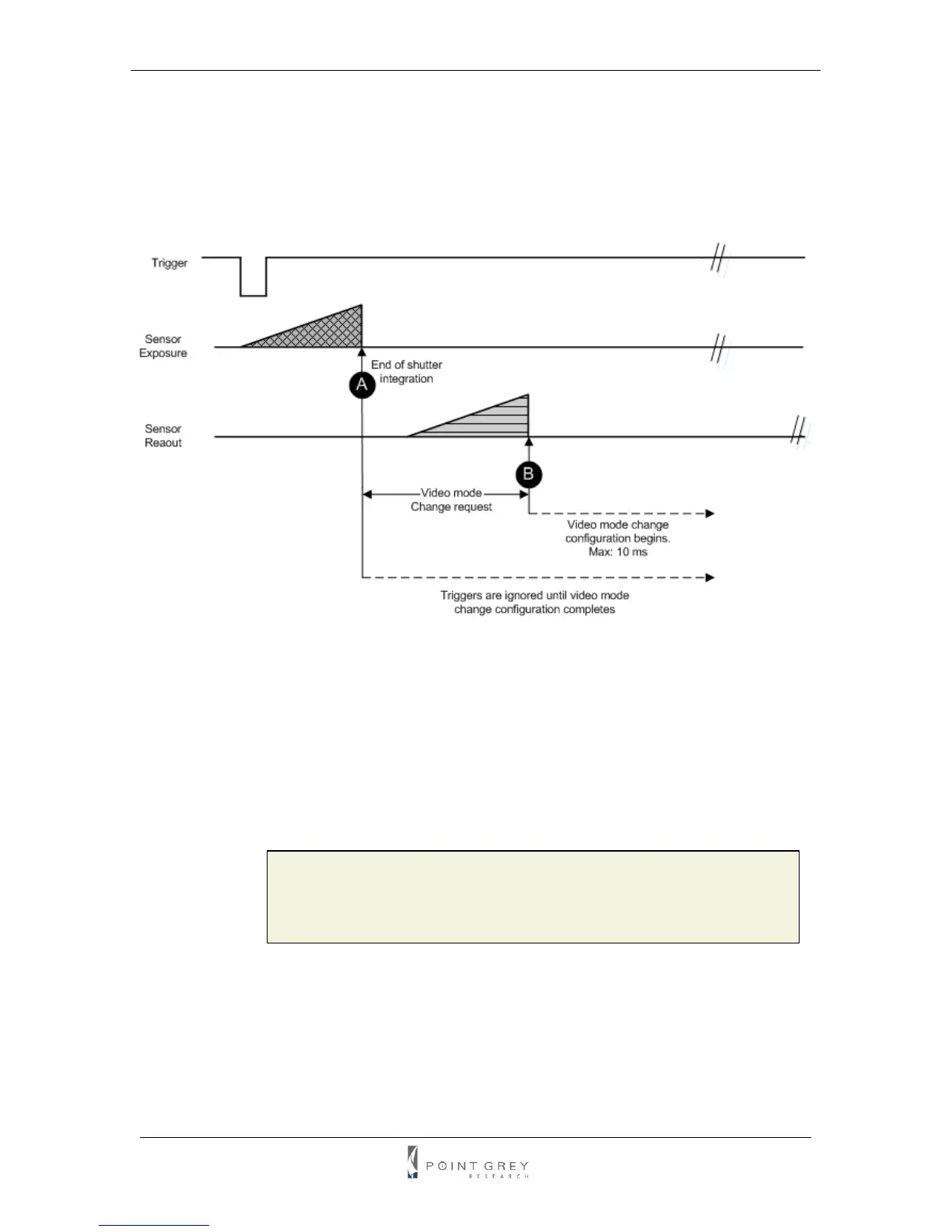
Figure 5 shows the
relationship between changing video modes and triggering.
Figure 5: Relationship between video mode change and triggering
Any request to change video mode following the end of shutter integration of the last-triggered
image (point A) causes subsequent triggers to be ignored until the video mode reconfiguration
completes. Note that this configuration does not begin until the end of sensor readout of the last-
triggered image (point B), and can last up to 10 ms, especially if the request involves a change in
pixel clock speed. If, for some reason, sensor readout is delayed, the maximum time period that
triggers are ignored is 1.5 s.
To determine if the camera is ready to accept a trigger, read bit 0 of SOFTWARE_TRIGGER
register 0x62C. A value of 0 indicates readiness. For more information, see Section
4.5.10.2.
L
The effects of missed triggers due to a video mode change are likely to
be felt most acutely when triggering in ‘overlapped exposure/readout
mode’ (Mode 14).
4.5.11. On-Camera Frame Buffer
The Grasshopper has 32MB of memory that can be used for temporary image storage. This may
be useful in cases such as:


 To Next Page