32 PRODIGIT
However, these algorithms were designed for solar inverters. Inverter are different fro test
systems, so a MPPT algorithm that performs well in an inverter may not necessarily perform
well in a PV test system. This article introduces a MPPT algorithm that is a good fit for PV
testing with an eload. We discuss how the algorithm is implemented and why it’s a good fit for
MPPT in outdoor PV test systems.
The main difference between implementing a given MPPT algorithm in an inverter and an eload
is in the I/O latency. In inverters, the MPPT algorithm runs on an internal microprocessor that
can measure and compute and make load adjustments in microseconds. To perform the same
set of operations with custom software and an eload could easily take tens of milliseconds due
to the unavoidable I/O latency between the computer and the eload. This I/O latency is the
main bottleneck affecting tracking speed. With that in mind, we chose and modified the MPPT
algorithm discussed in this article to meet the needs of a PV test system using the 3310F series
eload.
An eload is an instrument that can sink and measure the output power of a power source, such
as a power supply or a PV device. Like a variable resistor, an eload can be adjusted to control
the amount of power it is sinking. Eloads can measure the voltage drop across them and the
current they are sinking. Eloads typically have four modes of operation: constant current,
constant resistance, constant voltage and constant power. The eload will maintain its mode
setting even when the power output of the source it is connected to changes. For instance, if
the eload is connected to the output of a PV panel and has a constant-voltage (CV) mode
setting of 30V, it will adjust its internal resistance to remain at 30V as the I-V curve of the panel
varies. If the maximum voltage of the panel (Voc) drop below 30V, the eload will act like an
open and the voltage across it will be whatever Voc is. In photovoltaic test, eloads are typically
used in CV mode, so we will use this mode for defining the algorithm.
3310F series ELOAD MPPT algorithm
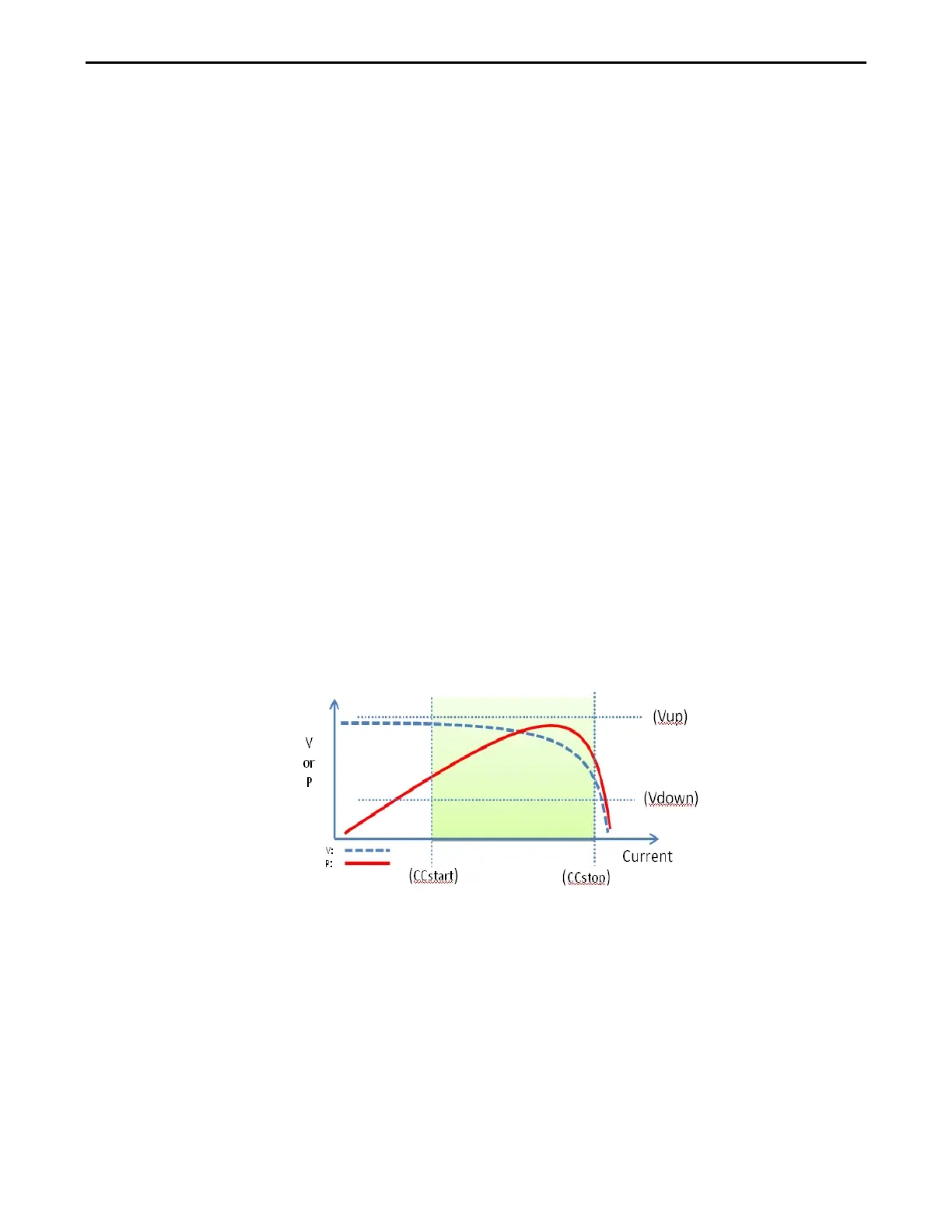
:Case in CC MODE, It is divided into two steps,The
first step on the basis of an input conditions scanning CCstart => CCstop identify the MPP point,The
second steps in accordance with MPP point perturbation (P & O) to find out the true value of MPP,At
the end of P&O time, recording an MPP value, and then repeat steps 1 & 2.
STEP1: scanning



 To Next Page